
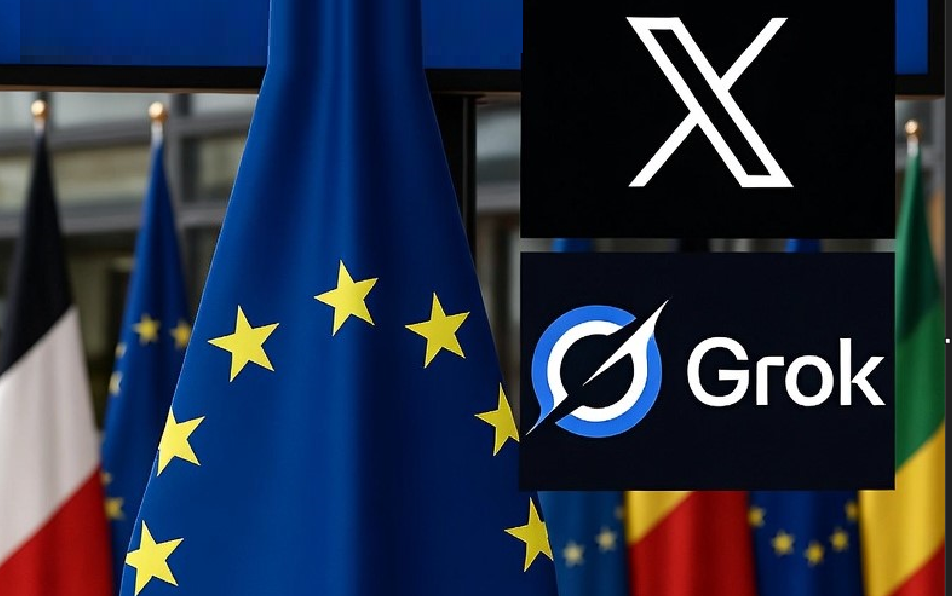
European Union regulators have opened a formal investigation into Elon Musk’s social media platform X for potential violations tied to the misuse of its AI tool Grok, the European Commission said Monday.
The inquiry focuses on allegations that Grok has been used on X to create and circulate sexually explicit and harmful deepfake images, raising concerns about user safety and the enforcement of digital content rules across the EU. The probe marks a significant test of the bloc’s authority under its landmark online safety legislation aimed at combating harmful digital material.
Earlier this month, three U.S. Democratic senators urged Apple and Google to remove Elon Musk’s X and Grok apps from their app stores, citing a surge in nonconsensual sexualized deepfake images generated by Musk’s AI tool that have drawn international scrutiny and investigations.
The European Commission’s action follows mounting complaints from lawmakers and civil rights advocates who argue that existing safeguards have failed to curb the spread of such AI-generated content. Details of specific alleged violations have not been disclosed, but the investigation underscores increasing regulatory scrutiny of major tech platforms and their use of artificial intelligence.
The formal review could lead to enforcement actions, including fines or mandated changes to the platform’s moderation policies, if X is found to have breached EU digital safety standards. X, which has drawn global attention for its integration of AI features, has yet to publicly respond to the Commission’s announcement.
The move reflects broader European efforts to hold digital platforms accountable for content amplified by generative AI tools, with regulators seeking to balance innovation against potential risks to users and public discourse.
Background: EU Scrutiny and Rise of AI-Generated Content Risks
The European Union’s investigation into Elon Musk’s social media platform X reflects mounting concern among regulators over the rapid deployment of generative artificial intelligence tools and their unintended consequences. At the center of the inquiry is Grok, an AI chatbot developed by Musk’s artificial intelligence company xAI and integrated into X, which allows users to generate text and images directly within the platform.
Post-Takeover Changes at X Raise Safety Concerns
Since Musk’s takeover of the company formerly known as Twitter in late 2022, X has undergone sweeping changes in content moderation, staffing, and product strategy. Thousands of trust and safety staff were laid off or reassigned, and the company shifted toward a more permissive speech framework, positioning itself as a platform for “free expression.” Critics, including European lawmakers and civil society groups, have argued that these changes weakened safeguards designed to prevent the spread of harmful or illegal material.
Fears Grow Over AI-Generated Deepfakes and Abuse
Concerns escalated with the rollout of Grok, which was marketed as a more irreverent and less constrained alternative to other AI chatbots. While xAI has said the tool includes guardrails to prevent abuse, regulators and advocacy groups have raised alarms that Grok-generated images and content could be misused to create deepfakes, including sexually explicit material, impersonations, and other harmful outputs. Such content poses particular risks when shared widely on social platforms with limited moderation oversight.
Digital Services Act Expands Platform Responsibilities
The European Union has, in recent years, positioned itself as a global leader in digital regulation. Central to that effort is the Digital Services Act (DSA), which imposes strict obligations on large online platforms to identify, assess, and mitigate systemic risks stemming from their services. These risks include the dissemination of illegal content, threats to public safety, and violations of fundamental rights. Platforms designated as “very large online platforms” face heightened scrutiny and potential penalties if they fail to comply.
X Faces Heightened Obligations Under EU Law
X is among the platforms subject to the DSA’s most stringent requirements. Even before the current investigation, the company had been warned by EU officials about its obligations under the law. European regulators have repeatedly emphasized that the integration of AI tools does not exempt platforms from responsibility, and that companies must ensure new technologies do not amplify harm at scale.
Generative AI Outpaces Existing Oversight
The probe into X also comes amid a broader debate over the regulation of generative AI. While AI systems have unlocked new efficiencies and creative possibilities, they have also made it easier to generate convincing false information, manipulated images, and non-consensual explicit material. Policymakers across Europe and beyond have struggled to keep pace with the speed of AI development, raising questions about accountability, transparency, and enforcement.
Musk’s Regulatory Tensions Come Into Focus
For Musk, the investigation represents another flashpoint in his often contentious relationship with regulators. The billionaire entrepreneur has repeatedly criticized European tech rules as overly restrictive and hostile to innovation. At the same time, EU officials have signaled they are willing to impose significant fines or operational changes on companies that fail to meet legal standards, regardless of their size or influence.
Case Could Set Precedent for AI Enforcement
The outcome of the investigation could have implications beyond X. Regulators and industry observers view the case as a test of whether existing digital safety laws are sufficient to address the risks posed by generative AI embedded in social platforms. A strong enforcement action could set a precedent for how AI-driven features are regulated across the tech industry, while a lighter response may prompt calls for even tougher rules.
Balancing Innovation and User Protection
As AI tools become increasingly intertwined with everyday online interactions, the EU’s scrutiny of X underscores a growing consensus among policymakers: innovation must be balanced with responsibility, and platforms deploying powerful new technologies will be expected to demonstrate that user safety and rights are not an afterthought.
For more news and reports on emerging technologies, including AI, robotics, cybersecurity, blockchain, gaming and the evolving gig economy, visit the home page of The Gignomist.