

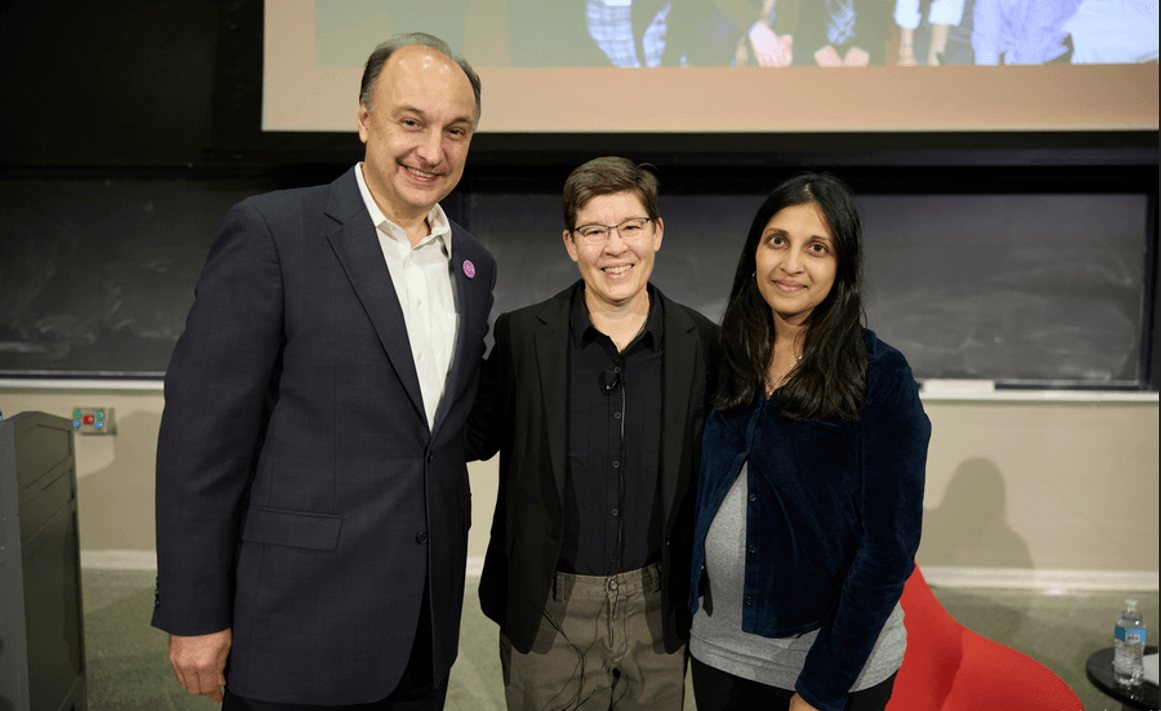
Jennifer Lewis, a Harvard University materials scientist and alumna of the Massachusetts Institute of Technology, delivered the 2025 Mildred S. Dresselhaus Lecture, outlining groundbreaking advances in 3-D printing that could reshape fields from soft robotics to human tissue engineering.
Lewis, the Hansjörg Wyss Professor of Biologically Inspired Engineering at Harvard’s John A. Paulson School of Engineering and Applied Sciences, addressed a combined in-person and virtual audience of more than 500 at MIT.nano. Her lecture, titled “Printing Soft and Living Matter in Three Dimensions,” explored how precise control of material composition and structure during printing can unlock new functional and biological applications.
“Can we make tissues that are made from you, for you?” Lewis asked the audience, framing her research goal of producing patient-specific tissues for therapeutic use and, ultimately, whole organs.
Lewis described how her team has developed innovative 3-D printing methods, specialized printhead designs, and viscoelastic inks that transition between liquid and solid states, enabling the fabrication of soft electronics, autonomous soft robots, and living tissues. She highlighted projects such as a robot octopus, built using sacrificial inks that change state with temperature, and efforts to engineer vascularized human tissues by integrating stem cells and bioprinting.
Her lab’s work toward creating perfusable vasculature — networks of channels that mimic blood flow — represents a major step toward producing viable tissues that could one day replace damaged organs without the need for lifelong immunosuppression. “Where we’re going is to expand this not only to different tissue types, but also building in mechanisms by which we can build multi-scale vasculature,” she said.
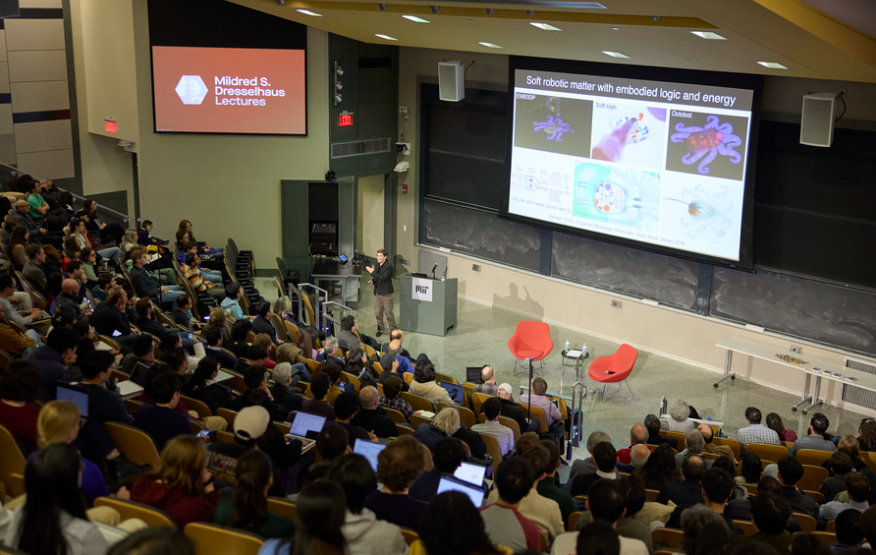
The lecture honored the late Mildred S. Dresselhaus, a pioneering MIT professor known as the “queen of carbon science.” Lewis, who earned her Sc.D. at MIT, reflected on the influence of Dresselhaus — particularly her role in inspiring women in engineering. “The best thing about having a lady professor on campus is that it tells women students that they can do it, too,” Lewis quoted Dresselhaus, underscoring the importance of representation in STEM fields.
After her talk, Lewis joined Ritu Raman, an assistant professor of tissue engineering at MIT, for a discussion on challenges in bioprinting hardware and software, tissue repair and regeneration, and applications in space research.
Vladimir Bulović, director of MIT.nano, praised Lewis as embodying the spirit of Dresselhaus, saying her work in 3-D printing and bio-inspired materials continues a legacy of innovation and leadership.
For more news and reports on emerging technologies, including AI, robotics, cybersecurity, blockchain, gaming and the evolving gig economy, visit the home page of The Gignomist.