

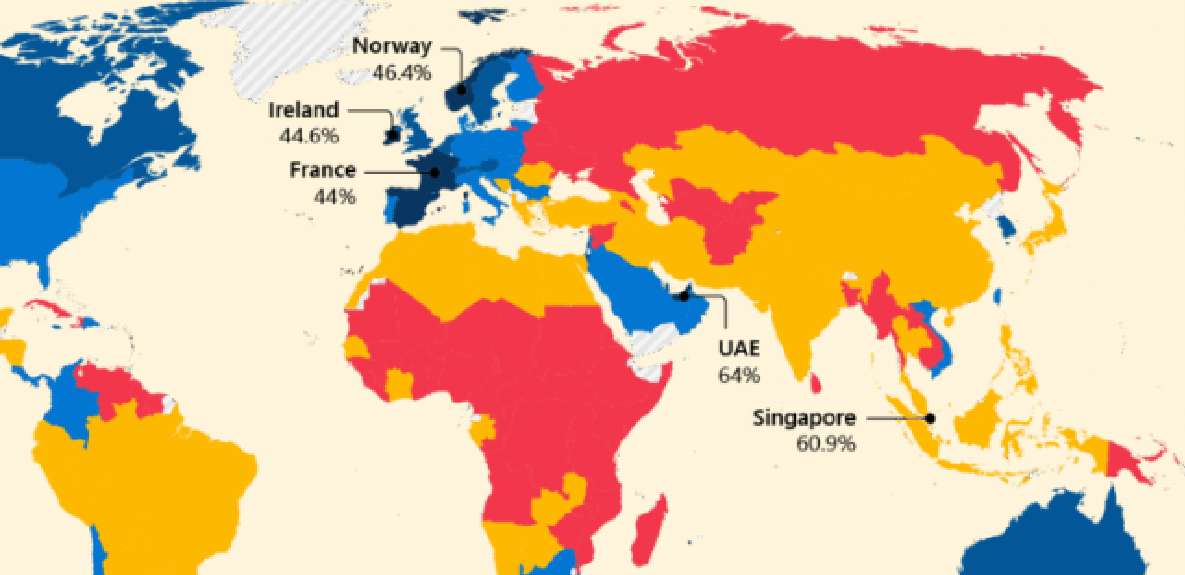
Global adoption of generative artificial intelligence reached 16.3% of the world’s population in the second half of 2025, marking a 1.2 percentage point increase from the first half and bringing AI to roughly one in six people for learning, work or problem-solving.
The growth, while record-setting, remains uneven, with the Global North advancing nearly twice as fast as the South, widening the adoption gap from 9.8 to 10.6 percentage points.
A new report on global AI adoption by Microsoft’s AI Economy Institute highlights stark disparities, with AI adoption in the Global North reaching 24.7% of the working-age population, compared to 14.1% in the Global South. High-income economies dominated gains, with the top 10 increasers all from that group.
The United Arab Emirates led globally at 64%, up 4.5 points, followed by Singapore at 60.9%. South Korea jumped from 25th to 18th place with a 4.8-point rise to 30.7%, fueled by policy reforms and model improvements in Korean language capabilities.
The United States, despite leading in AI infrastructure, slipped to 24th at 28.3%, up 2.1 points. China and India saw modest gains to 16.3% and 15.7%, respectively. Open-source platform DeepSeek surged in underserved markets like China, Russia, Iran, Cuba, Belarus and Africa, where usage was 2-4 times higher than elsewhere, driven by free access and partnerships.
Benefits include enhanced productivity in workplaces and public services, but challenges persist: accessibility barriers, linguistic gaps and governance concerns. The report urges balancing innovation with policies to narrow divides.
AI Adoption Strategies in the United States
The U.S. shifted toward deregulation and innovation in 2025 under the Trump administration’s AI Action Plan, released in July 2025. The plan’s three pillars—accelerating innovation, building infrastructure and leading international diplomacy—aim to sustain U.S. leadership. Key actions include removing red tape, promoting open-source AI, establishing regulatory sandboxes and investing in AI-enabled science. Federal agencies like the State Department released AI strategies for 2026, focusing on real-time decision-making and infrastructure. Nearly 90% of agencies use or plan to use AI, though state-level regulations create a patchwork, prompting calls for federal preemption.
China’s Push for AI Dominance
China’s “AI Plus” plan, issued in August 2025, targets 70% AI penetration in key sectors by 2027 and 90% by 2030, aiming for a fully AI-integrated society by 2035. The State Council directive emphasizes “intelligent everything” across industry, governance and society. Investments include $8.2 billion in AI funds and a national computing network. Policies link AI to industrial modernization via Made in China 2025, with exports through the Belt and Road Initiative creating dependencies in Africa and Asia. The 14th Five-Year Plan elevated AI to drive 10% of GDP from digital industries. In 2026, focus shifts to manufacturing integration and ethical standards.
European Union’s Apply AI Strategy
The EU’s Apply AI Strategy, launched in October 2025, complements the AI Continent Action Plan with €1 billion to boost adoption in 10 sectors like healthcare and manufacturing. It promotes an “AI-first” policy, sectoral flagships and SME support via Digital Innovation Hubs. The GenAI4EU initiative fosters open ecosystems. By 2026, AI factories and gigafactories will train models, with regulatory sandboxes mandatory by August. The strategy addresses workforce readiness and sovereign AI development while implementing the AI Act.
India’s Inclusive AI Mission
India’s IndiaAI Mission, approved in March 2024, invests INR 10,300 crore to deploy 38,000 GPUs and establish 600 AI labs by 2026. The 2025-26 Economic Survey advocates phased adoption focusing on small, open-weight models aligned with capital and energy constraints. AI talent is projected to grow to 1.25 million by 2027. The February 2026 AI Impact Summit emphasizes “People, Planet, Progress,” promoting diffusion over frontier models. Guidelines stress safe, trusted innovation.
Japan’s Agile AI Promotion
Japan’s AI Promotion Act, effective June 2025, emphasizes innovation without penalties, aiming to make Japan the “most AI-friendly” nation. The December 2025 Basic Plan allocates ¥10 trillion through 2030 for AI and semiconductors. Policies include “Government AI” for agencies and guidelines for ethical use. Adoption lags at 27%, trailing the U.S. and China, but cloud growth and open-source push aim to close gaps. The Hiroshima AI Process aligns with G7 values.
Brazil’s Balanced AI Framework
Brazil’s PBIA 2024-2028 invests R$23 billion to advance generative AI in sectors like healthcare and agribusiness. The AI Bill, approved by the Senate in 2024, awaits House review in 2025, focusing on risk-based regulation. ANPD’s AI sandbox runs through 2026 for ethical testing. Adoption hit 13% in 2023, higher in large firms, with policies emphasizing inclusion and sovereignty. Brazil leads Latin America in maturity, but gaps in investment persist.
These strategies reflect a global push toward AI, but the report’s divide underscores the need for inclusive policies to ensure equitable benefits.
For more news, reports and insights on emerging technologies, including AI, robotics, cybersecurity, blockchain, gaming and the evolving gig economy, visit the home page of The Gignomist.