

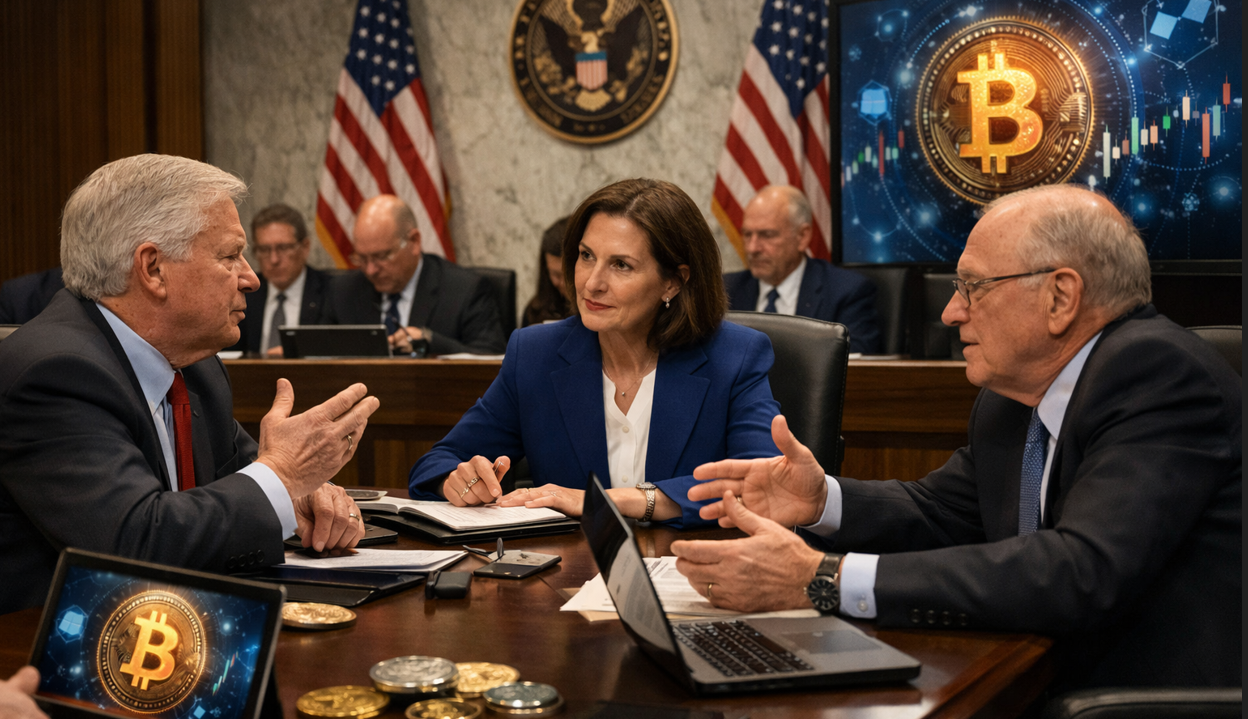
U.S. senators late Monday unveiled draft legislation aimed at creating a regulatory framework for cryptocurrency that could clarify which financial regulators oversee the fast-growing sector, potentially boosting adoption of digital assets.
The proposed law would define when crypto tokens are considered securities, commodities, or other asset types, providing the long-sought legal clarity the industry has pushed for. It would also grant the U.S. Commodity Futures Trading Commission — favored by crypto companies over the Securities and Exchange Commission — authority to oversee spot crypto markets.
The banking industry has lobbied for adjustments to last year’s stablecoin legislation, which created a federal framework for dollar-pegged tokens. Bank groups warned Congress that allowing intermediaries to pay interest on stablecoins could displace trillions of dollars from community banks, threatening financial stability. “Trillions of dollars could be displaced from community financial institutions, weakening the financial fabric of towns and neighborhoods nationwide,” the American Bankers Association and other trade groups said in a letter to lawmakers Monday.
Crypto firms, however, argue that restricting third parties, such as exchanges, from paying interest on stablecoins would be anti-competitive.
The legislation comes as cryptocurrency has become increasingly mainstream, aided by political support. Former President Donald Trump courted the industry, pledging to be a “crypto president,” while his family’s crypto ventures helped raise the profile of digital assets. The industry also spent heavily during the 2024 elections to support pro-crypto candidates, seeking to advance the market structure bill.
The House passed its version of the legislation in July 2025, but talks stalled in the Senate over issues including anti-money-laundering rules and requirements for decentralized finance platforms, which allow users to trade tokens without intermediaries, according to sources familiar with the discussions.
With Congress now focusing on the 2026 midterm elections — where Democrats could retake the House — some lobbyists are skeptical that the crypto market structure bill will become law, leaving firms reliant on regulatory guidance that could be altered by future administrations.
For more news, reports and insights on emerging technologies, including AI, robotics, cybersecurity, blockchain, gaming and the evolving gig economy, visit the home page of The Gignomist.