

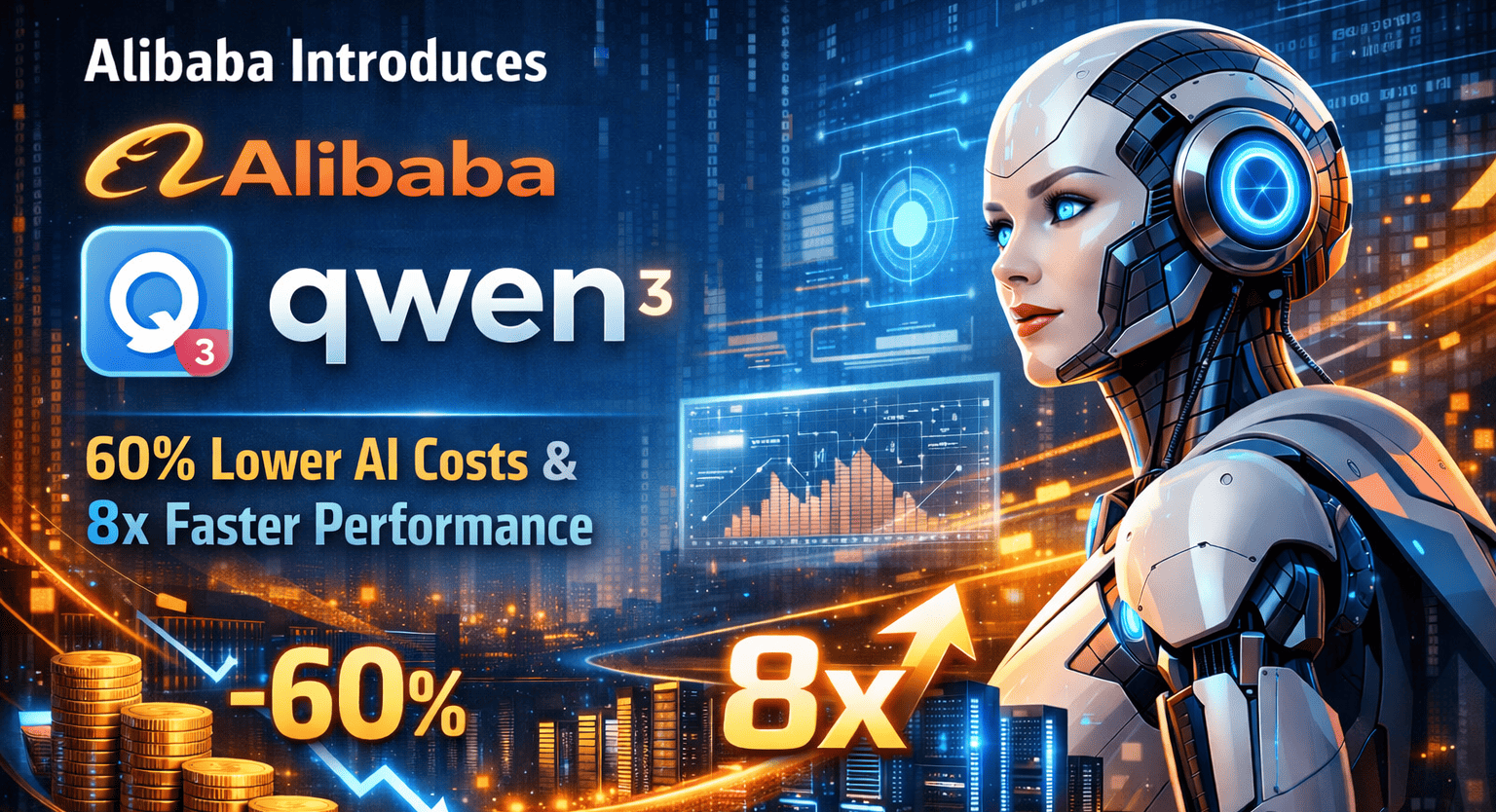
Chinese tech giant Alibaba Group has revealed its latest artificial intelligence model, Qwen 3.5, marking a significant push in its efforts to compete globally with AI systems developed in the United States and domestically. The announcement underscores intensifying rivalry as governments and corporations race to lead in generative and autonomous artificial intelligence capabilities.
The Qwen 3.5 embodies a leap in performance and utility over previous versions of Alibaba’s AI models, promising both efficiency and practical application across a range of automated tasks. Alibaba says the new system has been engineered to perform complex, multi-step actions independently — a hallmark of what the industry calls “agentic AI.”
The model’s launch comes at a moment of heightened activity in China’s technology sector, where local firms are racing to match and surpass advances made by foreign competitors, particularly in the United States. Rivals such as ByteDance — with its own AI platform Doubao 2.0 — are simultaneously expanding their offerings, contributing to a crowded and highly competitive market.
Features and Performance Claims
According to Alibaba, Qwen 3.5 is designed to help developers and businesses do more with the same computing power by reducing infrastructure costs and increasing operational efficiency. In its public announcement, the company said the model can operate at about 60% lower cost than its immediate predecessor while delivering up to eight times greater performance on large workloads.
Notable in the new release is the model’s visual agentic capability, meaning it can interpret and interact with software interfaces — clicking buttons, navigating screens and orchestrating workflows across operating systems without human intervention. This represents a move beyond traditional chat-style AI toward systems that can execute real-world tasks autonomously.
Alibaba also released an open-weight version of Qwen 3.5 with 397 billion parameters, a size that experts describe as ambitious but competitive. The company claims that this configuration performs on par with advanced AI models from OpenAI, Anthropic and Google DeepMind according to its internal benchmarks. However, these comparisons do not necessarily reflect performance relative to the very latest models on the market.
In addition to the open-weight version, Alibaba introduced a closed-source variant with even more extensive capabilities, including a context window of 1 million tokens — among the largest publicly discussed in the industry — enabling the model to analyze and relate massive amounts of data within a single interaction.
A Strategic Move in China’s AI Landscape
Industry analysts say Qwen 3.5 reinforces Alibaba’s broader strategy to strengthen its position in the global AI ecosystem. With governments, investors and customers seeking powerful automation tools, China’s major technology companies are eager to capture both domestic and international demand.
China’s domestic AI landscape has become increasingly dynamic. ByteDance’s Doubao AI service reportedly draws the largest weekly user base among Chinese language chatbots, and local startup DeepSeek has drawn attention with low-cost, high-capability open-source models. These rivalries have reshaped expectations for cost, accessibility and performance in generative AI.
Alibaba’s push this year follows an aggressive promotional campaign for its Qwen chatbot app that drove active users to surge, albeit with some technical limitations reported by users. The broader strategic objective appears to be not just attracting users but securing enterprise customers willing to deploy autonomous AI in business operations.
Global Impact and Broader Implications
Earlier this month Microsoft Reports Global AI Adoption at 16.3%, With Two-Thirds of Professionals Using AI Tools. While Alibaba claims performance parity with leading Western AI models, geopolitical tensions may shape adoption patterns. U.S. regulators and enterprise buyers have expressed ongoing concerns about data privacy and national security, particularly regarding technologies developed by Chinese firms. These issues could impede broader uptake outside Asia, even if the models demonstrate competitive performance.
The Qwen 3.5 release also highlights broader trends in the AI industry: models are increasingly being designed not just to respond to user queries but to take proactive action. This shift may have implications for software development, automation of complex workflows, and the future of AI integration into operating systems and applications.
Analysts have noted that the ability of large language models to execute task sequences — such as scheduling appointments, troubleshooting software issues, or performing data analysis — could reduce dependency on human operators in a range of fields, from customer service to technical programming.
However, critics warn that these developments heighten concerns over AI safety, reliability and bias. Independent research has shown that some AI systems, including those developed in China, can reflect the political and cultural priorities of their creators, potentially shaping how these models handle sensitive or controversial topics.
What Comes Next?
With announcements like previously launched of Qwen3-VL AI and now Qwen 3.5 and Doubao 2.0 emerging back-to-back, China’s AI sector appears poised for rapid evolution in 2026. DeepSeek and others are expected to roll out next-generation models in the coming weeks, further intensifying competition and drawing global attention.
As AI systems become more capable and autonomous, stakeholders across business, government and research will be watching how these technologies influence jobs, economies and digital ecosystems worldwide.
For more news, reports and insights on emerging technologies, including AI, robotics, cybersecurity, blockchain, gaming and the evolving gig economy, visit the home page of The Gignomist.