

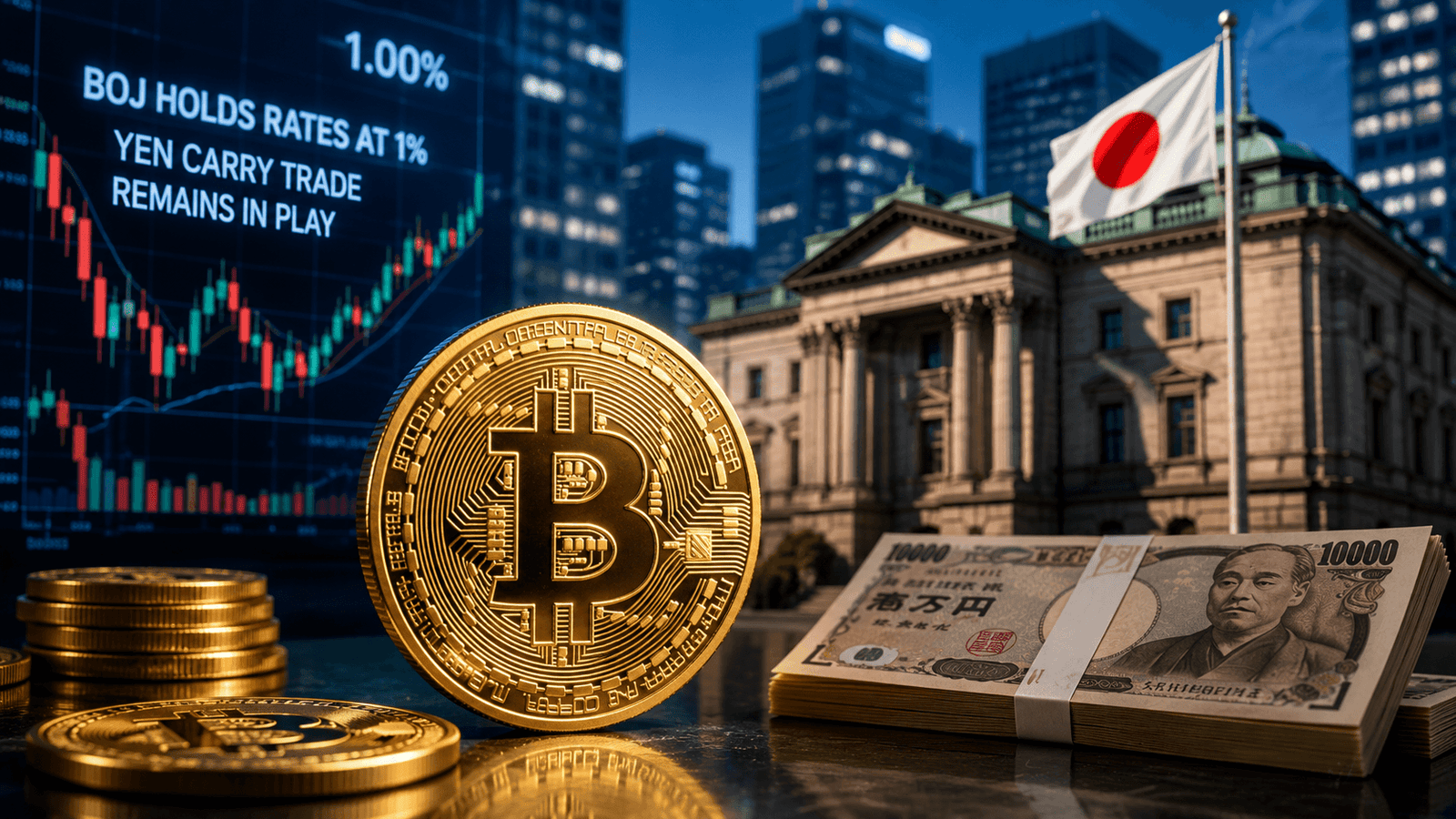
Bitcoin remained relatively stable Friday after the Bank of Japan left its benchmark interest rate unchanged at 1%, a decision that preserved a key source of global market liquidity while keeping investors alert to the risk of tighter Japanese monetary policy later in 2026.
The central bank’s decision was widely expected, but its accompanying message was less neutral. Bank of Japan Governor Kazuo Ueda said policymakers were paying closer attention to upside inflation risks and could accelerate rate increases if financial conditions remained too loose. One board member, Hajime Takata, voted to raise the policy rate to 1.25%.
Bitcoin traded near $63,862 during the session, with an intraday range of roughly $63,805 to $65,266. The muted response suggested cryptocurrency traders had largely priced in the BOJ decision and were instead assessing how long Japan’s relatively low borrowing costs could continue supporting leveraged positions across global markets.
Bitcoin Yen Carry Trade Remains a Liquidity Factor
The Bitcoin yen carry trade has become an important part of the broader macroeconomic debate surrounding cryptocurrencies.
In a traditional carry trade, investors borrow in a currency with relatively low interest rates and place the funds into higher-yielding or faster-rising assets elsewhere. For decades, the yen has been one of the world’s most widely used funding currencies because Japan maintained exceptionally low borrowing costs.
That trade can indirectly benefit Bitcoin and other risk assets by increasing the amount of inexpensive capital available to global investors. It does not mean every borrowed yen flows directly into cryptocurrency. Instead, low-cost funding can support broader demand for equities, bonds, commodities and digital assets, particularly when traders are willing to take greater risk.
The BOJ’s decision to leave rates at 1% preserved that interest-rate gap for now. However, the central bank also made clear that the current level may not be permanent.
Ueda said inflation risks were increasingly tilted upward and warned that delaying necessary action could eventually force the bank to raise rates more aggressively. He also identified currency movements and global demand related to artificial intelligence as factors that could influence future policy.
Yen Weakness Complicates Japan’s Policy Outlook
The Japanese yen weakened after the BOJ announcement, trading around 160.66 against the U.S. dollar after briefly strengthening during suspected currency intervention.
The market reaction reflected a difficult policy balance. Higher interest rates could support the yen and help contain inflation, but rapid tightening could also destabilize financial markets and raise borrowing costs across Japan’s economy.
Reuters described the decision as a “hawkish hold,” noting that the BOJ upgraded its growth outlook and acknowledged stronger inflation risks while offering limited evidence that its gradual tightening schedule had materially changed.
For Bitcoin traders, the direction of the yen matters because abrupt currency appreciation can force investors to unwind carry trades. When that happens, leveraged positions may be sold quickly as investors repay yen-denominated borrowing.
A sudden reversal of the carry trade can therefore reduce liquidity across multiple asset classes at the same time. Crypto markets, which trade continuously and often contain significant leverage, can react sharply when global investors move rapidly away from risk.
Why Bitcoin Avoided a Larger Move
Bitcoin’s restrained reaction showed that monetary policy surprises, rather than expected decisions, tend to generate the largest short-term market movements.
The BOJ had raised its policy rate from 0.75% to 1% in June, bringing Japanese borrowing costs to their highest level in more than three decades. Ahead of the July meeting, economists broadly expected the central bank to pause and evaluate the effects of that increase.
That reduced the likelihood of an immediate shock.
Bitcoin also traded within a comparatively narrow range as investors weighed other market forces, including high U.S. Treasury yields, volatility in technology stocks, Middle East energy risks and changing expectations for major central banks.
Research published in 2026 has also suggested that Bitcoin can react more strongly to the language and expectations surrounding monetary policy than to the interest-rate decision itself. That finding supports the view that future BOJ guidance may matter more to cryptocurrency markets than Friday’s unchanged rate.
BOJ Guidance Could Shape Bitcoin’s Next Macro Test
The next major risk for Bitcoin may come if Japanese officials provide clearer evidence that another rate increase is approaching.
A move from 1% to 1.25% would still leave Japanese borrowing costs below those of many other developed economies. However, even a modest increase could alter investor behavior if it coincides with a stronger yen, tighter U.S. financial conditions or declining appetite for leveraged trades.
The impact would likely depend on how quickly the change occurs.
A gradual tightening path could allow markets to adjust without widespread disruption. A sudden shift, particularly after intervention in currency markets, could produce a sharper unwind of yen-funded positions.
Ueda’s comments indicated that the BOJ wants to avoid falling behind inflation while also preventing the kind of rapid policy correction that could damage growth and destabilize markets.
What Crypto Investors Should Watch Next
Crypto investors are likely to focus on three signals: the yen’s exchange rate, future BOJ inflation forecasts and the pace of Japanese rate increases.
Persistent yen weakness could increase pressure on policymakers to tighten monetary conditions. Stronger inflation data could reinforce that case, while a slowdown in economic growth or easing energy prices could give the BOJ more time.
Bitcoin’s stability after the July decision does not eliminate the risk associated with the Bitcoin yen carry trade. It shows instead that investors currently view the BOJ’s gradual approach as manageable.
That judgment could change quickly if the yen strengthens sharply or the central bank signals that rate increases will arrive faster than markets expect.
For now, the BOJ’s decision has kept one of the world’s most important funding trades alive, giving Bitcoin and other risk assets additional breathing room while leaving a significant macroeconomic test unresolved.
Like The Gignomist’s coverage? Subscribe to our free newsletter for the latest technology news, AI breakthroughs, startup updates, cybersecurity insights, blockchain developments, gaming trends, and expert analysis from across the global innovation ecosystem.Gignomist