

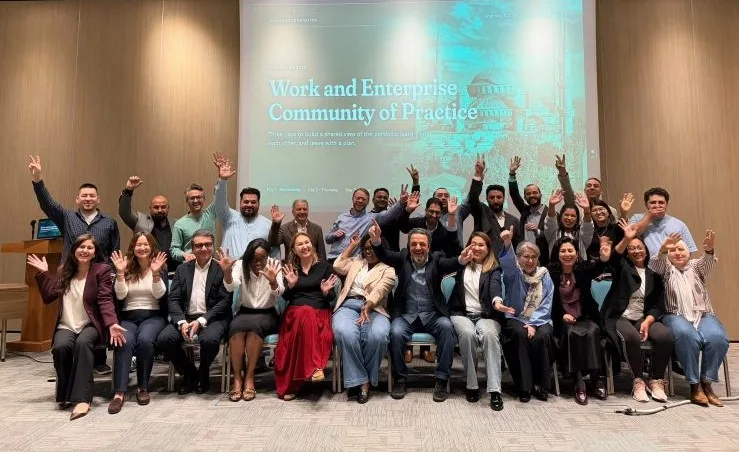
The Aga Khan Foundation (AKF) brought together Work and Enterprise professionals from different countries and Aga Khan Development Network (AKDN) agencies in Istanbul, Türkiye, from November 11 to 13, 2026, to strengthen cooperation on skills development, entrepreneurship and employment-focused programs.
The three-day Community of Practice (CoP) focused on developing a more consistent approach to Work and Enterprise initiatives while allowing participating countries to adapt programs to local economic conditions and priorities.
In a public LinkedIn post, Fouzia Qazi, Programme Manager – Work & Enterprise at the Aga Khan Rural Support Programme (AKRSP) Pakistan, stated that the discussions led to country-level action plans focused on piloting initiatives, strengthening program integration and fostering cross-country collaboration.
The gathering highlights an important challenge for international development organisations: how to transfer successful employment and entrepreneurship models between countries without overlooking differences in labour markets, infrastructure and economic opportunities.
One of the central themes emerging from the Istanbul discussions was the need for a common framework for Work and Enterprise programmes, particularly in skills development and entrepreneurship.
Such a framework could help participating organizations align their approaches to training, enterprise support and employment opportunities while maintaining flexibility in implementation.
That distinction matters because workforce development programs do not operate under identical conditions.
Skills training designed for an urban labour market may require substantial adaptation before it can serve rural communities where employment opportunities, connectivity and access to finance differ.
A common framework could establish shared objectives and methods for measuring progress without requiring every country to deliver identical activities.
Why the Discussions Matter for AKF’s Wider Work
The Istanbul meeting took place within an established development portfolio that combines employability, entrepreneurship, financial inclusion and access to markets.
According to AKF’s official Work and Enterprise information, the foundation provided employable skills training and support to approximately 47,000 people in 2025.
The foundation’s approach includes digital literacy, vocational skills, employer engagement, entrepreneurship and opportunities for digitally enabled work.
These activities address interconnected barriers to economic participation.
Training can improve an individual’s capabilities, but its impact depends partly on whether employers need those skills, whether entrepreneurs can access finance and whether businesses can reach customers.
The value of stronger program integration therefore extends beyond administrative coordination. It creates opportunities to connect training initiatives with enterprise development, market access and financial services.
For example, a vocational training program could potentially become more effective when combined with business mentoring, access to startup capital or partnerships with employers.
These are potential applications of integrated programming, rather than specific initiatives confirmed at the Istanbul meeting.
Pakistan’s Participation and Enterprise Development Opportunities
Pakistan’s Work and Enterprise experience was represented during the gathering, the country’s program was presented to colleagues from other AKF countries and AKDN agencies.
The participation created an opportunity to exchange approaches to skills development, entrepreneurship and locally adapted economic initiatives.
Pakistan also provides a relevant example of how enterprise development can connect with broader regional economic objectives.
AKDN’s existing program include Accelerate Prosperity, an entrepreneurship initiative operating in Pakistan, Tajikistan and the Kyrgyz Republic.
The initiative supports startups and early-stage businesses through business coaching, mentoring, networking, access to finance and market connections.
This existing cross-country model illustrates how shared enterprise-development expertise can be applied across different economic environments.
For Pakistan, the wider relevance includes opportunities to strengthen entrepreneurship support in underserved communities, where access to investment, business networks and specialised training may be limited.
From Knowledge-Sharing to Program Implementation
An important feature of the Community of Practice was its emphasis on converting discussions into practical action.
The participant’s account indicates that countries agreed to move forward with piloting relevant approaches, integrating programs and exploring collaborations suited to their respective contexts.
This creates a potential pathway for transferring experience between participating countries.
Rather than replicating another country’s programs in full, local teams could identify useful elements, test them in their own operating environments and adjust delivery based on results.
Such an approach may also make it easier to connect different thematic areas, including skills development, entrepreneurship and economic inclusion.
The effectiveness of this process will depend on implementation.
A successful pilot would need to demonstrate more than the completion of training sessions or the establishment of a partnership. Relevant outcomes could include improved employment prospects, stronger business performance, greater access to finance or sustained income opportunities.
These are possible evaluation measures, not outcomes already reported from the Istanbul gathering.
Digital Skills and the Future of Work
The discussions also have significance for workforce development in economies where digital capabilities are becoming increasingly relevant.
AKF’s official Work and Enterprise strategy identifies digital literacy, advanced digital skills, high-demand vocational training and emerging work opportunities as priorities.
Its approach also recognises the role of connectivity and technology infrastructure in supporting freelancing, business process outsourcing and other digitally enabled employment.
For countries such as Pakistan, these priorities create an opportunity to examine how traditional enterprise-development programs can complement digital skills initiatives.
For instance, entrepreneurship support could help small businesses adopt digital tools, while employment programs could connect technical training with the requirements of local and international employers.
However, digital training alone does not guarantee employment. Reliable connectivity, market demand, practical experience and access to business opportunities remain important.
The Istanbul meeting’s emphasis on cross-country learning could help participating organisations compare how these challenges are addressed in different settings.
The next stage will be the implementation of the country-level action plans. The reported priorities include program pilots, stronger integration between thematic areas and collaboration across AKF countries and AKDN agencies.
These details will be important in determining whether the gathering produces measurable improvements in employment and entrepreneurship support.
For AKF and its partners, the opportunity is to turn shared experience into approaches that can be tested, adapted and evaluated across different economic environments.