


Introduction: From Hype to Discipline in 2026 Startup Ecosystem
The global startup landscape in 2026 is undergoing a structural reset. After years of aggressive venture capital deployment driven by hype cycles, the market is now transitioning toward a more disciplined and performance-oriented funding environment.
Emerging technology startups continue to attract investor attention, but the criteria for funding have shifted significantly. Investors are no longer prioritizing bold visions alone—they are focusing on execution, measurable traction, and long-term sustainability. This shift is redefining how startups are built, funded, and scaled across industries.
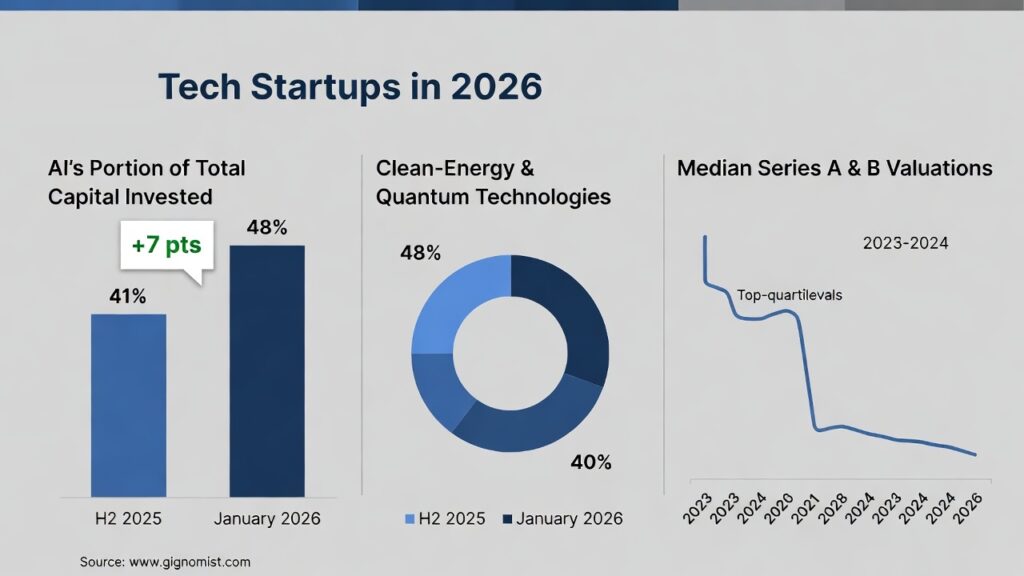
According to PitchBook’s report released in January 2026, global venture funding in emerging technologies climbed 14 % year-over-year in the second half of 2025, with AI-related deals accounting for 41 % of total capital deployed. Early data for January 2026 shows the trend accelerating: AI startups captured roughly 48 % of disclosed funding volume in the opening month, the highest monthly share recorded since the 2023 peak. At the same time, median round sizes for Series A and B stages have stabilized at levels last seen in late 2021, signaling that top-tier founders can still command premium valuations when they demonstrate defensible moats and meaningful revenue traction. Fore deeper dive into the Top 20 AI Startups That Raised $100M+ in 2025.
What Are Emerging Tech Startups in 2026?
Emerging tech startups are early- to growth-stage companies building products at the frontier of artificial intelligence, quantum computing, synthetic biology, next-generation robotics, climate technologies, advanced materials, and decentralized physical infrastructure networks (DePIN). In 2026 the definition has narrowed around commercial viability. Seed and Series A rounds now routinely require working prototypes that have been piloted with paying customers or that demonstrate clear technical differentiation validated by third-party benchmarks.
The “emerging” label no longer applies to generic large language model wrappers. Investors increasingly demand one or more of the following: novel training techniques that materially reduce inference cost, domain-specific reasoning that outperforms frontier models in a narrow but lucrative vertical, autonomous agent architectures capable of multi-step planning with human-in-the-loop oversight, or hardware-software co-design that provide with preemptive cybersecurity or unlocks performance unattainable on commodity cloud GPUs. This maturation reflects a market that has moved past hype and into pragmatic scaling.
1. The End of Hype-Driven Funding Cycles
1.1 What Changed After the Market Correction
Over the past few years, the startup ecosystem experienced inflated valuations and rapid capital deployment. However, recent market corrections have forced investors to reassess risk.
In 2026, funding decisions are influenced by:
- Verified user growth
- Revenue consistency
- Unit economics
- Operational efficiency
Startups that rely solely on narratives without performance indicators are increasingly being filtered out during early-stage evaluations.
1.2 Why Investors Are More Cautious Now
Investors have become more selective due to:
- Increased failure rates in overfunded startups
- Macroeconomic uncertainty
- Pressure to deliver returns to limited partners
This has resulted in a shift from aggressive expansion strategies to capital-efficient growth models.
2. How Investor Behavior Has Evolved
2.1 Data-Driven Decision Making
Modern investors are leveraging analytics and benchmarks more than ever. Instead of relying on founder storytelling, they evaluate startups based on:
- Customer Acquisition Cost (CAC) vs Lifetime Value (LTV)
- Retention curves and cohort analysis
- Monthly recurring revenue (MRR) growth
- Burn rate vs runway
This approach reduces speculation and increases accountability in funding decisions.
2.2 Rise of Performance-Based Funding
A notable trend in 2026 is the rise of milestone-based investments.
Key characteristics:
- Funding released in phases
- Performance benchmarks tied to capital
- Increased investor involvement post-investment
This model aligns incentives between founders and investors while minimizing financial risk.
Major Funding Rounds That Defined Early 2026
January and February 2026 produced several landmark rounds that set the tone for the year.
In mid-January, United States based QuantumLeap AI closed a US$ 50 million Series B led by a consortium of sovereign wealth funds and corporate venture arms from semiconductor giants. The company’s hybrid classical-quantum reasoning engine has already secured multi-year contracts with three Fortune 100 pharmaceutical companies for accelerated drug-discovery simulations. The round valued the business north of US$ 650 million post-money and included participation from several AI-native hedge funds seeking exposure to post-Moore’s-law compute paradigms.
Across the Pacific, China / Singapore dual-headquartered NeuraSynth announced a US$ 120 million Series C extension in late January. The round was led by a major state-backed fund and included new money from three top-tier Silicon Valley firms—an unusual cross-border syndicate. NeuraSynth’s edge lies in efficient on-device multimodal agents that run complex workflows entirely locally, addressing data-sovereignty concerns prevalent in APAC and EU markets.
In the European Union, GreenForge from Germany raised € 85 million (US$ 92 million) in a Series B round anchored by two large European energy utilities and a climate-focused fund managed out of London. The startup’s AI-driven materials-discovery platform has reduced rare-earth dependency in next-generation wind-turbine magnets by 40 % in pilot tests, aligning perfectly with the EU’s Net-Zero Industry Act requirements.
North America saw continued momentum in agentic AI. Autonomous Workflow Inc. in Canada secured CAD 110 million (US$ 80 million) in a Series B co-led by two Canadian pension funds and a prominent US growth equity player. Their platform orchestrates fleets of specialized AI agents that automate end-to-end procurement and supply-chain reconciliation for mid-market manufacturers—a use case that has delivered 30–45 % cost reductions in early deployments.
Australia’s deep-tech scene also produced a notable raise: AquaTrace closed a A$ 65 million (≈ US$ 42 million) Series A for its AI-powered ocean-carbon-monitoring network that combines autonomous underwater drones with satellite data and edge inference. The round drew interest from resource-heavy superannuation funds seeking climate-aligned investments with tangible MRV (measurement, reporting, verification) credibility.
3. High-Growth Sectors Attracting Investment in 2026
Despite tighter capital conditions, several sectors remain highly attractive due to their long-term potential.
3.1 Artificial Intelligence and Enterprise Automation
AI continues to dominate investment flows, particularly in:
- Enterprise workflow automation
- Industry-specific AI applications (healthcare, legal, finance)
- AI infrastructure and tooling
Investors are now prioritizing practical AI solutions over experimental concepts.
3.2 Fintech Infrastructure Over Consumer Apps
The focus has shifted from consumer-facing fintech products to backend infrastructure, including:
- Payment processing systems
- Regulatory compliance tools
- Cross-border financial solutions
This reflects a broader move toward foundational technologies rather than saturated markets.
3.3 Climate Tech and Sustainable Innovation
Climate-focused startups are receiving steady capital due to global sustainability goals.
Key areas include:
- Carbon tracking platforms
- Renewable energy storage
- Green supply chain solutions
These startups benefit from both investor interest and regulatory support.
3.4 Developer Tools and SaaS Platforms
Startups building tools for developers and enterprises continue to perform well due to consistent demand.
Examples include:
- Workflow automation platforms
- API infrastructure
- Collaboration and productivity tools
These businesses often demonstrate strong recurring revenue models, making them attractive to investors.
4. Changing Structure of Funding Rounds
4.1 Decline of Mega Rounds
Large funding rounds are becoming less common as investors aim to reduce exposure.
Instead, the market is seeing:
- Smaller initial investments
- Faster validation cycles
- Follow-on funding based on performance
4.2 Strategic Capital Deployment
Investors are now prioritizing:
- Capital efficiency
- Sustainable scaling
- Clear ROI timelines
This has led to a more structured funding ecosystem where growth is carefully managed rather than aggressively pursued.
5. What Founders Must Do to Secure Funding in 2026
5.1 Focus on Execution Over Vision
While vision remains important, execution has become the primary differentiator.
Founders must demonstrate:
- Product-market fit
- Customer validation
- Revenue traction
5.2 Build Sustainable Business Models
Startups that rely heavily on external funding without clear monetization strategies face higher rejection rates.
Investors now expect:
- Early revenue streams
- Clear pricing models
- Scalable operations
5.3 Strengthen Transparency and Communication
Clear and consistent communication with investors is critical.
This includes:
- Regular performance updates
- Honest reporting of challenges
- Data-backed decision-making
Regional Innovation Ecosystems and Regulatory Tailwinds
The United States maintains its lead in sheer dollar volume and mega-round frequency, fueled by deep pools of risk capital and unparalleled talent density in Silicon Valley, Boston, and emerging hubs such as Austin and Miami.
The European Union is experiencing a regulatory-driven renaissance. The AI Act’s risk-based framework, fully effective in 2026, has forced companies to build compliance into the product development cycle from day one—an expensive hurdle for under-capitalized teams but a powerful moat for those that clear it. Horizon Europe’s € 95 billion budget continues to de-risk early R&D, making EU seed rounds unusually large relative to stage.
China’s startup scene operates in a highly directed environment. State guidance funnels capital toward strategic priorities, producing rapid scaling in areas such as humanoid robotics and satellite mega-constellations, though international investor participation remains constrained.
Canada benefits from stable pension capital and favorable immigration policies that continue to attract global AI talent. Toronto and Vancouver are solidifying as cost-effective alternatives to Bay Area operations.
Australia’s ecosystem is smaller but increasingly focused. Critical minerals, ocean tech, and quantum sensing receive outsized attention thanks to geographic advantages and government-backed R&D tax incentives.
Looking Ahead: What Will Define the Rest of 2026
The next six to nine months will test whether the current selective boom can broaden. Key questions investors are asking include:
- Can agentic systems move beyond structured internal workflows into customer-facing, revenue-generating products?
- Will multimodal frontier models reach a plateau that opens the door for smaller, specialized models to win in verticals?
- How quickly will embodied AI (robotics + AI) translate lab demonstrations into commercial unit economics?
Early signals suggest that companies showing paying customers, strong gross margins, and measurable defensibility will continue to attract capital—even in a market that has grown far more discerning.
The 2026 vintage is shaping up to be one of the most polarized cohorts in recent memory: exceptional founders with exceptional traction are raising faster and at higher valuations than at any point since 2021, while everyone else faces a prolonged “prove it” window.
The Gignomist’s report Top 20 AI Startups That Raised $100M+ in 2025 deeply highlights high-growth AI startups, key investors, and funding trends driving the global AI ecosystem.
Conclusion
Emerging tech startups in 2026 are navigating a more disciplined and competitive funding environment. The shift from hype to execution is redefining success, favoring startups that deliver measurable value and sustainable growth.
For founders and investors alike, this marks the beginning of a more resilient and mature innovation cycle.
FAQs
Which emerging technologies are receiving the most venture funding in 2026?
Agentic AI, multimodal reasoning models, quantum-classical hybrid systems, climate-tech materials discovery, and embodied robotics lead funding volume in early 2026, with AI-related rounds capturing nearly half of disclosed capital.
What is the average size of Series B rounds for AI startups in 2026?
Top-tier AI Series B rounds in the United States and select EU markets range from US$ 40–120 million, with median rounds stabilizing around US$ 50–65 million for companies showing revenue traction.
How is the EU AI Act affecting startup funding in 2026?
The regulation creates higher compliance costs but also acts as a barrier to entry. Startups that embed risk-classification processes early often secure larger rounds from corporate and institutional investors seeking regulatory-aligned partners.
Are investors still funding general-purpose AI models in 2026?
Pure general-purpose frontier-model development has largely consolidated among a handful of well-capitalized players. Most new funding flows to vertical applications, reasoning enhancements, inference optimization, or agent orchestration layers.
Which regions offer the best environment for early-stage emerging tech startups in 2026?
The United States leads in total capital and speed; the EU provides strong de-risking through grants and regulatory clarity; Canada offers cost advantages and talent access; China excels in directed scaling for strategic sectors; Australia is gaining momentum in climate and quantum domains.