
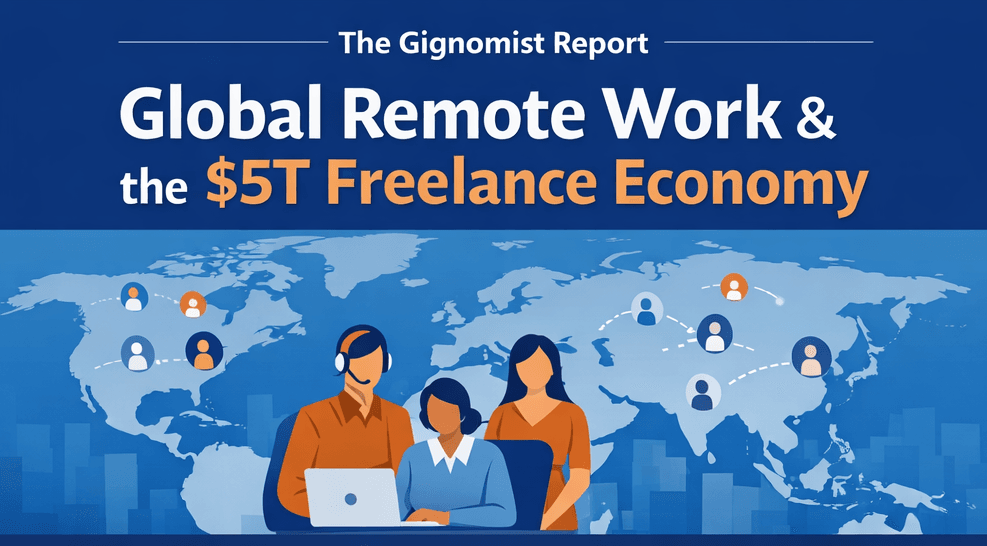
Remote work has evolved from a temporary pandemic response into a permanent structural pillar of the global labor market. As today, approximately 330 million people worldwide engage in full-time remote or hybrid arrangements. More significantly, 52% of the global workforce now participates in remote work at least part-time, while online freelancing emerges as preferred career choice amid AI job disruptions. These trends confirm a long-term transformation in how knowledge work is structured and delivered.
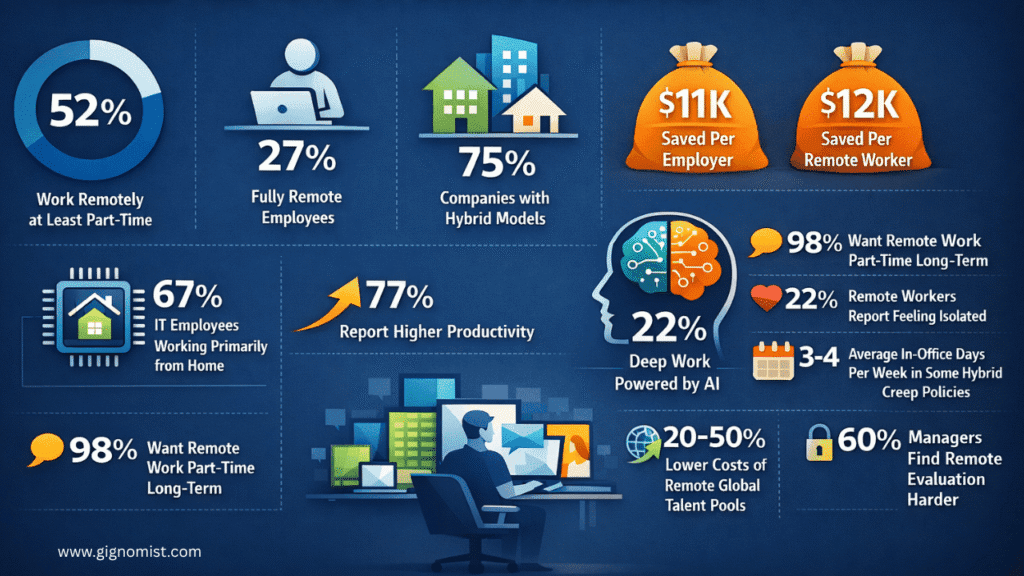
Hybrid work has emerged as the dominant configuration. Among remote-capable employees, 52% operate in hybrid arrangements, while 27% work fully remote. At the organizational level, approximately 75% of companies have adopted hybrid models, signaling institutional normalization rather than experimental flexibility
Employee preference data reinforces this permanence: 98% of professionals express a desire to work remotely at least part-time for the remainder of their careers, indicating that flexibility is now a baseline expectation rather than a discretionary benefit.
Key Findings From This Expanded Analysis Include:
- Globally, 52% of employees work remotely at least part-time.
- 27% of full-time employees worldwide are fully remote.
- 75% of organizations now operate hybrid structures.
- The technology sector leads adoption, with 67% of IT employees primarily working from home.
- Hybrid/remote employers save approximately $11,000 per employee annually, while remote professionals save roughly $12,000 per year in commuting and lifestyle expenses.
- 77% of remote workers report higher productivity, with controlled studies demonstrating a 13% productivity uplift relative to in-office models.
- AI now supports 22% of deep-work time across knowledge roles
The Gignomist projects hybrid will remain the dominant employment model through 2030, while remote-capable digital jobs are forecast to grow by 25%, reaching nearly 90 million globally.
Global Remote Work Adoption
Prior to 2020, remote work represented a marginal share of employment—approximately 6.5% of U.S. private-sector workers primarily worked from home. By contrast, 2026 data confirms a structural reset.
Today:
- 52% of the global workforce participates in remote work at least part-time.
- 330 million individuals work in either fully remote or hybrid structures.
- 27% of full-time workers globally are fully remote.
This expansion reflects digitization of knowledge work, cloud infrastructure maturity, and post-pandemic cultural acceptance. The normalization phase (2023–2025) has transitioned into stabilization (2026), suggesting remote/hybrid is not reversing despite isolated RTO mandates. Rather, the system is recalibrating toward sustainable hybrid equilibrium.
The Gignomist concludes that remote participation has reached a structural plateau—elevated but stable—consistent with long-term equilibrium rather than volatility.
Regional Variations of Remote and Hybrid Work
Adoption varies by region due to infrastructure, culture, and regulatory frameworks.
Remote and Hybrid Work in North America, United Kingdom & Australia
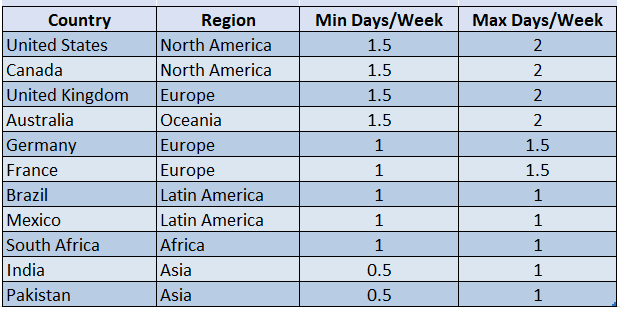
North America, the United Kingdom, and Australia remain global leaders in remote and hybrid work adoption, averaging approximately 1.5 to 2 work-from-home days per week across knowledge-driven sectors. These markets benefit from advanced digital infrastructure, flexible labor policies, and early enterprise cloud adoption. In the United States specifically, 26% of remote-capable roles are fully remote, while 52% operate under hybrid arrangements. Overall, nearly 78% of remote-capable employees work either fully remote or hybrid, reflecting structural normalization rather than temporary adjustment. Strong talent competition, high real estate costs, and mature service economies continue reinforcing sustained flexibility across these regions.
English-speaking economies benefit from flexible labor systems and early technology adoption.
Remote and Hybrid Work in Europe
Europe demonstrates moderate but structurally stable adoption of hybrid work, averaging approximately 1–1.5 remote days per week across knowledge-based sectors. Around 22% of workers aged 15–64 telework at least occasionally, with roughly 9% operating fully remotely. Adoption varies by country, with Northern and Western Europe leading Southern and Eastern regions. Regulatory clarity is improving, particularly following updated OECD guidance addressing cross-border tax and permanent establishment risks. Strong labor protections and “right to disconnect” policies continue shaping balanced hybrid frameworks.
Remote and Hybrid Work in Asia
Asia records lower average remote participation, typically between 0.5 and 1 remote day per week, influenced by deeply rooted office-centric and “face time” work cultures in India, Pakistan, South Korea, and China. Traditional management structures and urban corporate norms slow widespread adoption. However, multinational technology firms and export-oriented IT services significantly exceed regional averages, with hybrid penetration surpassing 40% in select sectors. As digital infrastructure expands and AI-enabled workflows mature, gradual policy liberalization is expected.
Remote and Hybrid Work in Latin America & Africa
Latin America and Africa represent emerging hybrid ecosystems, primarily concentrated in major urban technology and financial hubs such as São Paulo, Lagos, Nairobi, and Johannesburg. Adoption is driven by startup ecosystems, outsourcing industries, and multinational corporate presence. However, broadband limitations, power reliability issues, and digital access inequality remain structural constraints on broader scale implementation. Governments investing in digital infrastructure and remote talent initiatives are likely to accelerate participation and improve regional competitiveness in global knowledge markets.
Hybrid Creep (2026 Trend)
A defining 2026 workplace trend is “hybrid creep” — the gradual increase in mandatory office attendance to three or four days per week while organizations continue branding themselves as hybrid. This reflects strategic recalibration rather than a full reversal of flexibility policies. Employers are attempting to balance collaboration, cultural cohesion, and oversight with employee expectations for autonomy. The shift signals a maturing phase of hybrid experimentation, where companies refine models based on productivity data, retention metrics, and operational outcomes.
The Gignomist observes that while geographic disparities persist, long-term convergence is likely as infrastructure expands.
Remote Work Demographics & Workforce Trends
Remote work participation is heavily concentrated among higher-educated professionals in knowledge-intensive occupations. Roles requiring analytical, digital, financial, or strategic expertise are significantly more adaptable to remote environments than manual or location-dependent jobs. This structural divide continues shaping workforce participation patterns globally.
Industry Leaders
The technology sector leads remote adoption, with approximately 67% of IT employees working primarily remote or hybrid. Finance, marketing, consulting, and digital services follow closely, reflecting their reliance on cloud infrastructure and digital collaboration tools. These industries demonstrate sustained productivity in distributed models.
Education & Income
Advanced-degree holders participate in remote work at disproportionately higher rates compared to the general workforce. Higher-income, white-collar professionals dominate hybrid and fully remote arrangements due to job flexibility, digital skill requirements, and employer competition for specialized talent across geographic boundaries.
Generational Patterns
Gen Z demonstrates a stronger preference for hybrid models rather than fully remote structures, prioritizing mentorship, networking, and collaborative learning opportunities. Simultaneously, online freelancing also emerges as gen Z’s first career choice amid AI job disruptions accelerates demand for adaptable, skills-based work.
Gender & Equity
Women are significantly more likely to apply for remote positions, enhancing workforce participation and improving caregiving flexibility. Hybrid arrangements contribute to greater inclusion by reducing geographic and time constraints, supporting career continuity, and expanding professional access across diverse demographic groups.
Preference Permanence
The most striking statistic: 98% of professionals desire remote flexibility permanently, reinforcing remote work as an enduring structural expectation.
Other Demographics
Urban vs. rural—rural areas offer more flexibility to attract talent. Higher-income and white-collar workers dominate. Globally, platform-enabled and gig work expands access for underrepresented groups.
Upwork’s recent report shows rising “polyworking” (multiple roles) and skills-based hiring, with freelancers outpacing employees in AI proficiency (54% vs. 38%.
The Gignomist interprets this preference saturation as a powerful constraint against widespread RTO reversals.
Productivity & Business Outcomes
Hybrid and remote work models have proven effective across industries, demonstrating strong performance, flexibility, and sustainable productivity outcomes.
- 77% of remote workers self-report higher productivity.
- Stanford’s controlled study demonstrated a 13% productivity increase under structured remote arrangements.
- Hybrid employees show 33% lower attrition rates compared to fully in-office peers.
- Fully remote workers report high engagement but hybrid workers show stronger wellbeing metrics.
Financial implications
- Employers save approximately $11,000 annually per remote employee.
- Employees save approximately $12,000 annually.
- Real estate cost reductions range from 30–50% in optimized hybrid portfolios.
The Gignomist identifies hybrid as the optimal balance: productivity parity, retention uplift, and satisfaction gains.
Technology & AI Enablement
Robust digital infrastructure underpins adoption. Core tools include Microsoft Teams, Slack, Zoom, Asana/Trello for project management, and cloud platforms (Google Workspace, AWS). Cybersecurity has become paramount—73% of executives view remote workers as higher security risks.
AI is transformative: tools for automated transcription, virtual assistants, sentiment analysis in meetings, and performance analytics enable scaled remote management. Freelancers lead AI adoption (62% use weekly vs. 53% employees). Emerging: VR/AR for immersive collaboration, “digital twins” for office simulation. Cybersecurity remains critical; 73% of executives consider distributed environments higher risk.
AI integration is accelerating:
- 22% of deep work time now involves AI tools.
- AI supports drafting, coding, analysis, meeting summarization, and decision augmentation.
- Freelancers show higher AI proficiency than traditional employees.
Emerging innovations include:
- AI scheduling agents
- Automated performance dashboards
- VR/AR collaboration
- Digital twin office simulations
The Gignomist anticipates AI-assisted distributed teams becoming the norm by 2030.
Freelancing Marketplaces vs Direct Contracts
The gig economy complements traditional remote employment. Upwork reports more than 28% of U.S. skilled knowledge workers freelance or independent, generating $1.5 trillion in earnings (2024). Gen Z: 53% already freelance.
Marketplaces (Upwork, Fiverr, Freelancer dot com): Provide vetted talent, escrow, global reach. Advantages: speed, specialization, lower overhead. 78% of employers plan freelance hires in coming quarters amid economic caution.
Direct Contracts: Via LinkedIn, personal networks, or company portals. Offer deeper integration, loyalty, IP control. Hybrid models emerge—companies blend full-time remote with on-demand freelancers for agility.
Freelancers excel in AI skills and report higher income satisfaction. The Gignomist observes marketplaces democratize access while direct contracts suit strategic roles; together they expand the “contingent digital knowledge market” toward $5 trillion by 2028.
Challenges & Opportunities
Remote and hybrid work models present both structural challenges and transformative opportunities for organizations and professionals navigating the future of work. Success depends on proactive design, leadership adaptation, and strategic technology integration.
Challenges include employee isolation (22% report loneliness), hybrid creep, evaluation bias, cybersecurity risks, digital inequality, and managerial resistance— with 60% of leaders reporting difficulties in performance assessment.
Opportunities are substantial: employers can save around $11,000 per employee annually, while employees may save up to $12,000. Additional benefits include global talent access (20–50% cost differentials), sustainability gains, greater resilience to disruption, and AI-driven productivity systems.
Organizations that intentionally design hybrid strategies consistently outperform those that adopt them reactively.
Policy, Regulations & Legal Landscape
Frameworks vary:
- EU: Strong “right to disconnect” laws; hybrid encouraged but taxed carefully.
- U.S.: State-level variations; no federal mandate. IRS/ DOL monitor classification.
- OECD (2025 Model Tax Convention Update): Clarifies when home offices create Permanent Establishment (PE) risk for cross-border remote work—time-based thresholds and examples provided to reduce uncertainty.
- Emerging: Data privacy, labor protections for platform workers, incentives for rural remote hubs.
World Economic Forum scenarios for 2030 highlight platform talent and location-decoupled skills as key, urging reskilling for AI-augmented remote ecosystems. Governments investing in broadband and digital literacy will capture gains. The Gignomist emphasizes regulatory clarity as critical to cross-border remote scaling.
Future Outlook and Key Predictions (2026–2030)
Hybrid will remain dominant through 2030 in leading markets. AI will supercharge remote productivity, enabling “agent workforce” models where humans oversee AI agents across borders.
The Gignomist key predictions for 2026–2030:
- 50%+ workforce participation in remote/hybrid sustained.
- Remote-capable digital roles reach 90 million globally.
- AI integration exceeds 35% of deep work workflows.
- Full RTO mandates remain under 15% of firms.
- Asia converges toward Western hybrid norms.
- Output-based metrics replace presence-based evaluation.
Economic upside includes trillions in optimized labor allocation and infrastructure savings. Risk remains if digital access inequality persists.
Key Takeaways
- Remote/hybrid work has stabilized at transformative levels (52% global participation).
- Hybrid is dominant and preferred.
- Productivity gains (13%) and cost savings ($11K/$12K) reinforce economic logic.
- AI integration (22% deep work) is reshaping distributed productivity.
- 90 million remote-capable jobs by 2030 signal structural permanence.
The Gignomist underscores that organizations embracing evidence-based flexibility will lead in talent wars and innovation. Leaders should audit current models, upskill managers for distributed teams, and monitor 2026 job market signals.
This report incorporates some information from Gallup, Stanford, OECD, Upwork, Robert Half, Forbes Advisor, WEF, and BLS. We sincerely thank these sources for their valuable data, which was helpful in different parts of this report. For information and education purposes only. © 2026 The Gignomist. All rights reserved