
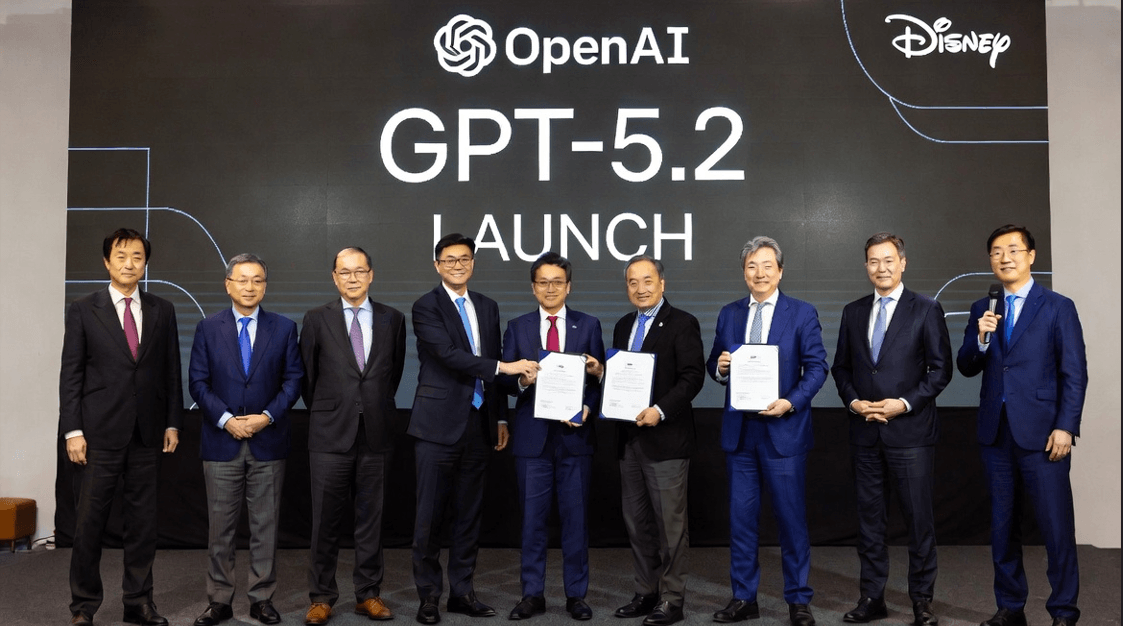
OpenAI launched its latest artificial intelligence model, GPT-5.2, on Thursday, touting advances in reasoning, coding and long-context processing as the Microsoft-backed startup races to reclaim ground lost to Google’s Gemini 3 in the escalating battle for AI supremacy.
The release comes weeks after CEO Sam Altman declared an internal “code red” in early December, halting nonessential projects and marshaling resources to counter the November debut of Alphabet’s Gemini 3, which has surged to the top of key performance benchmarks and boasts 650 million monthly active users.
OpenAI executives, including applications chief Fidji Simo, insisted during a media briefing that GPT-5.2’s timeline — planned for months — was not rushed despite the competitive pressures, though the extra focus proved “helpful” in refining the model. The company positioned the update as its “best model yet for everyday professional use,” with benchmarks showing GPT-5.2 outperforming predecessors and rivals like Gemini 3 Pro and Anthropic’s Claude Opus 4.5 in areas such as software engineering tasks (55.6% on SWE-Bench Pro), doctoral-level science (70.9% on GDPval) and abstract reasoning. It also reduces hallucinations, handles complex multi-step projects like spreadsheet creation and presentation building more reliably, and excels in tool use for agentic workflows.
The model ships in three tiers — Instant for quick queries, Thinking for math and planning, and Pro for high-accuracy challenges — rolling out first to paid ChatGPT subscribers Thursday, with API access for developers to follow. OpenAI has no immediate plans to retire earlier versions like GPT-5.1 or GPT-4.1 from its API, ensuring continuity for enterprise users amid surging adoption: enterprise tool usage has jumped dramatically over the past year.
Altman, speaking alongside Disney CEO Bob Iger in a CNBC interview, downplayed Gemini 3’s sting: “It has had less of an impact on our metrics than we feared.” The exchange highlighted OpenAI’s revenue momentum, which Altman called “unusual at this scale,” as the firm eyes monetization strategies without immediate ads for ChatGPT. Google did not immediately respond to requests for comment on the rivalry.
The announcements dovetailed with a landmark partnership: Disney revealed a $1 billion equity investment in OpenAI, plus warrants for more shares, in a three-year licensing deal making it the first major studio to feed intellectual property into Sora, OpenAI’s short-form video generator launched in September. Starting early next year, Sora users can prompt videos featuring over 200 characters from Star Wars, Pixar, Marvel and Disney classics — think Darth Vader lightsaber duels or Lightning McQueen races — without talent likenesses or voices, and with Disney-set guardrails to prevent misuse.
Curated fan videos will stream on Disney+, blending AI creativity with the platform’s short-form push, while Disney deploys ChatGPT internally and co-develops subscriber experiences. Iger framed the move as proactive: “We’d rather participate than be disrupted by it,” emphasizing licensed fees that “honor and respect” creators amid Hollywood’s AI skepticism, including recent cease-and-desist letters to Google and suits against firms like Midjourney. Altman echoed the optimism, calling Disney “the global gold standard for storytelling” and hailing the pact for unlocking “latent creativity.”
The dual developments underscore AI’s dual-edged blade for entertainment: fueling innovation while stoking fears over jobs and IP. OpenAI, valued at over $500 billion, eyes an “adult mode” for ChatGPT in Q1 2026 and teases a January model with sharper images and speed. As Altman put it in the CNBC sit-down, progress has outpaced even their wildest forecasts, setting the stage for a trillion-dollar AI ecosystem where tech titans and Tinseltown collide.
For more similar news and reports go to the home page of The Gignomist