

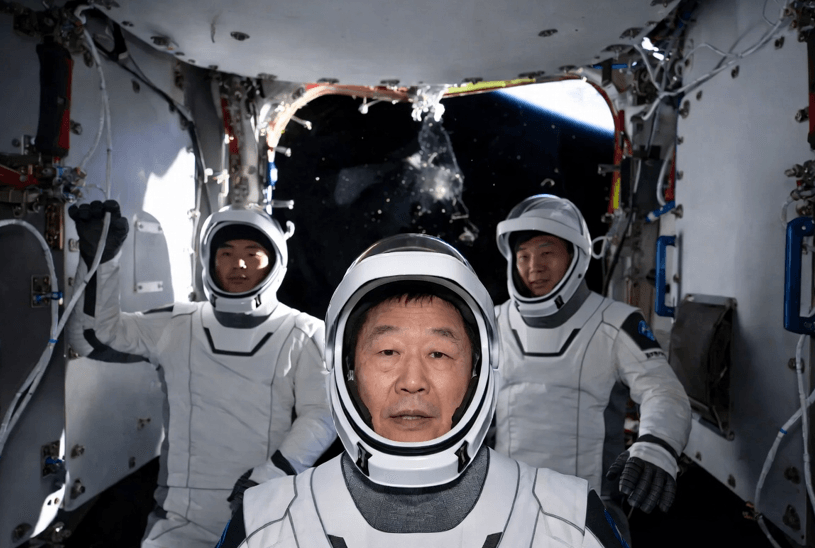
Three Chinese astronauts remain stranded aboard the Tiangong space station after damage to a return capsule forced a sudden change in mission plans, leaving the crew without a fully functional lifeboat.
The issue surfaced last week when astronauts discovered that Shenzhou 20 — one of the two return vehicles docked at the station — had been hit by space debris. A preliminary assessment found a crack in the capsule’s window glass, making it unsafe for reentry, according to the China Manned Space Agency.
According to Stephen Clark, space reporter at Ars Technica, the damaged craft was originally scheduled to bring home Commander Chen Dong and crewmates Chen Zhongrui and Wang Jie. Instead, the trio returned to Earth on Friday aboard another Shenzhou spacecraft, leaving the newly arrived crew on Tiangong with only one operational escape vehicle.
Space station procedures require at least two return capsules on standby at all times to ensure every astronaut has a safe way home in case of emergency. With Shenzhou 20 no longer flightworthy, Tiangong is temporarily operating without the necessary redundancy.
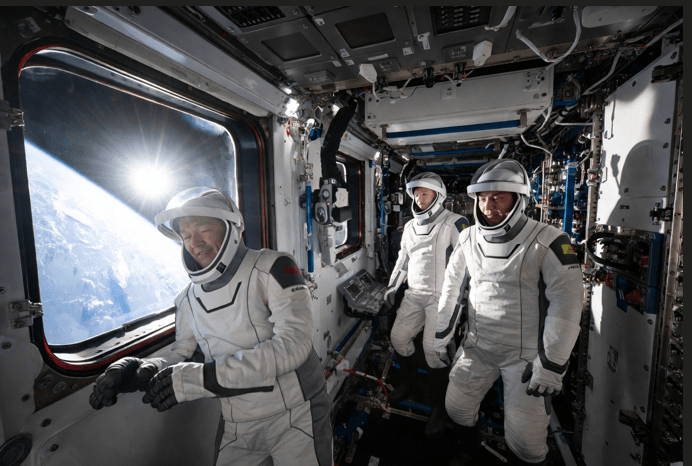
Chinese officials confirmed that the crack was most likely caused by a small piece of space debris and said the damage did not meet safety standards for crewed reentry. They have not provided a timeline for launching a replacement capsule.
The remaining three astronauts aboard Tiangong will continue their mission but currently lack a second emergency return option — a rare situation in human spaceflight and one China will need to resolve before future crew rotations.
Similar Incidents in Global Spaceflight History
Spacecraft damage, lifeboat failures, and emergency return situations have occurred before in human spaceflight. Below are some notable examples:
1. NASA’s Space Shuttle Columbia Disaster (2003)
In one of the most devastating incidents, Space Shuttle Columbia (STS-107) was destroyed during reentry when a hole in its wing—caused by foam debris striking the orbiter during launch—led to the spacecraft breaking apart. All seven astronauts were killed. While the crew was not stranded in orbit, the event underscored how minor launch or orbital damage can lead to catastrophic consequences if not detected early.
2. Soyuz MS-22 Coolant Leak (2022–2023)
Russia’s Soyuz MS-22 spacecraft suffered a major coolant leak, likely caused by a micrometeoroid strike. The capsule became unsafe for crewed reentry, leaving two Russian cosmonauts and one NASA astronaut without a return vehicle.
Russia launched an uncrewed replacement spacecraft, Soyuz MS-23, similar to China’s recent emergency launch. The incident is the closest modern parallel to the Shenzhou 20 damage.
3. Apollo 13 Oxygen Tank Explosion (1970)
While not a lifeboat failure, the Apollo 13 crew lost their main spacecraft after an oxygen tank exploded. With their return vehicle damaged, astronauts used the Lunar Module as a lifeboat for four days before safely returning to Earth. The mission remains a defining example of surviving space emergencies through innovation and resilience.
4. International Space Station (ISS) Debris Near-Misses
The ISS has experienced multiple close calls with orbital debris, forcing crews to shelter in their docked Soyuz or Dragon spacecraft in case of evacuation. In some instances, these lifeboats were the crew’s only protection if the station had sustained critical damage.
5. Mir Space Station Fire and Collision (1997)
The Russian Mir station faced two major emergencies:
- A fire caused by a malfunctioning oxygen generator.
- A collision with a Progress cargo ship that damaged a module and caused depressurization.
Crews prepared their Soyuz lifeboat several times, coming close to abandoning the station.