

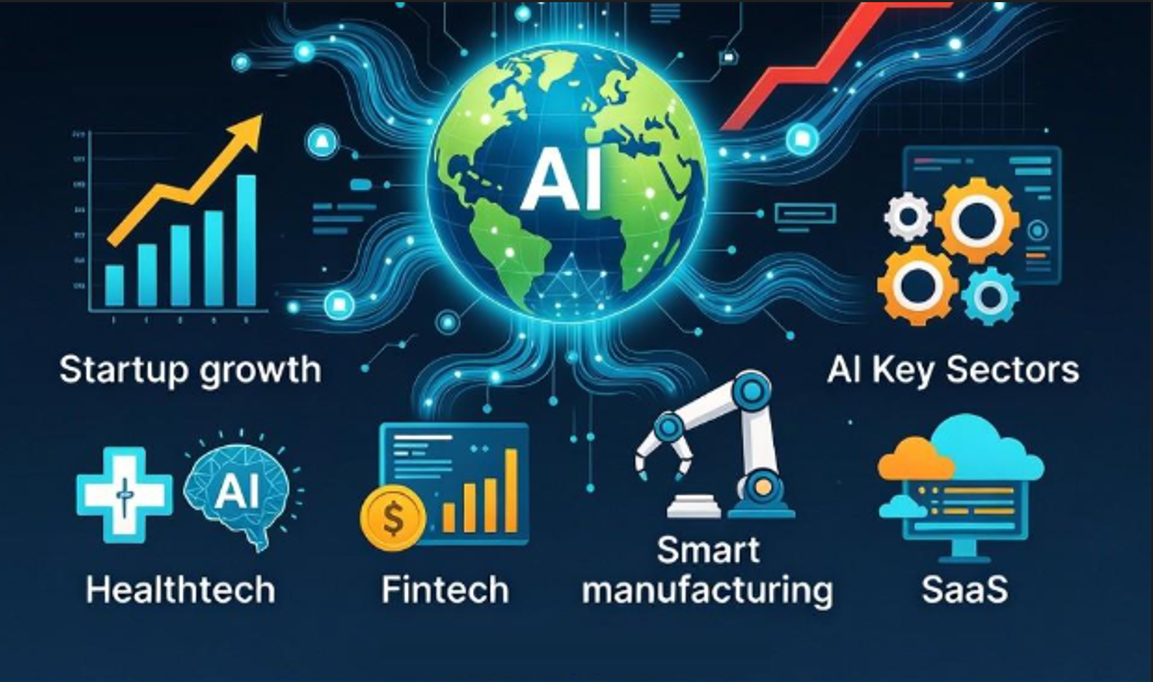
Artificial Intelligence is no longer an experimental IT project in a research lab—it has become the driving spine of today’s startups. According to a report by McKinsey & Company, over 55% of organizations across the world have already adopted AI in at least one business function, and this is only set to accelerate as we move towards 2026. On the other hand, the World Economic Forum estimates that the transformation powered by AI could add trillions of dollars to the global economy in the next few years.
Startups benefit even more from this dynamic. Unencumbered by legacy infrastructure, they can design and launch AI-first products from the outset. Whether it’s Silicon Valley in the United States, Berlin’s innovation scene in Germany, Shenzhen’s AI research labs in China, or Toronto’s machine learning innovation hubs in Canada, startups are leveraging AI not only to compete but to disrupt entire industries.
What Is AI in Startups?
AI in startups refers to the integration of machine learning, natural language processing, computer vision, and predictive analytics into early-stage business models, products, and operations. It can power recommendation engines, fraud detection systems, personalized marketing campaigns, logistics optimization platforms, and even autonomous robotics solutions.
In essence, AI enables startups to function smarter, leaner, and faster. Startups do not have to build big teams for data analysis and customer service. They can use AI systems that learn from user behavior continuously. This is a huge advantage in a competitive market such as the EU and the US.
Why AI Matters for Startups in the Run-Up to 2026
This section explains why AI adoption is no longer optional, outlining the economic, competitive, and technological forces that now make it essential for startup survival and long-term scalability. As markets become increasingly data-driven and automation-focused, startups are expected to operate with greater speed, efficiency, and precision than ever before. Organizations that successfully integrate AI can streamline operations, enhance decision-making, and deliver more personalized products and services, while those that delay adoption risk falling behind more agile competitors.
For a deeper exploration of this transformation, The Gignomist previously examined “AI Agents in 2026: How Autonomous AI Is Reshaping Daily Business Tasks and Workflows,” offering detailed insights into how autonomous systems are redefining everyday business processes and the future of work.
Faster Innovation Cycles
With the use of generative AI tools, startups can develop prototypes of applications, code, and analyze market trends and user behavior in a matter of weeks rather than months. In innovation hubs such as Australia and Germany, this enables startups to compete globally from the very start.
For example, AI-powered analytics platforms can instantly process customer feedback across multiple channels, helping founders refine product-market fit in real time. This speed is crucial in industries such as fintech, healthtech, and cybersecurity.
Cost Efficiency and Lean Operations
Startups usually have very tight budgets. AI is used to automate repetitive tasks such as accounting reconciliation, marketing segmentation, and inventory forecasting. This saves on costs and increases accuracy.
In Canada and the United States, most AI startups use cloud-based infrastructure for AI instead of developing their own systems. This allows startups to have access to enterprise-grade solutions even when they are at the seed stage.
Key Applications of AI in Startups
To appreciate the transformative power of AI, it is necessary to explore its applications across various sectors. The next sections will discuss the practical applications that are currently shaping innovation worldwide.AI in Product Development
AI assists startups in designing smarter products by analyzing large amounts of data. In the rapidly growing AI landscape in China, startups are applying computer vision to improve e-commerce and smart manufacturing.
AI in Marketing and Customer Experience
Personalization engines powered by AI are transforming the digital marketing landscape. Startups are able to segment their audience based on behavior, geography, and buying patterns.
For example, AI-powered chatbots and conversational interfaces allow for customer service around the clock, leading to increased retention rates. According to Gartner research, conversational AI is poised to handle a large percentage of customer interactions in the coming years.
Global AI Adoption and Regulatory Landscape
AI innovation does not exist in isolation—it is shaped by regional regulations, funding ecosystems, and enterprise partnerships. Understanding these differences is essential for startups planning global expansion.
United States and Canada
The U.S. continues to be a leader in AI innovation, with robust venture capital support and collaboration between startups and large tech companies. Canada, especially Toronto and Montreal, has become a hotbed for machine learning research.
The United States remains at the forefront of the global AI ecosystem, thanks to robust venture capital investment and the strong partnership between startups and leading technology companies. Research carried out by McKinsey & Company indicates that approximately 60-65% of organizations in the United States have adopted AI in at least one of their core business functions. This trend is further fueled by the Stanford University, which indicates that the United States accounts for close to 40% of the world’s private AI investment.
European Union and Germany
The European Union is taking a structured and forward-looking approach to AI governance, aiming to balance innovation with ethical responsibility through comprehensive regulatory frameworks. This measured strategy seeks to create trust in AI systems while maintaining Europe’s competitiveness in emerging technologies. According to estimates from the European Commission, approximately 42% of large enterprises in the EU are already experimenting with or deploying AI solutions, whereas adoption among SMEs remains below 30%, highlighting both progress and opportunity.
As Europe’s largest economy, Germany is playing a pivotal role in this transition. The country is investing heavily in industrial AI applications, particularly in manufacturing, automation, and advanced engineering, reinforcing its position as a leader in Industry 4.0 and applied artificial intelligence.
China and Australia
China is aggressively investing in AI-driven smart cities, robotics, and fintech startups. Strong government backing accelerates AI commercialization.
China is actively pursuing the development of AI-powered smart cities, dark factories robotics, and fintech startups. As per the Stanford University AI Index, China represents about 30% of the world’s AI patents and is second only to the United States in AI research publications. Moreover, over 50% of the leading Chinese technology companies have incorporated AI into their primary product offerings.
Australia, although smaller in size, is also seeing a rapid growth in the adoption of AI. According to government statistics, between 28% and 35% of Australian companies have adopted AI or automation technology, especially in mining, agriculture, and healthcare.
Challenges and Ethical Considerations
Although AI presents tremendous opportunities, startups face tough challenges. Data privacy, bias in AI, and cybersecurity are still major concerns.
Bias in AI models can cause discriminatory results, particularly in hiring or lending applications. Startups have to be compliant with regulations in various regions, including the EU and the US.
Cybersecurity threats also escalate as AI models deal with personal user information. Startups should develop secure infrastructure and governance to build trust.
The Future of AI-Driven Startups
Looking ahead, AI will move from being a competitive advantage to becoming a foundational requirement. Startups launched in 2026 will likely be “AI-native” by default.
Emerging trends include:
- AI copilots for founders
- Autonomous decision-making platforms
- AI-driven venture capital analytics
- Hyper-personalized consumer ecosystems
AI startups will move from prototyping to complete integration, becoming “AI-native” by design, not by upgrade. Entrepreneurs will integrate artificial intelligence into their business models, ranging from product development to decision-making and predictive analytics. Automation will lower operational expenses, and AI copilots will help teams with coding, marketing, and strategy.
AI to grow their businesses quickly. But ethical AI, regulatory issues, and cybersecurity preparedness will emerge as new success factors, distinguishing long-term innovators from short-term disruptors.
FAQs
How can early-stage startups implement AI with limited budgets?
Startups can leverage cloud-based AI services, open-source machine learning frameworks, and API-driven tools to reduce infrastructure costs.
What industries benefit most from AI in startups?
Fintech, healthtech, e-commerce, cybersecurity, and SaaS industries experience the fastest AI adoption rates.
Is AI regulation a threat to startup growth?
While compliance adds complexity, clear regulations increase consumer trust and long-term sustainability.
How AI changes startup hiring models?
AI automate routine tasks, increasing demand for data scientists, AI engineers, and ethical AI specialists.
What skills should startup founders develop for AI adoption?
Founders should understand data strategy, AI ethics, automation tools, and cross-border regulatory requirements.