
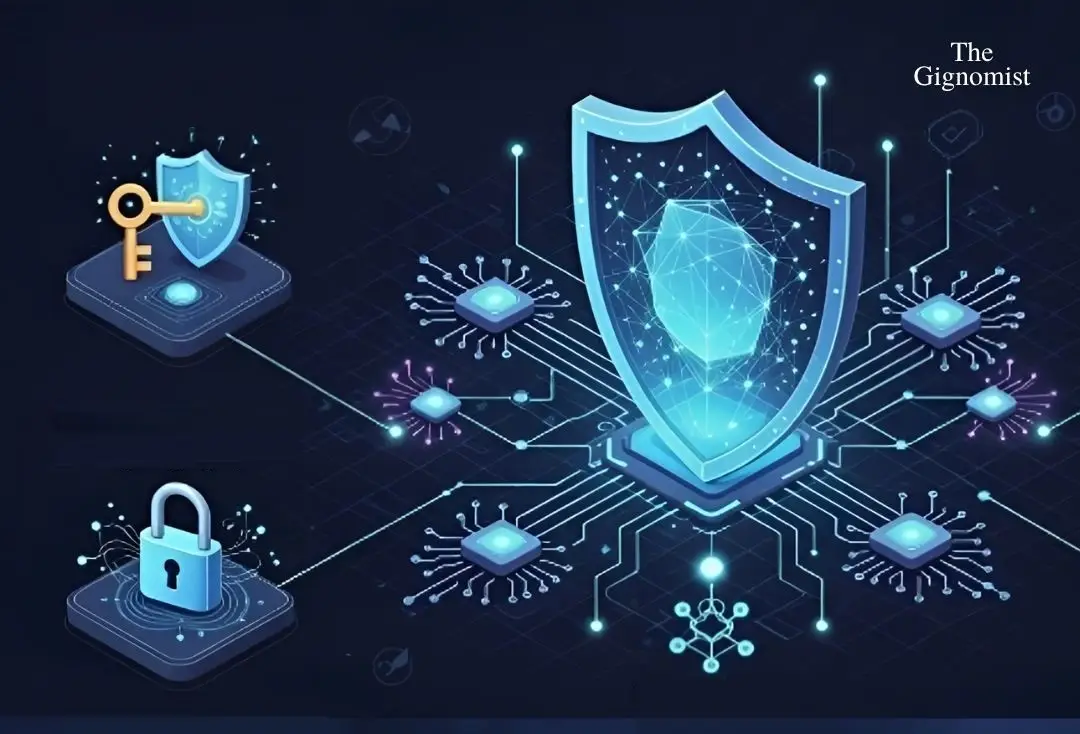
Cyber threats have been identified as one of the top risks in the World Economic Forum’s Global Risks Report for the past several years, based on both likelihood and impact. At the same time, the U.S. National Institute of Standards and Technology (NIST) has now begun the process of standardizing post-quantum cryptographic algorithms, noting that quantum computers may eventually be able to break commonly used encryption algorithms such as RSA and ECC.
Enterprises that fail to develop quantum-proof security plans by 2026 risk exposing their critical infrastructure, financial systems, and sensitive data to “harvest now, decrypt later” attacks in the near future. Quantum cybersecurity is no longer a concept—it is a necessity. As highlighted by The Gignomist in “How Preemptive Cybersecurity Defends Against AI-Powered Attacks in History’s Most Dangerous Cyber Risk Era,” proactive defense strategies are essential to staying ahead of emerging threats.
This convergence of accelerating quantum research in China, the United States, Germany, Canada, and Australia—and growing geopolitical cyber tensions—means organizations cannot afford to wait.
What Is Quantum Cybersecurity?
However, before we proceed, it is essential to understand what quantum cybersecurity is all about. Quantum cybersecurity is essentially a term that refers to the security technologies, protocols, and cryptographic techniques that are resistant to attacks by quantum computers.
Classical encryption techniques are based on mathematical problems that are difficult for classical computers to solve. However, quantum computers use the principles of quantum mechanics, namely superposition and entanglement, to solve mathematical problems exponentially faster.
Quantum cybersecurity includes:
- Post-quantum cryptography (PQC)
- Quantum key distribution (QKD)
- Hybrid cryptographic systems
- Quantum-safe network architectures
Its goal is simple but critical: ensure that today’s encrypted data remains secure tomorrow—even in a post-quantum world.
The Quantum Threat: Why Current Encryption Is at Risk
In order to grasp the concept of urgency, it is necessary to examine the way in which quantum computing challenges the current cryptographic basis. Algorithms such as Shor’s algorithm provide theoretically sufficient quantum computing power to factor large numbers efficiently, thereby breaking RSA encryption.
The “Harvest Now, Decrypt Later” Problem
This subheading points out one of the biggest strategic challenges for governments and businesses. Even if quantum computers are not yet able to break encryption on a large scale, attackers can already today harvest encrypted data and wait until the decryption capabilities are available in the future.
Sensitive data like defense communications, intellectual property, financial data, and healthcare information may be relevant for decades to come. Nation-state actors in technologically advanced nations like China, the United States, and countries within the European Union are already heavily investing in quantum technology, which adds to the geopolitical aspect of cybersecurity threats.
Post-Quantum Cryptography (PQC): The First Line of Defense
Post-quantum cryptography is generally regarded as the most viable and scalable defense option. It entails the design of new cryptographic algorithms that are capable of being executed on classical computers but are not vulnerable to attacks by quantum computers.
NIST Standardization and Global Adoption
This is an important section because alignment between regulations and enterprises is highly dependent on standards. The U.S. NIST has chosen a number of algorithms to standardize, which is a significant step in the global quantum readiness process.
The adoption of quantum computing is increasing in the enterprise space, including banking, defense, telecommunication, and cloud service sectors. Enterprises are carrying out cryptographic audits to pinpoint systems that are vulnerable to attacks and are planning to migrate to quantum-safe systems.
Some countries, such as Germany and France, are aligning their cybersecurity structures with PQC transitions. Canada and Australia are aligning quantum resilience with their cybersecurity strategies, while China is progressing on both quantum computing and quantum communication infrastructure development.
Quantum Key Distribution (QKD): Physics-Based Security
While PQC is software-based, Quantum Key Distribution represents a hardware-driven security model. QKD uses the laws of quantum physics to securely exchange encryption keys.
How QKD Enhances Secure Communication
This subheading describes the differences between QKD and the traditional key exchange process. In the QKD process, if there is any attempt to intercept the key, the quantum state will change, and this will immediately alert the parties involved in the communication process.
China has already developed quantum communication satellites, and the European Union is working on the EuroQCI (European Quantum Communication Infrastructure).
The QKD process still has scalability and infrastructure issues, especially when it comes to commercial deployment on a global scale.
Enterprise Readiness: Transitioning to Quantum-Safe Infrastructure
Organizations cannot replace cryptographic systems overnight. Transition requires planning, budgeting, testing, and regulatory alignment.
Crypto Agility as a Strategic Advantage
Crypto agility is the ability of an organization to rapidly change cryptographic algorithms without having to redesign whole systems. This is becoming an increasingly key area of cybersecurity architecture in the US, Germany, and Australia.
Financial institutions, cloud computing companies, and SaaS providers are integrating crypto-agile architectures to future-proof their digital offerings. Companies pursuing hybrid approaches, which integrate classical and quantum-safe encryption, are poised for a smooth transition to 2026 and beyond.
Business leaders must also take into account the need for compliance, especially in the EU with the latest data protection and digital resilience regulations.
Regulatory Landscape and Global Innovation Ecosystems
Quantum cybersecurity is not developing in isolation; it is intertwined with policy, funding, and national strategy.
- United States and Europe
The United States has enacted the Quantum Computing Cybersecurity Preparedness Act, requiring federal agencies to conduct an inventory and upgrade their cryptographic systems. The European Union is pursuing quantum research through Horizon Europe funding programs and digital sovereignty initiatives.
- China and Asia-Pacific
China’s aggressive quantum investment includes the development of quantum communication networks that cover major cities. Australia and Singapore are also emerging as innovation hotspots, where research from academia is being combined with applications in cybersecurity.
This is leading to innovation at a faster pace but also to increased tensions over the security of digital infrastructure.
Challenges and Ethical Considerations
Despite the great potential of quantum cybersecurity, there are technical, economic, and ethical issues associated with it.
The cost of migration may be high, especially in developing countries. There are also uncertainties in terms of timelines, since no one knows when large-scale quantum computers will be operational.
There is also a concern that the availability of quantum-safe technology may exacerbate the digital divide in cybersecurity.
Quantum Cybersecurity Will Look Like by 2026
However, from 2026 onwards, we can anticipate significant enterprise adoption and government enforcement. The big cloud companies will provide quantum-safe encryption as an option. Governments will require PQC adoption in critical infrastructure industries.
Cybersecurity companies will promote “quantum-ready” solutions as a marketing advantage. Startups focused on quantum-safe hardware, encryption software, and secure communication solutions will attract venture capital investments in North America, Europe, and Asia.
Early movers will establish trust, resilience, and a long-term competitive advantage in a rapidly shifting threat environment.
FAQs
1. What is post-quantum cryptography and why is it important?
Post-quantum cryptography refers to encryption algorithms designed to resist quantum computer attacks. It is important because current encryption methods may become vulnerable once powerful quantum computers emerge.
2. When will quantum computers break current encryption?
Experts disagree on exact timelines, but many estimate significant breakthroughs could occur within the next decade. This uncertainty drives early preparation.
3. Is quantum key distribution better than post-quantum cryptography?
QKD offers physics-based security but requires specialized infrastructure. PQC is more scalable for widespread enterprise adoption.
4. How can enterprises prepare for quantum cybersecurity risks?
Organizations should conduct cryptographic audits, adopt crypto-agile systems, monitor regulatory guidance, and begin phased migration toward quantum-safe algorithms.
5. Which countries are leading in quantum cybersecurity development?
The United States, China, Germany, Canada, Australia, and other EU nations are leading investments in quantum research, secure communication networks, and regulatory frameworks.