
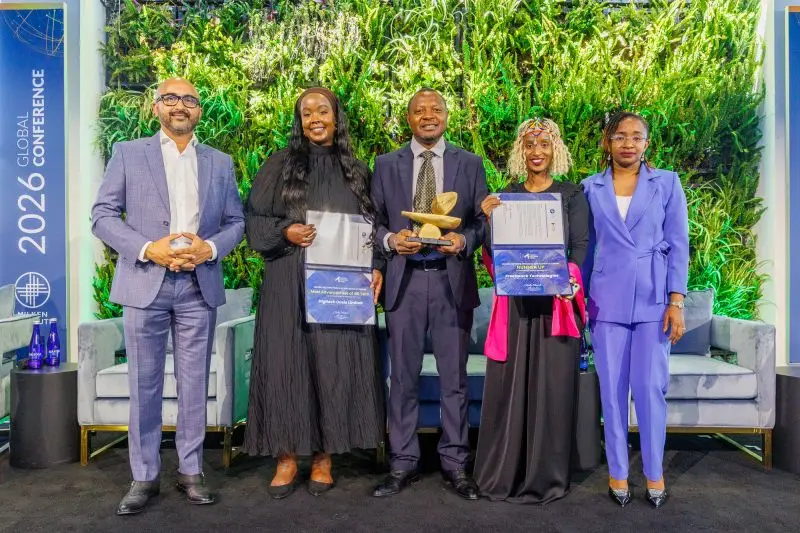
Cameroon-based startup BleagLee has won the top honor at the Milken-Motsepe Prize in AI and Manufacturing during the Milken Institute Global Conference held in Los Angeles Wednesday.
BleagLee uses AI-powered recycling technology to transform plastic, agricultural and electronic waste into high-value industrial products. The company received $1 million grand prize for advancing sustainable manufacturing and waste management systems across Africa.
The Milken-Motsepe Prize in AI and Manufacturing was launched to recognize innovative companies developing scalable technologies capable of creating jobs, strengthening industrial systems and accelerating the adoption of advanced manufacturing practices globally.
BleagLee’s patented AI software identifies and collects waste from communities before processing it into engineered recycled polymers, 3D-printing filaments and bio-based carbon materials. Organizers said the company’s approach combines environmental impact with economic opportunity and could help mitigate 300 million tons of carbon dioxide-equivalent emissions by 2030.
“Africa is producing world-class AI and technology innovation that is solving problems and creating opportunities on a global scale,” Dr. Precious Moloi-Motsepe, co-founder and CEO of the Motsepe Foundation, said in a statement. “When we invest in innovation that is both locally grounded and globally minded, the returns are limitless.”
Freshpack Technologies of Tanzania received the $250,000 runner-up award for its AI-powered cold storage systems aimed at reducing food waste. Digitech Oasis Limited of the United Kingdom won the $100,000 award for the most advanced use of Fourth Industrial Revolution technologies in manufacturing.
Additional interim awards totaling $750,000 were distributed among semifinalists and finalists throughout the competition. Organizers said all prize funds are unrestricted, allowing companies to invest directly in expansion, pilot projects and operational development.
Launched in May 2025, the competition attracted more than 2,000 entrepreneurs from 100 countries across five continents, with only 10 teams advancing to the semifinal stage. Finalists pitched their innovations to investors during the Milken Institute Middle East and Africa Summit in Abu Dhabi before presenting again at this year’s Global Conference in Los Angeles.
Judges evaluated companies based on commercial viability, scalability, operational economics and technological integration. The five finalists included BleagLee, Digitech Oasis Limited, Freshpack Technologies, Spiro and Toto Safi Limited.
The AI and Manufacturing award is the fourth competition launched under the Milken-Motsepe Innovation Prize Program, which was established in 2021 to encourage technology-driven solutions addressing global economic and environmental challenges. Since its launch, the program has awarded more than $8 million to over 50 innovators worldwide. Participating companies have collectively secured nearly 31 times the value of the prize money in outside investment, according to organizers.
The conference also marked the announcement of a new Milken-Motsepe Prize focused on the circular economy. The upcoming $2 million competition, which includes a $1 million grand prize, will recognize companies using technology to replace traditional “take-make-waste” production systems with more sustainable and regenerative industrial models.
The new prize will target innovations in waste recovery, recycling and resource efficiency across sectors including food systems, electronics, construction, packaging and fashion. Organizers said the initiative aims to strengthen manufacturing systems in Africa while promoting safer and more specialized waste management practices.
Emily Musil, managing director of Environmental and Social Innovation at the Milken Institute, said the next phase of the program will focus on entrepreneurs reimagining how materials are produced, recovered and reused.
“These innovators are not only reducing waste — they are unlocking new economic value, strengthening local industries and driving resilient, inclusive growth,” Musil said.
Applications for the circular economy prize are open through Aug. 13, 2026. Eligible companies must have operated for more than two years, generated at least $500,000 in revenue and demonstrated measurable social impact and operational readiness in Africa.