
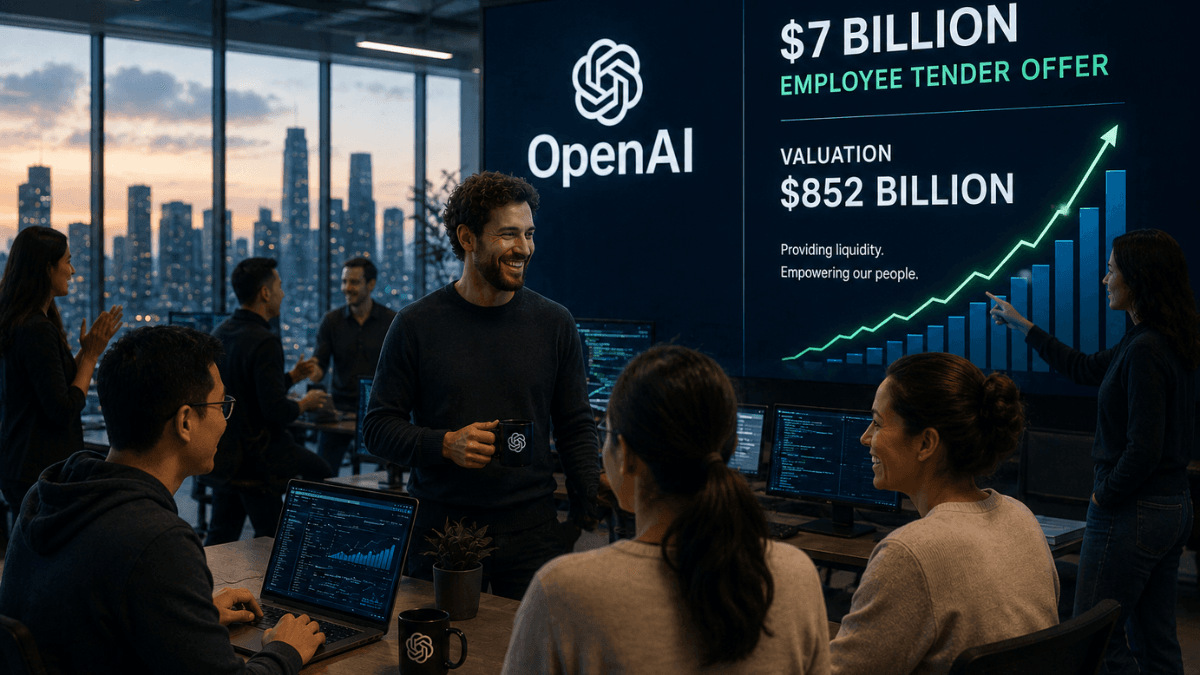
OpenAI has reportedly completed a roughly $7 billion tender offer that allowed current and former employees to sell shares in the artificial intelligence company, providing a major source of private-market liquidity as questions continue over when the ChatGPT maker could move ahead with an initial public offering.
The transaction valued OpenAI at approximately $852 billion, unchanged from the post-money valuation established in its massive March financing round.
Unlike some employee tender offers that bring in outside investors to purchase shares, OpenAI reportedly used its own funds to buy the stock from employees and former employees.
The OpenAI tender offer gives shareholders an opportunity to realize some of the value of their equity without waiting for the company to complete an IPO. It also provides another indication of the extraordinary scale OpenAI has reached as competition intensifies across the global artificial intelligence industry.
The OpenAI tender offer has not publicly disclosed detailed terms of the tender transaction.
$852 Billion Valuation Holds After Historic Funding Round
The reported tender price maintains the valuation OpenAI tender offer established earlier this year.
On March 31, OpenAI tender offer announced that it had closed a financing round involving $122 billion in committed capital at an $852 billion post-money valuation.
That financing placed the company among the world’s most valuable privately held technology businesses and provided substantial capital for an AI expansion strategy requiring enormous investments in computing infrastructure, research and product development.
The OpenAI tender offer said at the time that access to computing capacity had become a strategic advantage as the company expanded ChatGPT, its application programming interfaces, Codex and enterprise AI products.
Maintaining the same $852 billion valuation in the employee transaction is significant because secondary-market transactions can provide another indication of how private-company equity is being priced between major financing rounds.
However, a tender offer should not be interpreted in the same way as a public stock-market valuation. OpenAI remains privately held, and its shares do not trade continuously on a public exchange.
Tender Offer Gives Employees Liquidity Before an IPO
Equity compensation has become an important tool for technology companies competing for engineers, researchers and executives.
For employees of publicly traded companies, shares can generally be sold after vesting and applicable trading restrictions.
The OpenAI tender offer Private-company employees face a different situation.
Their equity can become extremely valuable on paper while remaining difficult to convert into cash until an acquisition, IPO or approved secondary transaction occurs.
OpenAI tender offers provide an alternative.
By allowing eligible shareholders to sell a portion of their holdings, companies can provide liquidity while remaining private. The mechanism can also help retain employees who might otherwise have to wait years before realizing the financial value of their compensation.
That consideration is particularly relevant in artificial intelligence, where competition for specialized researchers and engineers has intensified among OpenAI, Anthropic, Google, Meta and other technology companies.
For OpenAI, a multibillion-dollar liquidity program could therefore serve both financial and workforce objectives.
OpenAI Has Already Taken a Major Step Toward an IPO
The OpenAI tender offer transaction arrives only months after OpenAI formally opened the door to a potential public listing.
On June 8, the company confirmed that it had confidentially submitted a draft registration statement to the U.S. Securities and Exchange Commission for a proposed IPO.
OpenAI tender offer did not provide details about the potential offering’s size, number of shares or expected price.
More importantly, the company emphasized that it had not decided when a listing would occur.
OpenAI said there were activities that could be easier to accomplish while remaining privately held, making clear that the confidential filing provided flexibility rather than establishing a firm IPO timetable.
A confidential submission allows a company to begin working with regulators before making its registration documents publicly available.
The process therefore represents an important step toward an IPO but does not guarantee that a listing will happen immediately.
Does the Tender Offer Change OpenAI’s IPO Timeline?
The $7 billion employee transaction inevitably raises questions about whether OpenAI feels less urgency to enter public markets.
Providing liquidity privately can reduce one traditional reason for pursuing an IPO: giving employees and early shareholders a way to monetize their holdings.
But the transaction alone does not establish that OpenAI has postponed its public-market plans.
The OpenAI tender offer company has already stated that the timing remains undecided.
A public listing would also serve objectives that an employee tender cannot fully replace. An IPO could provide access to a much broader capital base, create publicly traded stock that could be used for acquisitions and compensation, and establish a market-driven valuation for the business.
Those benefits must be weighed against additional regulatory disclosures, quarterly reporting requirements and greater scrutiny from public investors.
At OpenAI’s scale, that trade-off is unusually consequential.
AI’s Capital Requirements Remain Enormous
OpenAI’s financing strategy is particularly important because frontier AI development requires extraordinary amounts of capital.
Training increasingly capable models requires advanced chips, data centers, networking infrastructure and electricity. Serving hundreds of millions of users creates another layer of computing expense.
The company has argued that durable access to computing resources is fundamental to its strategy.
That requirement separates leading AI laboratories from many previous generations of software startups, which could expand globally without comparable physical infrastructure investments.
The result is an unusual financial model: some of the world’s fastest-growing technology companies may also be among its most capital-intensive.
OpenAI’s March fundraising demonstrated the scale of capital investors are prepared to commit to that race.
An eventual IPO could significantly expand the company’s financing options.
OpenAI’s Valuation Approaches a Historic Threshold
At $852 billion, OpenAI is already approaching a valuation that would have been almost unimaginable for a private technology company only a few years ago.
Reports surrounding its prospective IPO have raised the possibility that the company could eventually seek a valuation approaching $1 trillion.
Reaching that level in public markets would place OpenAI among an exceptionally small group of technology companies.
But public investors would also subject its financial performance, capital expenditures, competitive position and path toward sustainable profitability to much greater scrutiny.
OpenAI tender offer faces formidable competition.
Anthropic has expanded rapidly in enterprise AI and coding, while Google continues integrating Gemini across its consumer and cloud businesses. Meta is investing heavily in models and AI infrastructure, and a growing group of Chinese laboratories is competing across both proprietary and open-model ecosystems.
The race is increasingly about more than producing the most capable model. Distribution, computing capacity, enterprise adoption, developer ecosystems and financing have all become strategic advantages.
OpenAI Tender Offer Highlights AI’s New Private-Market Scale
The reported OpenAI tender offer illustrates how dramatically the economics of artificial intelligence companies have changed.
A $7 billion employee liquidity transaction would itself rival the size of major technology funding rounds from earlier startup eras.
For OpenAI employees, the deal provides an opportunity to turn part of their accumulated equity into cash.
For investors, the $852 billion tender valuation provides another reference point for assessing how the private market currently values one of the world’s most closely watched AI companies.
And for the broader technology industry, the transaction reinforces the unprecedented amounts of capital flowing through the AI ecosystem.
OpenAI has already taken the procedural step of confidentially filing for an IPO, but it has deliberately left the timing open.
That means the next major milestone may not simply be whether OpenAI goes public, but when the company decides that the advantages of public capital markets outweigh the flexibility it currently enjoys as one of the most valuable private companies ever created.
Like The Gignomist’s coverage? Subscribe to our free newsletter for the latest technology news, AI breakthroughs, startup updates, cybersecurity insights, blockchain developments, gaming trends, and expert analysis from across the global innovation ecosystem.