

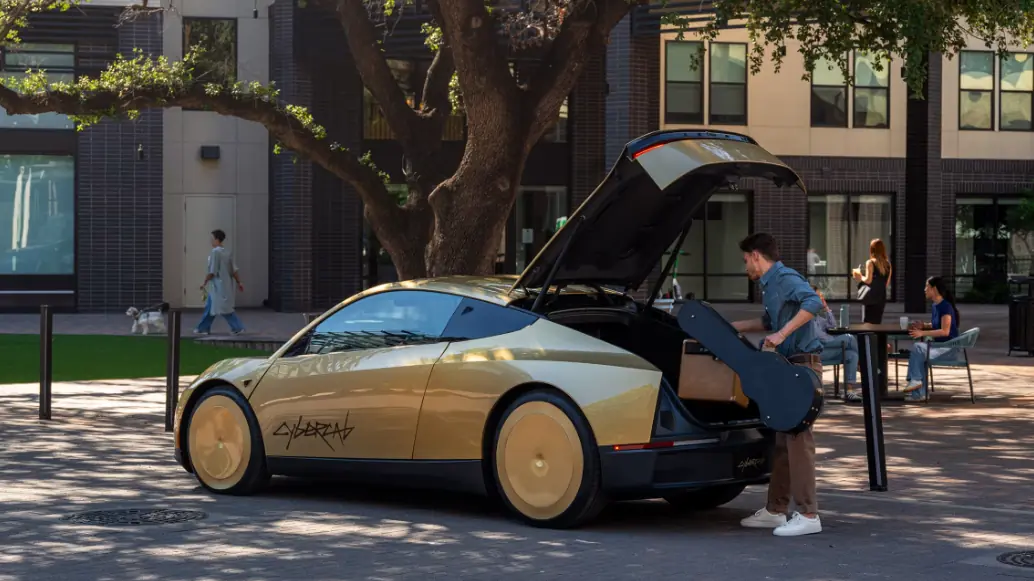
Tesla Robotaxi has evolved from a concept into a commercial autonomous ride-hailing service, with Model Y vehicles and purpose-built Cybercabs serving passengers in selected US cities.
The company’s Robotaxi website lists Austin, Dallas, Fort Worth, Houston, Miami, Orlando, San Antonio and Tampa among its service locations. Tesla has also begun deploying its two-seat Cybercab, designed without a steering wheel or pedals.
But operating driverless vehicles and building a profitable transportation network are fundamentally different achievements.
The next stage of Tesla’s autonomous-driving ambitions will depend on three measurable outcomes: safety performance, vehicle utilization and operating costs.
What Tesla Robotaxi Service Actually Offers
Tesla’s Robotaxi platform allows passengers to request a vehicle through a dedicated application, confirm pickup details and begin their journey using an in-car touchscreen.
The service combines automated driving software with electric vehicles, remote operational support and a digital booking platform.
Two vehicle types are central to the strategy.
The Model Y accommodates up to four passengers and provides a familiar vehicle platform for fleet expansion. Cybercab is a dedicated two-passenger vehicle intended for autonomous operations, with no conventional driver controls.
Tesla also advertises a future Robovan for larger groups, although that vehicle should not be confused with its operating Robotaxi fleet.
Geographic availability remains important. Service within a city does not necessarily mean every neighborhood, road or weather condition is supported.
What Do Tesla’s Autonomous Driving Miles Prove?
Tesla’s public Robotaxi dashboard has reported more than five million miles driven autonomously, reflecting a growing body of real-world operational experience.
That is meaningful progress, but mileage alone does not establish that the service is safer than human driving.
The critical questions concern the conditions under which those miles were accumulated, the incidents recorded and the methodology used to compare performance.
Tesla’s published safety analysis covering January 22 through October 18, 2026, reported approximately 3.1 million miles driven without an onboard safety monitor. It reported no qualifying injuries in which a Robotaxi made first contact, no Robotaxi airbag deployments and no pedestrians or cyclists struck under its stated definitions.
These figures deserve attention, but they are company-reported results, not a comprehensive independent certification of safety.
Tesla’s methodology excludes trips with an onboard safety monitor and applies specific definitions to injury and collision categories. Its comparison with human drivers also relies on estimated crash frequencies.
Furthermore, millions of miles may still be insufficient to measure exceptionally rare but severe events with high statistical confidence.
For autonomous transportation, the relevant standard is not simply whether a vehicle can drive itself. It is whether its safety performance remains reliable as operations expand into unfamiliar environments.
Cybercab Could Change the Economics of Ride-Hailing
Tesla’s biggest commercial opportunity may come from removing the cost of a human driver.
Traditional ride-hailing businesses must compensate drivers for their time. Autonomous fleets replace that recurring labor expense with substantial spending on vehicles, software, charging, maintenance, insurance and remote assistance.
Cybercab’s purpose-built design could help reduce vehicle acquisition and operating costs.
However, lower manufacturing costs do not automatically produce cheaper rides.
A robotaxi that completes only a few paid trips daily may struggle to recover its costs. A vehicle operating for extended periods with high passenger demand has a better chance of achieving attractive economics.
Consider a simplified illustration.
If an autonomous vehicle costs $30,000 and operates for five years, its purchase price alone represents $6,000 annually before financing, maintenance, electricity, insurance or other expenses.
At 30,000 paid miles per year, that equals approximately 20 cents per paid mile in vehicle acquisition cost. At 15,000 paid miles, the figure doubles to 40 cents.
These are illustrative calculations, not Tesla’s disclosed operating costs. They demonstrate why utilization matters as much as vehicle price.
Tesla has not published enough detailed fleet-level financial information to independently establish sustained Robotaxi profitability.
The Regulatory Challenge: A Car Without Driver Controls
Cybercab introduces a challenge beyond software reliability.
Conventional vehicles provide steering wheels and pedals so humans can intervene. Cybercab removes those controls entirely, making its operational safety and legal compliance inseparable from its autonomous system.
US regulators are examining whether Tesla properly certified Cybercab vehicles under applicable federal safety requirements.
The National Highway Traffic Safety Administration also requires reporting of specified crashes involving automated driving systems.
Its automated-driving crash reporting framework distinguishes fully automated systems from Level 2 driver-assistance technology, which still requires human supervision.
That distinction matters because Tesla’s consumer Full Self-Driving (Supervised) software is not equivalent to an unrestricted driverless taxi service.
The expansion of autonomous transport will therefore depend on both engineering performance and regulatory confidence.
Tesla Versus Waymo: Two Different Paths to Autonomy
Tesla’s approach emphasizes cameras, neural networks, vehicle manufacturing scale and the possibility of lower-cost hardware.
Alphabet-owned Waymo has followed a different strategy, deploying autonomous services with a broader sensor configuration that includes lidar and radar.
Both companies must solve the same commercial problems: maintaining safety, managing fleet operations, securing regulatory permissions and attracting enough passengers to support their networks.
Tesla’s manufacturing expertise could become an advantage if Cybercab production scales efficiently.
Waymo’s experience operating driverless services across multiple markets provides a different advantage: accumulated operational processes and experience in city-by-city deployment.
The eventual winner may not be the company with the most impressive demonstration. It may be the operator that combines reliable autonomous performance with affordable, widely available service.
Beyond autonomous-driving software, advances in vehicle hardware are also shaping intelligent mobility. For example, Goodyear’s AI-enabled tire and EV innovations illustrate how connected components could contribute to the next generation of vehicles.
The Overlooked Question: Who Controls the Autonomous Vehicle?
Tesla’s November 2026 move toward limited personal Cybercab sales introduces another business question.
Reported purchase terms include a price of approximately $29,990 and a $299 monthly autonomy subscription, with restrictions on operating areas and commercial use.
For a vehicle without manual controls, access to driving software is essential rather than optional.
That creates an unusual ownership arrangement: a buyer may own the physical vehicle while depending on an ongoing software service to use it.
At $299 monthly, the subscription adds $17,940 over five years, before insurance, electricity and maintenance.
The issue is not limited to Tesla. Autonomous vehicles could accelerate a broader shift toward software-defined transportation, where functionality, geographic access and recurring fees become central to vehicle ownership.
Digital technology is also reshaping automotive business models beyond autonomous driving. Ferrari’s use of AI and cryptocurrency in an exclusive Le Mans car auction offers another example of how established automotive brands are exploring emerging technologies.
What Tesla Must Prove Next
Tesla’s Robotaxi progress is real, but the most important milestones remain ahead.
Investors, regulators and passengers should watch for independently assessable safety results, expansion beyond limited operating zones, vehicle availability, average paid miles per vehicle and transparent operating economics.
Tesla’s Robotaxi platform presents a compelling vision of transportation without human drivers. The commercial test is whether that vision can deliver consistently safe journeys at a cost customers are willing to pay.
The deeper lesson extends beyond Tesla: autonomous driving is becoming an operational business, not merely a technological achievement.
The companies that succeed will need to prove that their vehicles can do more than drive themselves. They must operate safely, reliably and economically—day after day, city after city.