
Generative artificial intelligence is becoming part of game development, but the industry’s argument over the technology increasingly depends on a more specific question: what exactly should developers use it for?
A former producer associated with Sony’s God of War franchise has defended experimenting with generative AI, adding another voice to a debate that has divided developers, artists and players. The controversy reflects a wider tension inside the games business.
AI tools can potentially accelerate coding, prototyping and repetitive production work. But generating artwork, dialogue, voices or other creative material raises substantially different questions involving copyright, training data, employment and creative ownership.
Treating all of those applications simply as “AI in games” misses that distinction.
AI Can Enter Development Long Before Players See It
Video games are unusually complicated software products.
A large release can require programmers, designers, artists, animators, writers, actors, quality-assurance teams, audio specialists and producers working together for years. That creates many opportunities for automation.
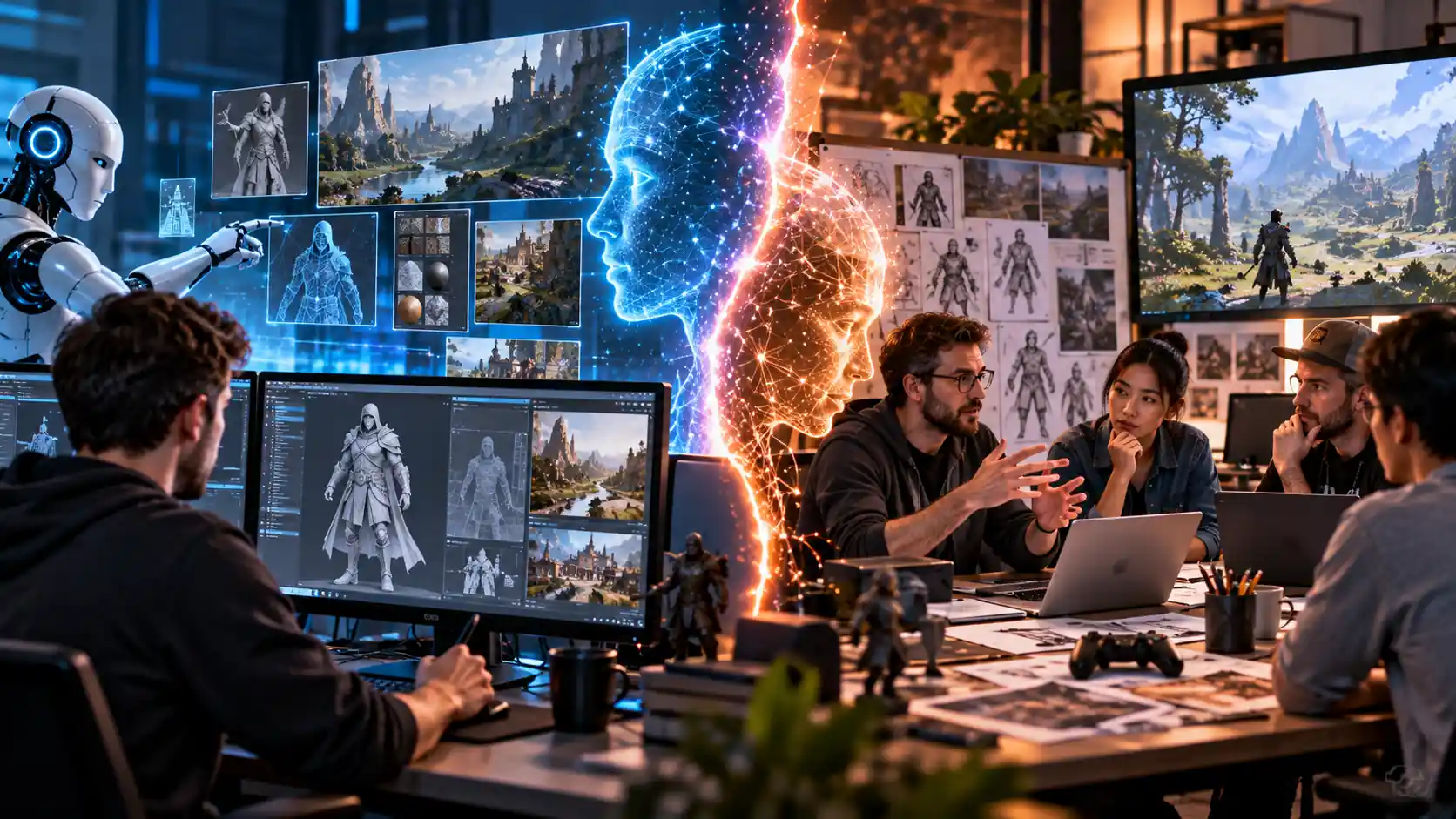
Developers can use AI-assisted tools to brainstorm concepts, write or debug code, test ideas, generate temporary assets or accelerate repetitive production tasks. In those cases, AI-generated material may never appear in the finished game.
A designer, for example, could use generated imagery to explore the visual direction of an environment before professional artists create the final assets. A programmer could use an AI coding assistant to explain an error or draft routine code that is subsequently reviewed and rewritten. That is substantially different from releasing a game containing AI-generated characters, voices or artwork.
The distinction helps explain why developers who support AI experimentation do not necessarily agree with every commercial use of generative AI.
Why Game Studios Are Interested
Development costs provide a powerful incentive to experiment.
Major games can require enormous teams and years of production. Delays and cancellations can result in substantial financial losses, while publishers increasingly compete for players’ limited time. Tools that reduce repetitive work or make prototypes faster therefore have obvious commercial appeal.
The same pressure is appearing across the broader technology industry as companies look for practical productivity gains from AI rather than experimentation alone.
Gignomist has examined that transition in its coverage of enterprise AI adoption and the growing demand for dedicated AI leadership. But productivity is only one side of the equation.
Game development produces intellectual property, performances and visual assets. Using generative models in those areas can raise questions that coding assistance or internal brainstorming may not.
Copyright Remains a Central Problem
Generative AI models learn patterns from large amounts of existing material.
That has produced disputes across creative industries over whether copyrighted works can be used for model training without permission and under what circumstances AI-generated output can receive copyright protection.
In the United States, the Copyright Office’s artificial intelligence initiative has examined questions involving digital replicas, copyrightability and the use of copyrighted works in generative-AI training. Those issues matter directly to game studios.
A developer needs confidence that commercially released characters, environments, dialogue, music and other assets do not create unexpected intellectual-property liabilities.
The legal question is therefore not merely whether an AI tool can produce useful content. Studios also need to understand where the underlying model came from, how it was trained and what rights they have over its output. That can make enterprise AI governance as important as the technology itself.
Workers Have Different Concerns
For artists, writers and performers, the debate also involves employment.
A tool that removes repetitive technical work can make a creative employee more productive. A system introduced specifically to reduce the number of artists, writers or actors required for production has a different economic effect. Voice and performance rights have become especially contentious.
Actors have sought protections governing digital replicas and AI-generated performances, reflecting concerns that a person’s voice or likeness could be reproduced without appropriate consent or compensation. Those concerns became part of wider labor negotiations as generative AI spread through entertainment.
The result is an important distinction between using AI as an employee’s tool and using AI as a substitute for the employee. Real-world implementations can fall somewhere between those two extremes.
Players Are Part of the Equation
Studios also have to consider their customers.
Generative AI has become unusually visible to gaming audiences, and some players actively object to games containing generated artwork or other AI-created material. Platforms have responded by requiring greater disclosure.
Steam, for example, asks developers submitting games to disclose certain uses of generative AI, including pre-generated content and live-generated material.
Its Steamworks rules for AI content distinguish between content created with AI during development and content generated while a game is running.
For live-generated content, developers must explain what safeguards prevent illegal material from being produced.
That creates another incentive for studios to distinguish internal productivity tools from AI content shipped to customers.
Generative AI Could Also Change Games Themselves
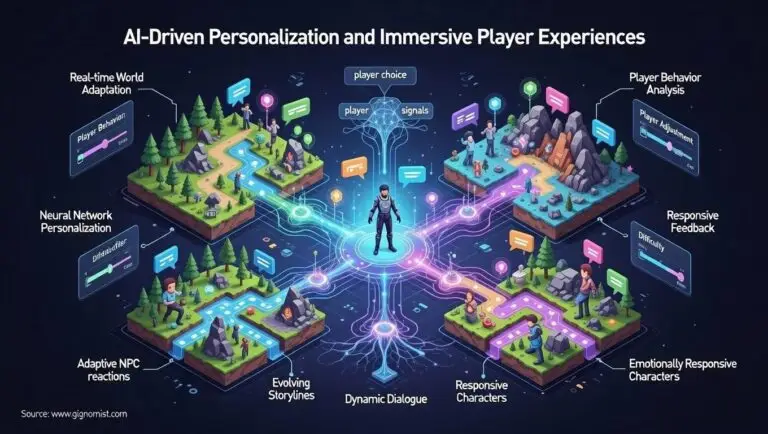
The longer-term possibility goes beyond making existing development cheaper. Generative systems could eventually make games more dynamic.
Characters could respond to players with less reliance on predetermined dialogue trees. Environments or missions could adapt to individual behavior. Smaller studios could potentially create experiences that previously required much larger production teams. Those possibilities remain technically and creatively challenging.
A character capable of generating unlimited dialogue is not automatically a well-written character. A system that can continuously create environments does not necessarily understand pacing, narrative structure or game balance.
Human direction therefore remains central even when generative systems expand what software can produce.
That broader relationship between automation and human work is appearing well beyond gaming. Gignomist has also examined how AI is reshaping entry-level careers and contributing to Gen Z’s interest in freelancing.
The Debate Is Really About Where the Boundary Sits
The gaming industry’s generative-AI argument is often presented as a binary choice between embracing the technology and rejecting it. Actual development practices are more complicated.
A studio could prohibit AI-generated final artwork while allowing programmers to use coding assistants. It could use AI-generated placeholders during prototyping but require human-created assets before release. It could allow generative tools trained exclusively on material the company owns.
Those are different policies with different creative, legal and labor implications. That is why comments from developers defending experimentation should not automatically be interpreted as support for replacing creative teams.
Generative AI is likely to remain part of game development because studios have strong incentives to make production faster and more flexible.
The unresolved question is how far those tools move from assisting human creators toward generating the creative work itself.
For developers, workers and players, that boundary matters considerably more than whether the industry can simply be described as “pro-AI” or “anti-AI.”