
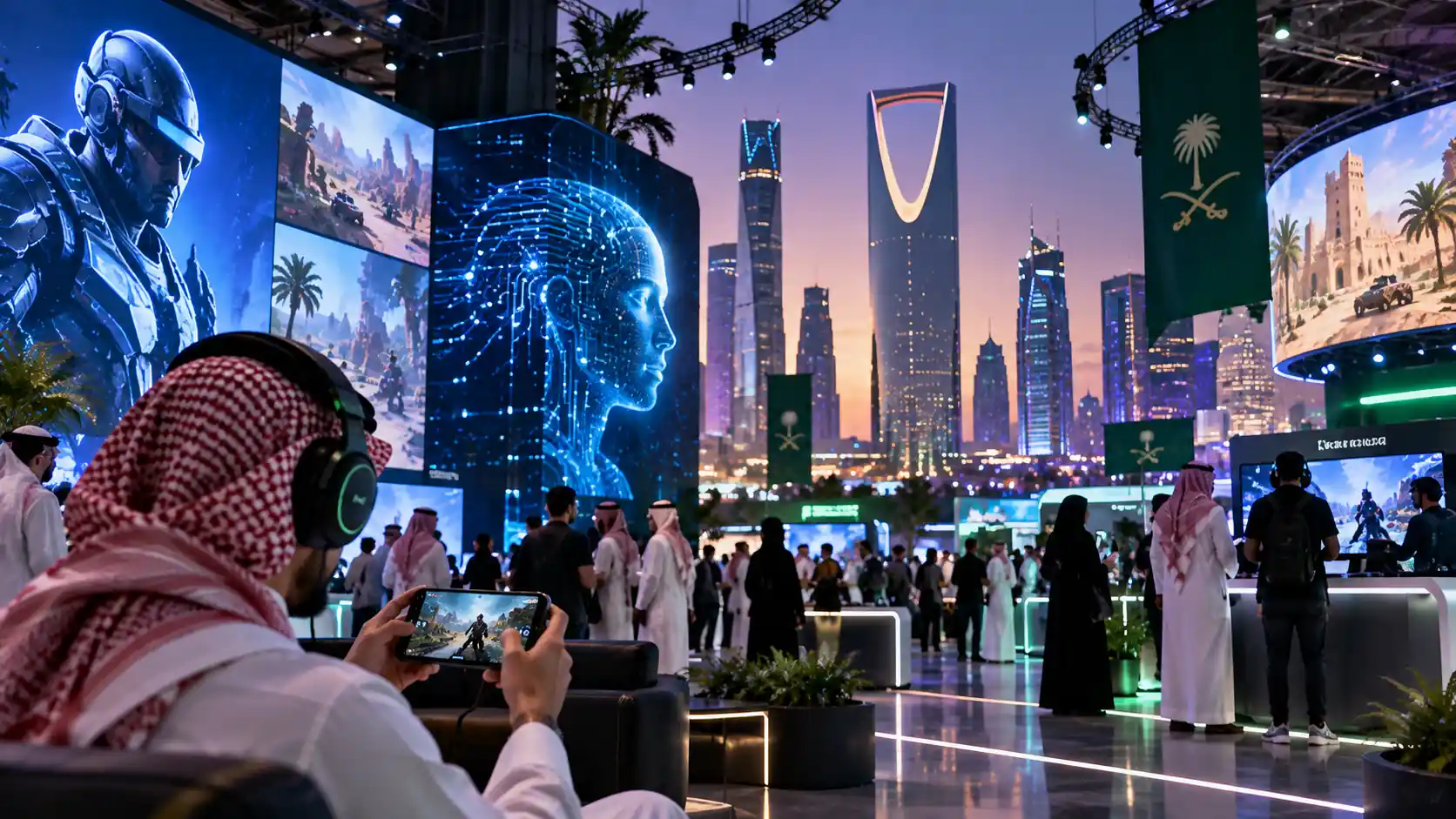
Global Games Show Riyadh 2026 concluded its two-day business program with artificial intelligence, mobile gaming, cloud infrastructure and immersive technology emerging as some of the strongest themes shaping the next phase of interactive entertainment. Held in Riyadh on June 29–30, the event brought game developers, publishers, esports executives, investors, technology companies and content creators together as Saudi Arabia continued building its position in the international games industry.
Organizers reported more than 15,000 registrations and 6,723 attendees, alongside more than 100 speakers and 100 exhibitors. Participants represented more than 80 countries, while organizers said approximately 70% of the delegation consisted of C-level executives. Those attendance figures are organizer-reported rather than independently audited, but they indicate the scale VAP Group sought for the Riyadh edition and its emphasis on business-to-business connections rather than a conventional consumer gaming expo.
More significant than the attendance numbers was what the discussions revealed about where investment and development attention is moving. Instead of focusing primarily on new console hardware or traditional release cycles, the event placed substantial emphasis on AI-assisted development, LiveOps, mobile-first games, cloud infrastructure, Web3, digital ownership and immersive experiences. That technology mix also aligned closely with Saudi Arabia’s wider effort to develop gaming and esports as an economic sector rather than treating them solely as entertainment.
Global Games Show Was Part of a Larger Riyadh Technology Gathering
Global Games Show took place alongside the Global AI Show and Global Blockchain Show, creating a combined technology program spanning artificial intelligence, decentralized technologies and gaming. VAP Group organized the events, while Global Games Show itself was powered by Times of Games. The co-location was particularly relevant because the boundaries between those sectors are becoming less distinct as AI tools enter game-development pipelines and blockchain companies continue experimenting with digital ownership and gaming economies.
The gaming event was structured around keynotes, panels, exhibitions and business networking rather than functioning primarily as a public showcase for major game releases. Speakers and participants came from game development, esports, Web3, publishing, investment, entertainment technology and other parts of the ecosystem. That B2B positioning gave the conference a different purpose from consumer events built around playable demos and blockbuster announcements.
Riyadh was also a strategically relevant location. Saudi Arabia has spent several years investing in gaming companies, esports competitions, domestic development capabilities and entertainment infrastructure, making the city increasingly active on the international gaming calendar. Global Games Show therefore arrived in a market where gaming is connected directly to national economic-diversification policy.
AI-Driven LiveOps Emerged as a Major Theme
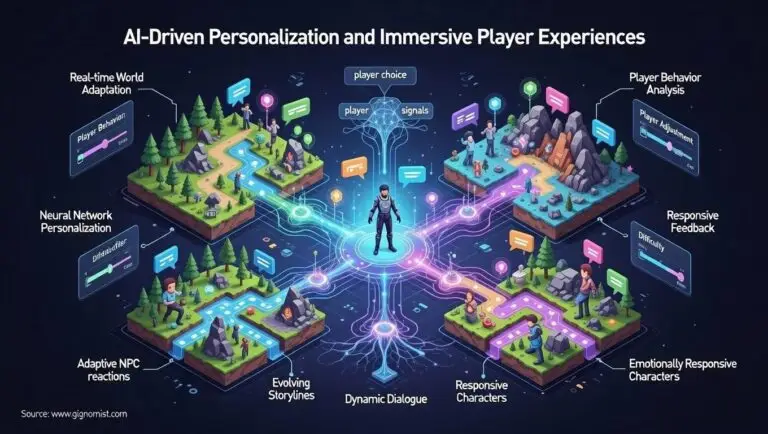
Artificial intelligence was one of the clearest technological themes to emerge from the conference. Discussions extended beyond generative AI producing artwork or dialogue and into the operational systems that developers use to manage games after launch. AI-driven LiveOps was highlighted as one area where machine learning could influence player segmentation, content scheduling, personalization and the management of continuously evolving games.
LiveOps has become increasingly important because many successful games are no longer treated as products that are effectively finished on release day. Developers update them for years through new events, characters, competitive seasons, virtual items and gameplay changes. Maintaining engagement across large player communities requires teams to analyze enormous quantities of behavioral data and decide which content should be introduced, modified or removed.
AI can potentially accelerate parts of that process by identifying patterns across player populations and helping teams test or personalize experiences. It could also assist developers with quality assurance, localization, asset creation and other production tasks. The commercial attraction is straightforward: if AI allows studios to create or operate content more efficiently, it could reduce development costs while supporting games designed to remain active for longer periods.
The technology also introduces risks that gaming companies cannot ignore. Automated personalization can become intrusive if it is optimized primarily around spending or engagement, generative tools raise intellectual-property and workforce questions, and AI-produced content still requires quality control. The most consequential shift is therefore unlikely to be replacing developers wholesale, but integrating AI into more stages of the development and operating pipeline.
Mobile Gaming Was Treated as a Core Platform, Not a Secondary Market
Mobile gaming was another prominent theme in Riyadh. Smartphones have long provided the gaming industry’s largest potential audience because players do not need dedicated consoles or high-end PCs to participate. Improvements in mobile processors, connectivity and game engines have also narrowed the technical gap between smartphone titles and experiences previously associated with more expensive hardware.
That accessibility has particular relevance across the Middle East and other regions with young, digitally connected populations. A successful mobile title can reach players who may never purchase a console, while free-to-play distribution allows developers to acquire enormous audiences before monetizing through advertising, subscriptions or in-game purchases.
Competitive mobile games have also challenged the assumption that serious esports requires PCs or consoles. Titles such as PUBG Mobile and Mobile Legends: Bang Bang have demonstrated that smartphone games can sustain large competitive communities and professional tournaments. For markets trying to expand esports participation quickly, mobile therefore offers a potentially lower barrier to entry.
The commercial challenge is that mobile gaming is also extraordinarily competitive. App stores contain huge numbers of games competing for attention, while customer-acquisition costs can make it difficult for smaller studios to reach profitable scale. AI-powered LiveOps, personalization and community management become especially relevant in that environment because retaining existing players can be as important as acquiring new ones.
Cloud Gaming Remains Attractive but Technically Demanding
Cloud gaming also featured in the event’s broader technology discussion. The concept moves much of the computing workload away from a player’s local device and into remote data centers, allowing games to be streamed in a way conceptually similar to video services. In theory, that can give users access to sophisticated games without requiring them to purchase expensive hardware.
In practice, gaming places much stricter demands on networks than ordinary video streaming. A movie can buffer several seconds of content without affecting the experience, while a game must respond almost immediately when a player presses a button or moves a controller. Latency, network congestion and data-center location therefore become critical variables.
Saudi Arabia’s broader investment in digital infrastructure makes the technology strategically interesting even if cloud gaming has not replaced conventional hardware. Local and regional computing capacity can reduce the physical distance between players and servers, while improved connectivity can make streamed games more practical across a wider range of devices.
Cloud gaming may consequently develop less as an immediate replacement for consoles and more as another distribution model. Players could move between local hardware, mobile devices and streamed sessions depending on the game and their circumstances, while publishers gain another channel through which to reach users.
AR and VR Remain Part of Gaming’s Immersive Technology Push
Augmented and virtual reality demonstrations formed another part of the Global Games Show program. These technologies have spent years moving through cycles of intense optimism and slower adoption, but they remain relevant to gaming because interactive entertainment provides one of the clearest reasons for consumers to experiment with immersive hardware.
Virtual reality can place players inside fully digital environments, while augmented reality layers digital objects over the physical world. Both approaches create opportunities for games that depend on movement, spatial interaction and presence rather than conventional screens and controllers. Advances in displays, sensors and computing continue to improve those experiences, although hardware cost and comfort remain obstacles to mass adoption.
The larger lesson from Riyadh was not that AR or VR is about to replace conventional gaming. Instead, immersive technology is becoming one part of a much broader collection of interfaces through which interactive entertainment can be delivered. Console, PC, mobile, cloud and headset-based gaming can coexist because they address different use cases and audiences.
For developers, that fragmentation creates both opportunity and complexity. Studios can reach players through more devices than ever, but designing, optimizing and monetizing experiences across those platforms requires additional technical and commercial expertise.
Web3 Gaming Is Still Searching for a Sustainable Model
Blockchain and digital ownership were also represented at Global Games Show, helped by the event’s co-location with the Global Blockchain Show. Web3 gaming has repeatedly promised that players could own or trade digital items independently of individual game publishers, potentially creating economies where virtual assets move between users or applications.
The concept attracted enormous investment during earlier cryptocurrency cycles, but many blockchain games struggled to create compelling gameplay before focusing on tokens and financial incentives. That history has made the sector more cautious about “play-to-earn” models in which economic speculation becomes the central reason for participating.
A more sustainable approach would require blockchain features to solve an actual player or developer problem. Digital ownership, interoperable assets or community economies may have applications, but adding tokens to an otherwise conventional game does not automatically improve the experience. Developers also have to contend with wallet usability, transaction costs, regulation and the volatility of cryptocurrency markets.
The overlap between the Global Games Show and Global Blockchain Show made those questions particularly visible. Web3 gaming remains part of the technology conversation, but its future depends less on attaching blockchain terminology to games and more on proving that decentralized infrastructure creates something players genuinely value.
Riyadh’s Gaming Push Is Much Bigger Than One Conference
Global Games Show matters most when viewed against Saudi Arabia’s broader gaming strategy. The Kingdom launched its National Gaming and Esports Strategy in 2022 with the stated goal of becoming a global hub for games and esports by 2030. Official targets include establishing 250 gaming companies, creating 39,000 jobs and increasing the sector’s contribution to GDP to SAR 50 billion.
Those goals form part of Vision 2030, Saudi Arabia’s wider attempt to diversify its economy beyond hydrocarbons and develop sectors including tourism, entertainment, technology and digital services. Gaming is particularly attractive because Saudi Arabia has a young population, high levels of digital engagement and an existing domestic audience for games and esports.
The strategy goes beyond hosting international competitions. Saudi policymakers want local development companies, skilled workers, intellectual property, publishing capabilities and technology businesses to form a sustainable industry. Conferences can support that ambition by connecting domestic companies and talent with international investors and operators, but the harder measure of success will be how much development and ownership ultimately takes root inside the country.
That distinction is important. Hosting major gaming events can generate international attention relatively quickly; creating globally competitive studios and original intellectual property takes years of investment, talent development and repeated commercial experimentation.
Savvy Games Group Is Central to Saudi Arabia’s Gaming Strategy
Saudi Arabia’s Public Investment Fund-backed Savvy Games Group has become one of the most visible vehicles for that strategy. Savvy says its mission is to drive long-term growth and innovation across games and esports while helping establish Saudi Arabia as a global industry hub. Its portfolio includes Scopely, the publisher behind Monopoly GO! and other mobile titles, alongside ESL FACEIT Group and Riyadh-based developer Steer Studios.
The strategy combines global acquisitions with domestic ecosystem development. Buying established international companies gives Saudi-backed entities immediate exposure to intellectual property, experienced management teams and global audiences, while local initiatives are intended to build development skills and create opportunities inside the Kingdom.
Saudi Arabia’s Public Investment Fund describes this as an effort to connect game developers, marketers, distributors, hardware companies and intellectual-property owners within a broader industry ecosystem. Savvy’s activities therefore provide useful context for understanding why Riyadh is attracting more gaming conferences and competitions: the events complement a much larger capital and industrial strategy.
The challenge is translating international investment into domestic capability. Ownership of successful foreign gaming businesses can generate financial returns and strategic influence, but Saudi Arabia’s longer-term objective requires creating studios, talent and intellectual property that are rooted locally rather than relying primarily on acquisitions.
Saudi Arabia Is Also Investing in Gaming Talent
Developing local skills has become an increasingly visible part of the strategy. Savvy operates Steer Studios in Riyadh and has launched or supported partnerships intended to expose Saudi students and developers to game development, esports and emerging technologies. In 2026, the group also announced partnerships involving AI tools for the Saudi gaming ecosystem and programs intended to develop local talent.
That matters because game development is a knowledge-intensive industry. Building a globally successful title requires programmers, artists, designers, producers, writers, data specialists and business teams capable of operating together for years. Capital can purchase companies and infrastructure, but creating an experienced development workforce takes much longer.
Saudi Arabia therefore faces a different challenge from simply building esports venues. If the National Gaming and Esports Strategy is to produce sustainable economic diversification, the country needs domestic professionals capable of developing and commercializing games rather than only consuming or hosting them.
Events such as Global Games Show can contribute by connecting local developers with international expertise and potential investors. Their long-term value, however, depends on whether those connections translate into companies, products and employment after the conference ends.
VAP Ventures Added a Startup Dimension
Global Games Show also coincided with VAP Group’s announcement of VAP Ventures, an initiative that organizers say aims to support 100 startups by 2030 across AI, Web3 and gaming. The initiative reflects another theme running through the three co-located Riyadh events: technology convergence is creating opportunities for companies that do not fit neatly inside one sector.
For gaming startups, access to investors and distribution partners can be as important as development technology. Games are expensive to market, and even technically strong projects can fail if developers cannot acquire players or secure publishing relationships. Structured investor access can therefore be valuable, particularly for studios emerging from markets without established publishing ecosystems.
The important measure will be execution. A target to support 100 startups is an ambition rather than evidence that 100 sustainable businesses will result. Funding deployed, companies supported, follow-on capital raised and commercially successful products would provide more useful indicators of the program’s impact over time.
That distinction applies to the wider Saudi gaming strategy as well. Announcements and events can demonstrate intent, but sustainable industry development ultimately has to be measured through companies, employment, intellectual property and commercial output.
Riyadh Is Becoming a More Important Stop on the Gaming Calendar
Saudi Arabia has already used major esports competitions and gaming events to attract international players, teams, publishers and audiences. Global Games Show adds another format to that strategy by focusing more directly on executives, developers, investors and technology providers rather than competitive esports alone.
That matters because a functioning gaming hub needs several layers. Esports competitions create audiences and visibility, but developers create intellectual property, publishers finance and distribute products, technology providers supply infrastructure, and investors fund companies capable of taking commercial risks. Bringing those groups into the same market can create connections that individual tournaments cannot.
Riyadh’s growing calendar therefore serves both an entertainment and an industrial purpose. International events market Saudi Arabia as a gaming destination while simultaneously giving local companies and policymakers access to executives who might otherwise have little reason to spend time in the market.
Whether Riyadh becomes a durable global gaming center will depend on what happens between those events. International companies need reasons to establish permanent operations, local studios need pathways to scale, and Saudi-developed games need to compete for audiences outside the domestic market.
Global Games Show Reflected a Gaming Industry in Transition
The technology themes highlighted in Riyadh also reveal how the global gaming business itself is changing. AI is entering production and LiveOps, mobile has become a major competitive platform, cloud infrastructure is creating new distribution options, and immersive technologies continue expanding the ways players can interact with digital worlds.
These shifts do not imply that traditional games are disappearing. Consoles and PCs remain important platforms, conventional game development remains central to the industry, and blockbuster intellectual property continues to attract enormous audiences. What is changing is the number of technologies surrounding the core experience.
A modern game can incorporate cloud services, AI-generated assistance, real-time analytics, mobile companion experiences, esports competition and continuously updated content. The business surrounding a game can therefore resemble a technology platform as much as a packaged entertainment product.
That helps explain why gaming increasingly overlaps with AI, cloud computing and digital infrastructure conferences. The industry is no longer defined only by the software players install; it includes the systems required to operate persistent global communities around that software.
What Global Games Show 2026 Ultimately Said About Saudi Gaming
The original story around Global Games Show Riyadh was that another international gaming event was coming to Saudi Arabia. Now that the event has concluded, that is no longer enough to justify the page. The more useful story is what the conference revealed about both the technology direction of gaming and Saudi Arabia’s attempt to capture a larger share of the industry.
AI-assisted development, LiveOps, mobile gaming and cloud infrastructure suggest that some of gaming’s most important changes are occurring behind the screen rather than through another generation of hardware. Studios increasingly compete on their ability to operate games continuously, understand player behavior and distribute experiences across multiple devices.
For Saudi Arabia, those trends create an opening because an industry undergoing technological change can be easier to enter than one dominated entirely by established production models. Significant capital, infrastructure and a large domestic gaming audience give the Kingdom advantages, but building internationally competitive creative businesses remains a much harder objective than hosting events or acquiring overseas companies.
Global Games Show Riyadh 2026 therefore fits into a larger experiment. Saudi Arabia is trying to use investment, esports, technology partnerships, talent programs and international events to turn gaming from a popular form of entertainment into an economic sector. The conference demonstrated the scale of that ambition; the years leading to 2030 will show whether it can translate into a sustainable local games industry.