

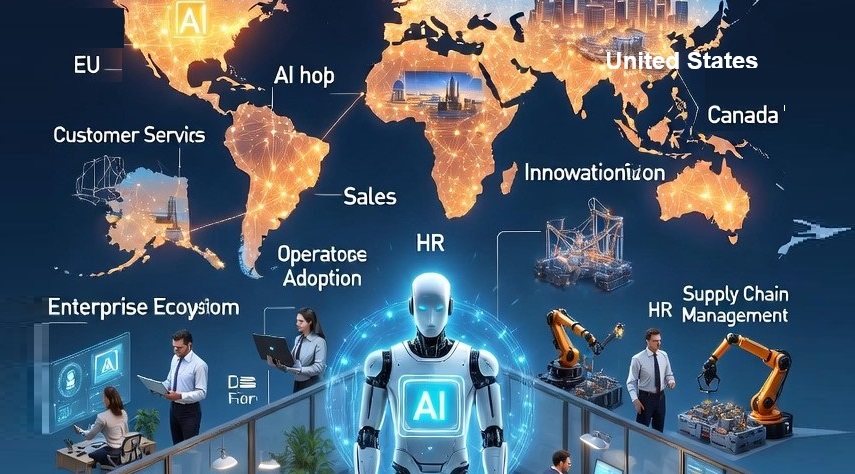
As we approach 2026, the landscape of business operations is on the cusp of a profound transformation driven by AI agents. These intelligent systems are not mere tools but active participants in decision-making and execution, promising to redefine efficiency in an era where speed and adaptability are paramount. During CES 2026 in Las Vegas this month, NVIDIA CEO Jensen Huang boldly declared, “The ChatGPT moment for physical AI is here—when machines begin to understand, reason, and act in the real world”—heralding the arrival of agentic AI and physical AI systems that are set to supercharge business automation and efficiency like never before.
According to industry forecasts, the AI agents market is projected to surge from approximately $7.84 billion in 2025 to over $52 billion by 2030, with a compound annual growth rate of 46.3%. This explosive growth underscores why AI agents matter now: they address the limitations of current automation by handling complex, multi-step processes autonomously, reducing human oversight while amplifying productivity.
In regions like the United States, where enterprise adoption is accelerating through initiatives from tech giants, and the European Union, with its stringent regulatory frameworks, businesses are already piloting these technologies to stay competitive. For instance, early adopters in Canada and Australia are leveraging AI agents to optimize supply chains amid global disruptions, highlighting their role in fostering resilience. As 2026 unfolds, AI agents will evolve from experimental pilots to core operational drivers, enabling enterprises to navigate economic uncertainties and unlock new revenue streams. This shift is particularly relevant for forward-thinking leaders in the US, EU, China, Canada, and Australia, where innovation ecosystems—such as Silicon Valley’s venture funding and the EU’s AI Act compliance mandates—are paving the way for widespread integration.
What Are AI Agents?
AI agents represent the next evolution in artificial intelligence, designed to operate independently and achieve specific goals with minimal human intervention. At their core, these systems are software entities powered by advanced machine learning models that perceive their environment, reason through problems, and take actions to accomplish tasks. For beginners, think of AI agents as digital assistants on steroids—they don’t just respond to commands like a simple chatbot; they plan sequences of steps, learn from outcomes, and adapt in real-time. This makes them ideal for AI automation in business, where they can handle everything from data analysis to workflow orchestration.
In 2026, AI agents are expected to become ubiquitous in enterprise settings across the US, China, EU, Canada, and Australia, supported by robust innovation ecosystems like the US’s federal AI guidelines and Canada’s AI strategy investments. Agentic AI explained simply: these agents use a combination of sensors (data inputs), actuators (tools for action), and a reasoning engine (often based on large language models) to function autonomously. For example, an AI agent in a retail supply chain might monitor inventory levels, predict shortages based on market trends, and automatically reorder stock from suppliers, all without human prompts. This beginner-friendly framework positions AI agents as accessible and powerful by emphasizing practical, scalable applications in modern enterprises.
Distinguishing AI Agents from Traditional Automation and Generative AI Tools
AI agents stand apart from traditional automation and generative AI tools by their proactive, adaptive nature, which allows them to manage dynamic environments rather than follow rigid scripts or react solely to inputs. Traditional automation, such as robotic process automation (RPA), excels at repetitive, rule-based tasks like data entry in spreadsheets but falters in unpredictable scenarios—it requires predefined paths and human reconfiguration for changes. In contrast, autonomous AI agents employ reasoning capabilities to break down complex goals into actionable steps, iterate based on feedback, and integrate with external tools, making them far more versatile for AI automation in business. For instance, while RPA might automate invoice processing in a fixed format, an AI agent could analyze variable supplier data, flag anomalies, and negotiate terms via integrated APIs, adapting to market fluctuations in real-time.
When compared to generative AI tools, the differences are even starker: generative AI, like models that create text or images from prompts, is reactive and content-focused, producing outputs such as reports or code snippets but stopping short of execution. Agentic AI explained through this lens reveals its agency— it not only generates plans but executes them, learning from results to improve future performance. This distinction is crucial in regulatory contexts across the world, and enterprises must navigate frameworks that classifies high-risk AI systems requiring oversight, ensuring AI agents align with ethical standards while outperforming passive tools.
Business Use Cases: AI Agents Across Industries
AI agents are poised to infiltrate diverse industries by 2026, automating intricate workflows and enhancing decision-making in operations, customer service, sales, finance, HR, software development, supply chains, and the gig economy. In operations, for example, manufacturing firms in the US and Australia are deploying AI agents to monitor equipment health, predict maintenance needs, and optimize production lines, reducing downtime by up to 30% as seen in early pilots. Customer service sees transformative applications, where agents handle end-to-end resolutions—from diagnosing issues to issuing refunds—cutting response times and boosting satisfaction in Canadian banks adhering to privacy regulations.
Sales teams in the European countries benefit from AI agents that qualify leads, personalize outreach, and manage CRM updates autonomously, as evidenced by tools integrating with systems like Salesforce to close deals faster. In finance, agents automate reconciliation, fraud detection, and compliance checks, with Australian enterprises leveraging them for real-time auditing amid strict financial oversight. HR departments use AI agents for talent screening, onboarding, and skill gap analysis, streamlining processes in the US where labor markets demand efficiency.
Software development accelerates with agents writing, testing, and deploying code, supporting agile teams in Canada. Supply chains gain resilience through predictive agents that reroute shipments during disruptions, a boon for EU firms under sustainability mandates. Even in the gig economy, platforms employ agents to match freelancers with jobs, optimize payouts, and handle disputes, fostering growth in flexible work models across these regions. These use cases illustrate how AI agents drive holistic improvements, linking to broader discussions on AI-driven global payment solutions.
Key Benefits and Efficiency Gains for Modern Enterprises
The adoption of AI agents in 2026 promises substantial benefits for enterprises, particularly in efficiency gains that translate to cost savings, agility, and competitive edges in the developed countries. One primary advantage is workflow acceleration: agents eliminate bottlenecks by executing parallel tasks, reducing cycle times by 30-50% in areas like procurement and customer operations. This is evident in US-based insurers where agents process claims end-to-end, slashing handling times by 40% and improving net promoter scores.
Cost reductions follow suit, with automation of repetitive tasks cutting labor expenses by up to 40%, allowing reallocations to innovation—as seen in Australian supply chains where agents predict shortages and automate reorders. Enhanced decision-making stems from real-time data analysis, enabling proactive strategies; for instance, EU enterprises under GDPR use agents for compliant risk assessments, minimizing errors and fines. In Canada, agents foster scalability without proportional headcount growth, supporting small-to-medium businesses in gig economy platforms.
Overall, these gains build enterprise resilience, with McKinsey noting agents supercharge agility by transforming processes beyond mere efficiency. Linking to related insights, this aligns with trends in Microsoft’s AI growth, where cloud-integrated agents amplify revenue.
Navigating Risks, Challenges, and Ethical Considerations
While AI agents offer immense potential, they introduce risks, challenges, and ethical dilemmas that enterprises must address, especially under evolving regulations. Bias remains a core issue: agents trained on skewed data can perpetuate inequalities, such as in HR screening where underrepresented groups are overlooked, demanding diverse datasets and audits to mitigate.
Security vulnerabilities amplify with agents’ access to sensitive systems, risking data breaches or manipulation—Canadian firms face heightened scrutiny under privacy laws like PIPEDA. Governance challenges arise from autonomous decision-making, raising questions of accountability; for example, who is liable if an agent errs in financial advice, as seen in US airline chatbot lawsuits? Job impacts are profound, with automation potentially displacing roles, necessitating upskilling programs in Australia to align with ethical workforce transitions.
Ethical considerations extend to transparency and consent, where agents’ “black box” nature obscures decisions, conflicting with EU AI Act requirements for explainability in high-risk systems. Regulations vary: the EU’s AI Act, effective from 2026, categorizes agents by risk levels with strict oversight, while the US relies on guidelines like the AI Bill of Rights, Canada on its Directive on Automated Decision-Making, and Australia on voluntary ethics frameworks. Addressing these requires robust ethical AI practices, linking to discussions on AI image abuse probes.
Future Predictions and Trends for AI Agents Beyond 2026
Looking ahead, AI agents in 2026 and beyond will evolve into “super agents” orchestrating multi-agent systems, fundamentally reshaping business ecosystems with logical progressions from current trends. Predictions indicate a shift to agentic workflows over isolated tools, with IBM experts forecasting cross-functional “super agents” managing dashboards and control planes by 2026. This will enable seamless integration across enterprises in the US and Canada, where energy constraints may cap growth, prompting sustainable innovations like efficient data centers. In the EU and Australia, regulatory alignment will drive governance-first designs, ensuring agents adhere to ethical standards while scaling.
Logically, as agents transition from assistive to decision engines, low-code platforms will democratize deployment, allowing non-experts to build custom solutions—Forrester predicts 40% of enterprise apps will embed task-specific agents by 2026. Beyond 2026, multi-agent collaboration will dominate, with systems negotiating tasks autonomously, boosting sectors like healthcare in Canada through predictive diagnostics. However, power demands could create a “gigawatt ceiling,” limiting unchecked expansion and fostering hybrid human-AI models. This trajectory, supported by market growth to $52.62 billion by 2030, underscores a future where agents augment human potential, as explored in WEF26 AI upskilling calls.
FAQs
How will AI agents transform business automation in 2026?
AI agents in 2026 will revolutionize business automation by autonomously handling multi-step processes, adapting to changes, and integrating with tools, leading to 30-50% efficiency gains in operations across the US, EU, Canada, and Australia, as per BCG analyses.
What is agentic AI explain in simple terms for enterprises?
Agentic AI explained: It’s an advanced form of AI where autonomous agents plan, execute, and learn from tasks independently, differing from reactive generative AI tools by proactively achieving goals in business contexts like supply chain management.
What are the key risks of using autonomous AI agents in business?
Key risks include data bias leading to unfair outcomes, cybersecurity vulnerabilities from system access, and ethical issues like job displacement, mitigated through regulations such as the EU AI Act and governance frameworks in the US and Canada.
How do AI agents differ from generative AI tools in practical applications?
AI agents differ by being proactive executors that complete workflows, while generative AI tools focus on creating content from prompts; for example, agents automate sales CRM, whereas generative tools draft emails.
What future trends should businesses watch for AI agents beyond 2026?
Beyond 2026, trends include multi-agent systems collaborating like teams, low-code deployment for accessibility, and energy-efficient designs addressing power constraints, driving scalable innovation in global enterprises.
For more news, reports and insights on emerging technologies, including AI, robotics, cybersecurity, blockchain, gaming and the evolving gig economy, visit the home page of The Gignomist.