
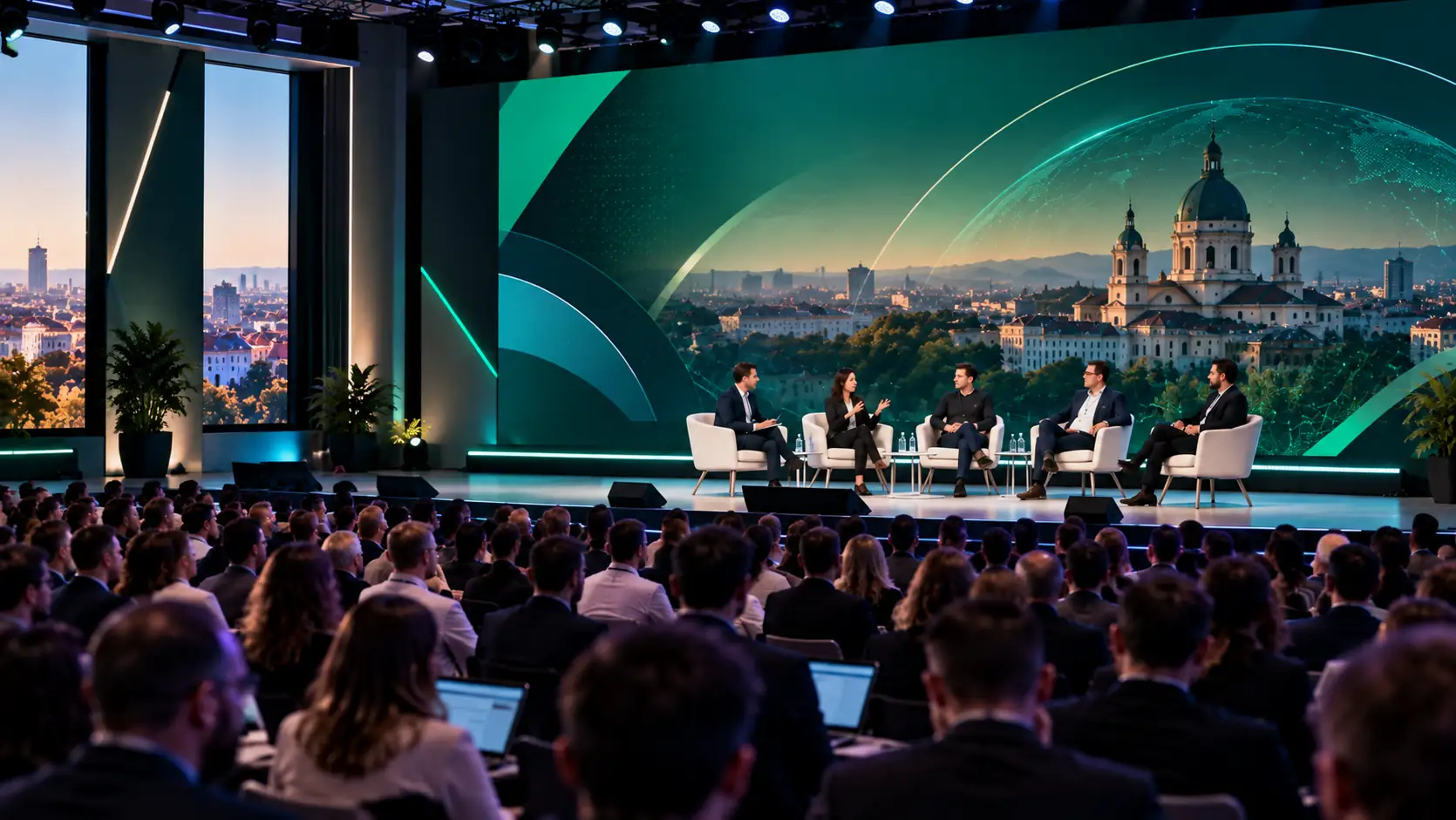
GoTech World 2025 brought 15,121 visitors, more than 100 exhibiting companies and 135 speakers to Bucharest as artificial intelligence moved from conference talking point toward practical business automation. Held on November 11–12 at Romexpo’s B1 Pavilion, the 14th edition spread more than 120 sessions across 11 stages covering AI, robotics, cybersecurity, cloud infrastructure, software development, digital marketing, sustainability and other areas of enterprise technology.
The event’s strongest theme was the convergence of AI and robotics — software capable of making increasingly sophisticated decisions combined with machines capable of translating those decisions into physical actions. Companies including Orange Business, Google, Genpact and certSIGN participated alongside technology providers serving areas from cloud and cybersecurity to smart buildings, while speakers examined how organizations can move from experimenting with emerging technology to integrating it into operational systems.
That makes the completed event more interesting than the original preview promising 100 companies and 135 speakers. Romania has strong connectivity and a substantial pool of ICT graduates, but European Commission assessments continue to identify weak technology adoption among businesses and persistent digital-skills problems. GoTech World 2025 therefore took place against a larger economic question: can Romania turn its technical infrastructure and talent base into broader digital adoption across its companies?
GoTech World 2025 Exceeded 15,000 Visitors
GoTech World took place at Romexpo on November 11 and 12, 2025, with the organizers reporting 15,121 visitors, more than 100 exhibiting companies, 135 local and international speakers and 11 thematic stages. Those are organizer-reported figures rather than independently audited attendance numbers, but they confirm that the final event broadly delivered the scale promoted before it opened.
The official GoTech World 2025 event information positioned the conference as a meeting point for business decision-makers looking for deployable technology rather than purely experimental concepts. Its agenda covered artificial intelligence, cybersecurity, software development, digital marketing, smart cities and other areas of enterprise transformation, while the exhibition floor allowed vendors to demonstrate products directly to potential customers.
The event also hosted the second edition of The Smart Home Summit, extending the discussion from enterprise software into connected buildings, automation and energy management. That breadth illustrates how digital transformation increasingly crosses conventional technology categories: cloud services connect with cybersecurity, AI connects with automation, and connected devices increasingly depend on both software and data infrastructure.
The result was less a showcase of one emerging technology than a snapshot of how multiple technology layers are converging inside modern businesses.
AI and Robotics Defined the 2025 Edition
Artificial intelligence dominated technology conferences throughout 2025, but GoTech World attempted to move the conversation toward what happens when AI becomes connected with physical systems. The organizers described the combination of AI and robotics as a defining concept for the 14th edition, emphasizing the progression from systems that analyze or generate information toward machines that can translate digital decisions into actions.
That distinction is important for businesses. Generative AI initially spread through text, image and software-development applications because those products could be distributed entirely through software. Robotics introduces additional constraints: hardware costs, physical safety, sensors, maintenance, reliability and integration with real-world environments.
An AI system that produces an incorrect paragraph creates a different type of problem from an autonomous machine making an incorrect physical movement. Industrial automation therefore requires companies to evaluate not only model accuracy but also engineering reliability, operational safety and how humans remain involved when automated systems encounter unexpected conditions.
For manufacturers, logistics companies, retailers and infrastructure operators, however, the potential gains are significant. Combining AI with robotics can potentially automate more variable tasks than conventional industrial machines designed around rigid, repetitive sequences.
The Robot Cellist Made That Convergence Visible
One of the event’s most distinctive demonstrations was Fredrik Gran’s robot cellist, which performed a composition created specifically for GoTech World. The performance turned the broader AI-and-robotics theme into something attendees could observe directly rather than another abstract discussion about automation.
A robotic musical performance is not itself evidence that general-purpose robots are ready to transform factories or offices. Playing an instrument under controlled conditions is very different from reliably performing unpredictable industrial or service tasks. Its value at the event was instead conceptual: it demonstrated the combination of software, mechanical engineering and precise physical control required for machines to interact with the physical world.
That is increasingly where the robotics industry is heading. Advances in AI perception and reasoning can potentially make machines more adaptable, while improved sensors and control systems allow them to operate in environments that are less structured than traditional production lines.
The commercial challenge is converting those demonstrations into systems whose productivity improvements justify their acquisition, integration and maintenance costs. Businesses ultimately invest in automation for measurable operational outcomes rather than spectacle.
Cybersecurity Grew More Important as Automation Expanded
Greater automation also enlarges the potential consequences of cybersecurity failures. When software merely stores information, a compromise can expose data. When connected software also controls operational processes, devices or machines, cyber incidents can potentially affect physical operations as well.
Cybersecurity therefore occupied a dedicated stage at GoTech World. Rapid7 Chief Scientist Raj Samani was among the speakers addressing how cybercriminal organizations have become more capable and which techniques they use to compromise businesses.
The issue extends beyond defending conventional corporate networks. Modern organizations increasingly depend on cloud infrastructure, software-as-a-service platforms, connected devices, APIs and AI applications, creating more points through which attackers can attempt to gain access. AI can simultaneously help defenders analyze threats while helping attackers automate reconnaissance, phishing and other malicious activity.
For companies moving toward AI-enabled automation, security has to be considered during deployment rather than added after systems are operating. The more authority an automated system receives, the more important identity controls, network segmentation, monitoring and incident response become.
Cloud Infrastructure Remained the Foundation
Even the most visible AI applications depend on less visible infrastructure. Models need computing capacity, applications need databases and networks, and enterprise systems need architectures capable of remaining available when demand suddenly increases.
Google Cloud Strategic Cloud Engineer Sergey Shcherbakov used the developer stage to discuss architecture capable of scaling beyond 100,000 requests per second, including technologies such as Google Kubernetes Engine, Cloud Service Mesh, AlloyDB and Memorystore. The session illustrated a practical reality often lost in AI discussions: a sophisticated model is only one component of a production system.
Companies deploying AI at scale still need conventional engineering disciplines. They need resilient cloud architectures, observability, access management, databases, cost controls and plans for handling sudden increases in traffic. An impressive AI demonstration can fail commercially if the infrastructure supporting it becomes too expensive or unreliable at production scale.
That is particularly relevant as companies move from experimental AI pilots toward customer-facing and operational deployments. The infrastructure requirements grow as usage expands, making cloud architecture and cost management central parts of the AI business case.
Romania Has Strong Connectivity but a Business Adoption Gap
GoTech World also needs to be understood in the context of Romania’s digital economy. The country’s challenge is not simply acquiring faster networks or hosting more technology conferences. It is converting technical capability into widespread business adoption.
The European Commission’s 2026 Digital Decade assessment of Romania describes the country as a leader in fixed connectivity, including in rural and sparsely populated areas, and says Romania has taken steps to strengthen its position in areas including semiconductors and artificial intelligence.
At the same time, the Commission identifies limited technology uptake among Romanian businesses as a continuing weakness. It recommends using European Digital Innovation Hubs to increase companies’ digital maturity, supporting startups and promoting domestically developed digital solutions.
That gap gives an event such as GoTech World greater economic relevance. If Romania already possesses strong connectivity, the next challenge is ensuring businesses use that infrastructure to modernize operations rather than treating digitalization primarily as an IT expenditure.
SMEs Remain Central to the Digitalization Challenge
Large companies generally have greater resources to experiment with cloud infrastructure, cybersecurity platforms and AI. Small and medium-sized enterprises face a more difficult calculation because technology projects compete with other immediate business needs for limited capital and management attention.
That matters in Romania because previous European Commission assessments have repeatedly identified SME digitalization as a weak point. Businesses can have access to fast connectivity while still relying on manual processes, outdated software or fragmented systems that make advanced AI adoption difficult.
AI does not automatically solve that problem. A company with poorly organized data and disconnected internal systems cannot simply add a generative AI product and expect comprehensive transformation. Modernization often requires less glamorous work first: migrating systems, improving data quality, strengthening cybersecurity and redesigning processes.
Technology exhibitions can help by allowing smaller companies to compare products and meet providers without conducting a global vendor search. Their real economic value, however, depends on whether those conversations result in actual deployments.
Romania Has ICT Talent but Struggles to Retain It
Another contradiction in Romania’s digital economy is its talent base. The European Commission says the country has a relatively high number of ICT graduates but continues to experience problems retaining technology talent domestically.
That creates an important distinction between producing skilled workers and building an ecosystem capable of keeping them. Engineers and other technology professionals can work remotely for international companies or relocate to larger European technology markets, meaning domestic education does not automatically translate into domestic innovation.
A stronger Romanian enterprise-technology market could help address part of that problem by creating more sophisticated local work. If companies adopt cloud computing, AI, cybersecurity and automation more aggressively, they create demand for engineers and specialists capable of implementing and operating those systems.
The relationship can become self-reinforcing. Greater technology adoption creates more high-value technical work, while a deeper talent pool makes Romania more attractive to companies considering technology investment.
But that cycle requires businesses to move beyond experimentation and invest in long-term technical capabilities.
Cybersecurity Is Part of Romania’s Competitiveness Problem
Digitalization without adequate cybersecurity can increase rather than reduce operational risk. Moving business processes online expands efficiency, but it also creates new dependencies on networks, software providers and digital identities.
For Romanian companies adopting cloud and AI, cybersecurity therefore cannot be separated from competitiveness. A successful cyberattack can interrupt operations, expose customer data and create regulatory or reputational costs that erase the gains from digital transformation.
This becomes especially important for SMEs, which may lack dedicated security teams. Smaller companies increasingly use the same cloud applications and connected services as larger organizations but often have fewer resources for monitoring and incident response.
Managed security services and cloud-based security tools can reduce that gap, which helps explain why cybersecurity vendors occupied a significant place at GoTech World. As digital adoption increases, the market for protecting those systems grows with it.
Europe’s AI Rules Added Another Layer to Enterprise Adoption
European businesses were also preparing for a more regulated AI environment when GoTech World took place. The EU AI Act had entered into force in 2024, with obligations being introduced in stages, requiring companies to understand how their AI applications fit within the regulation’s risk-based structure.
For enterprises, compliance is not only a legal department problem. Companies need to know what models they use, what data feeds those systems, how outputs affect customers or employees and whether particular applications fall into higher-risk categories.
That can influence purchasing decisions. Businesses may increasingly prefer technology providers capable of explaining their data handling, security controls and compliance processes rather than selecting products purely on model performance.
The European regulatory environment therefore creates both friction and opportunity. Compliance can increase implementation costs, but companies that build trustworthy and auditable systems may gain an advantage with customers operating in regulated industries.
For Romanian technology providers, understanding that environment is especially important because the EU single market allows successful products to reach customers far beyond Romania.
GoTech World Was Ultimately About Applied Technology
The common thread across AI, robotics, cloud and cybersecurity at GoTech World 2025 was implementation. The technologies themselves were not new discoveries introduced at the conference; most were already available commercially.
The harder question was how businesses could use them productively. AI needs appropriate data and workflows. Robotics needs reliable hardware and safety systems. Cloud infrastructure needs disciplined engineering and cost management. Cybersecurity needs continuous monitoring rather than a one-time product purchase.
That shift from novelty toward implementation is a sign of a maturing technology cycle. Once businesses stop asking whether AI exists and start asking whether it improves a process enough to justify its cost, the market moves from experimentation toward economic measurement.
Some technologies will fail that test. Others will become ordinary parts of enterprise infrastructure and eventually stop being described as emerging technologies at all.
The 15,121 Visitors Matter Less Than What Companies Do Next
GoTech World’s final attendance numbers provide a useful measure of the event’s scale, but visitor counts do not establish economic impact. Conferences ultimately matter when conversations lead to technology purchases, partnerships, investment, skills development or new companies.
That distinction is particularly relevant in Romania. The country already has strong fixed connectivity and produces substantial numbers of ICT graduates. Its persistent weakness is converting those advantages into broader technology adoption and stronger domestic innovation.
GoTech World brings vendors and decision-makers into the same environment, potentially reducing some of the information and networking barriers that slow adoption. But a two-day exhibition cannot resolve structural issues around digital skills, investment capacity, startup development or talent retention.
The useful measure of success is therefore what happens after Romexpo empties: whether Romanian businesses implement the technologies they saw demonstrated and whether those investments improve productivity, resilience and competitiveness.
GoTech World 2026 Will Provide the Next Test
GoTech World is scheduled to return to Romexpo on November 10–11, 2026, giving the organizers another opportunity to show how quickly enterprise technology priorities are changing. The difference between the two editions could be particularly revealing because AI products have continued moving rapidly toward agents, automation and deeper integration with business software.
The questions for attendees are also becoming harder. Businesses no longer need another explanation of what generative AI is. They need evidence about which deployments produce measurable returns, how AI systems can be governed, what security controls are necessary and which tasks should remain under human control.
That makes the legacy of the 2025 edition more useful than its original preview suggested. Its 100-plus exhibitors and 135 speakers were not important simply because they assembled in Bucharest. The event captured a point at which enterprise AI was beginning to converge with robotics, cloud infrastructure and cybersecurity while Romania itself was confronting a persistent gap between strong digital infrastructure and weaker business adoption.
For Romania, closing that gap will matter far more than conference attendance. The country’s next stage of digital development depends on turning connectivity and technical talent into companies that use advanced technology productively, securely and at scale.