

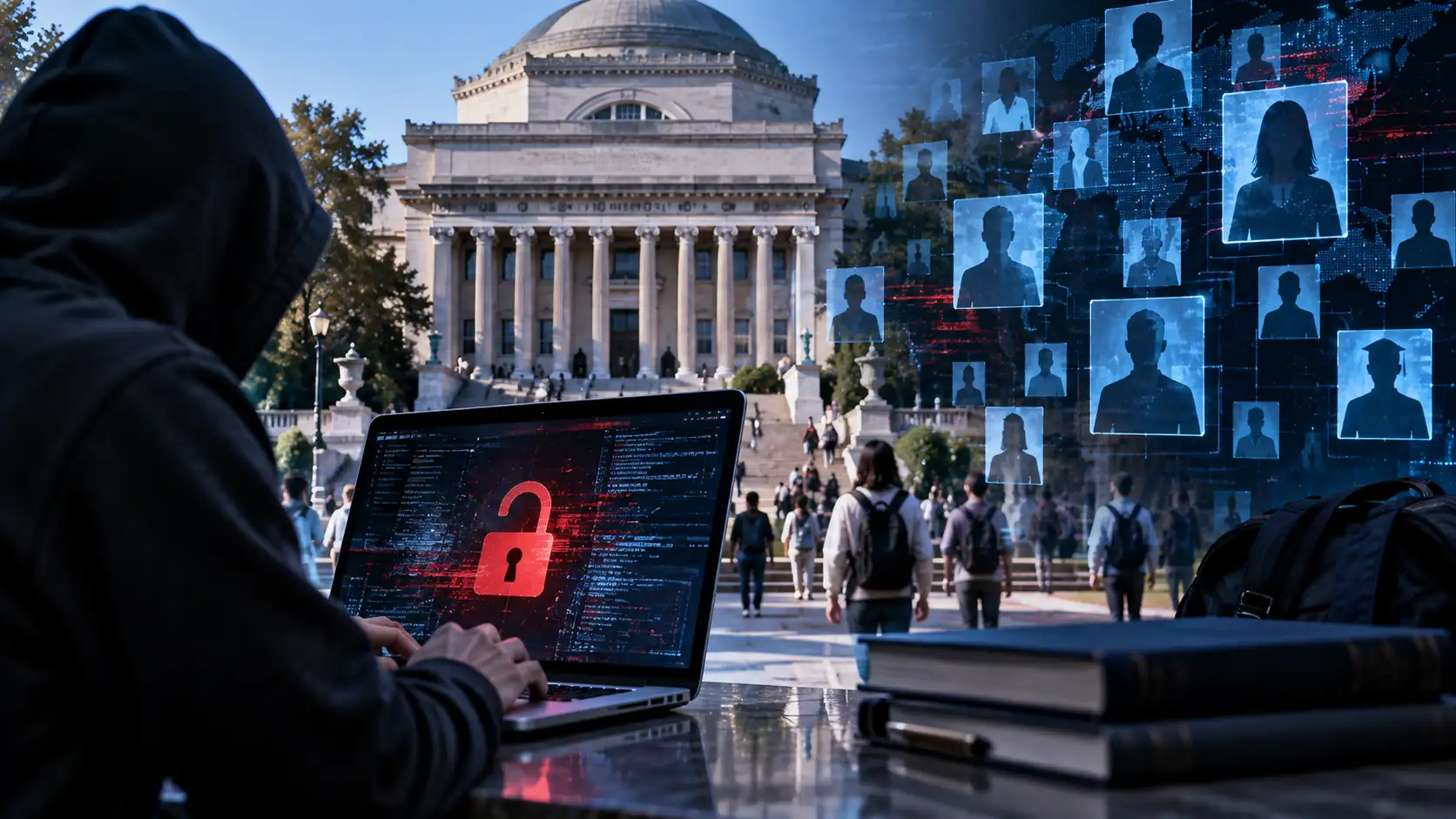
Columbia University’s 2025 cyberattack ultimately exposed personal information belonging to 868,969 people, transforming an incident initially detected through an IT outage into one of the most significant higher-education data breaches of the year. The compromised information included Social Security numbers, contact and demographic information, academic history, admissions and financial-aid records, insurance-related information and certain health information, although Columbia says patient records maintained by Columbia University Irving Medical Center were not affected.
Nearly a year later, the incident produced another troubling discovery. In June 2026, Columbia said it had completed notifications to people potentially affected by the breach and investigated questions from recipients who said they had no known connection to the university. Columbia concluded that at least some of their information apparently entered its systems through historical student-recruitment services that supplied colleges with information from prospective students who wanted to share test scores or receive information about institutions and scholarship programs.
That development makes the breach more significant than the original story about hackers stealing hundreds of gigabytes of university data. It raises a broader cybersecurity question confronting universities and other data-intensive organizations: how much sensitive information should institutions retain about people with whom they may no longer have — or may never have had — a direct relationship?
The Attack Began Weeks Before Columbia’s IT Outage
Columbia’s regulatory disclosures provide a clearer timeline than was available immediately after the attack. According to a breach notification submitted to state authorities, the university determined that an unauthorized third party gained access to its network on or about May 16, 2025, through a publicly exposed system. The intruder then used that access to reach and remove personal information from student admissions, financial-aid and certain employee databases.
The breach did not become publicly visible until June 24, when Columbia experienced a technical outage affecting parts of its IT environment. The university activated its incident-response procedures, worked to restore affected systems, brought in outside cybersecurity specialists and notified law enforcement. Columbia later said it had observed no additional unauthorized access after June 24.
That timeline illustrates one of the central difficulties of enterprise cybersecurity. An attacker can establish access and collect information before an organization sees an obvious operational symptom, meaning the outage that reveals an intrusion may occur considerably later than the initial compromise. In Columbia’s case, the disclosed dates indicate that unauthorized access potentially persisted for more than a month before the June disruption triggered the investigation.
Nearly 869,000 People Were Ultimately Identified as Affected
The scale of the incident became much clearer in August 2025. In its official breach notification filed with the Maine Attorney General, Columbia reported that 868,969 people were affected by the external system breach. The figure was dramatically larger than Columbia’s current student population because the compromised databases contained information accumulated through admissions, enrollment, financial-aid and employment processes over time.
The affected population included current and former students, applicants and certain employees, while subsequent investigation showed that the universe of affected people was even broader than those categories initially suggested. Depending on the individual, compromised records could include names, Social Security numbers, contact information, demographic details, academic history, financial-aid information, insurance-related information and other sensitive data.
Columbia began notifying affected people in August 2025 while its review of the stolen information was still underway. Additional groups were identified as the investigation continued, leading the university to begin another round of notifications at the end of December 2025. By June 2026, Columbia said the notification process had been completed.
The 460 GB Figure Needs More Careful Treatment
Early coverage of the incident widely reported that approximately 460 GB of data had been stolen. That number became a convenient shorthand for the scale of the Columbia breach and remains embedded in the existing Gignomist URL and headline. However, Columbia’s official breach disclosures confirm that data was removed without using the 460 GB figure as the central measure of the incident.
The amount has instead circulated through reporting based on information associated with the attacker and subsequent cybersecurity coverage. That distinction matters journalistically. A threat actor’s claim about the amount of data stolen can be useful evidence, particularly when samples or other technical evidence support it, but it should not be converted into an unquestioned fact simply because the number has been repeated across multiple publications.
The stronger verified measure is the number of affected people and the sensitivity of the information exposed. Columbia formally reported 868,969 affected individuals to regulators and directly confirmed that the attacker obtained data from admissions, financial-aid and employee systems. For people whose Social Security numbers and financial or academic histories were involved, the consequences do not depend on whether the total archive measured exactly 460 GB.
Social Security Numbers Were Among the Most Sensitive Data Exposed
Social Security numbers make the breach particularly serious because they are difficult or impossible for victims to replace in the way they would replace a compromised password or payment card. Combined with names, addresses, dates of birth and other personal information, an SSN can become a durable component of an identity-theft or social-engineering profile.
Columbia also identified academic history and financial-aid information among the affected records. Admissions systems can contain unusually broad profiles of individuals because universities need information about educational history, demographics, citizenship, financial circumstances and other characteristics when evaluating applications or administering aid.
That creates a concentration problem. A single higher-education institution can hold information collected at several stages of a person’s life — from applying to college through enrollment, financial aid, employment and alumni relationships. If retention policies allow those records to remain accessible for many years, a successful intrusion can expose historical information about far more people than the institution currently serves.
The Columbia breach demonstrates that cybersecurity risk therefore depends on more than the number of active users in a system. Historical data can dramatically enlarge the impact of a compromise even when many of the affected people have not interacted with the organization for years.
Columbia Says Medical Center Patient Records Were Not Compromised
The reference to health-related information requires an important distinction. Columbia confirmed that certain health and insurance-related information was present among affected records, but it has repeatedly said there is no indication that patient records maintained by Columbia University Irving Medical Center were compromised in this incident.
That difference matters because a university can possess health-related information outside a hospital’s electronic medical-record environment. Students and employees may provide insurance or other health information through administrative processes that are technically and organizationally separate from the systems used to maintain clinical patient records.
Reporting that “health data” was exposed without making that distinction could incorrectly imply that the attacker compromised Columbia’s hospital patient database. Columbia’s disclosures support a narrower conclusion: some health-related information associated with university administrative records was involved, while the university says CUIMC patient records were not.
That boundary also illustrates why large universities can be difficult cybersecurity environments. Research universities operate educational, administrative, financial, research and medical systems under the same institutional umbrella, but those systems can have very different data, security requirements and technical architectures.
Some Victims Had No Known Connection to Columbia
The most important new development arrived on June 3, 2026. Columbia said that after completing notifications, it received questions from people who had been told their information might have been affected even though they had no known connection to the university. That prompted an additional investigation into why their information existed in Columbia’s systems.
According to Columbia’s June 2026 cyber-incident update, the university believes the information came through student-recruitment services that historically provided colleges and universities with information from prospective students. Individuals could have indicated that they wanted to share information — for example, to report a test score or request information about colleges, universities or scholarship programs — resulting in their data being distributed through those services.
The finding substantially changes the privacy dimension of the incident. A person does not necessarily need to have enrolled at Columbia, worked there or even knowingly maintained a current relationship with the university for sensitive historical information to have remained inside its systems. Data collected through educational recruitment networks can persist beyond the interaction that originally caused it to be shared.
Columbia said Social Security numbers belonging to those individuals have been removed or are in the process of being removed from university systems, subject to applicable legal restrictions. That remediation is important, but it also raises the question of why those identifiers remained storefd long enough to become part of the breach.
The Breach Highlights the Cybersecurity Cost of Data Retention
Cybersecurity discussions often concentrate on keeping attackers outside networks through authentication, patching, endpoint protection and threat detection. The Columbia incident highlights another control that can reduce the impact of a breach even when prevention fails: data minimization.
An organization cannot lose information it no longer possesses. If historical records containing Social Security numbers or other sensitive identifiers have no continuing operational, regulatory or legal purpose, deleting or appropriately de-identifying them reduces the amount of information available to an attacker who later gains access.
Universities face legitimate reasons to preserve many records. Admissions decisions, financial-aid administration, research requirements, employment law and institutional recordkeeping can create retention obligations. The security challenge is distinguishing information that must be retained from information that remains stored simply because deleting legacy data is operationally difficult.
That distinction becomes more important as organizations accumulate information across decades of digital operations. Every old database, recruitment record and archived application can become part of the potential blast radius of a future cyberattack unless retention and access controls are actively managed.
Universities Are Attractive Targets Because Their Networks Are Unusually Complex
Higher-education institutions present a difficult security environment because their technology infrastructure is designed to support openness and collaboration. Universities serve students, faculty, researchers, administrators, contractors, alumni and external collaborators, often across decentralized departments running specialized applications and research systems.
That environment can produce a large attack surface. Internet-facing systems, legacy applications, research infrastructure and third-party services may all connect to institutional networks, while thousands of users routinely access resources from personal devices and external locations. Security teams have to protect sensitive financial and identity information without preventing the collaboration on which teaching and research depend.
Columbia’s disclosure that the attacker initially entered through a publicly exposed system illustrates the importance of managing that external attack surface. Organizations need an accurate inventory of internet-facing assets, rapid vulnerability remediation, strong authentication and monitoring capable of detecting unusual access before an attacker can move from an exposed service into more sensitive databases.
The incident should not be interpreted as evidence that all university systems are inherently insecure. It demonstrates why institutions with large, decentralized digital environments require continuous asset discovery and data governance alongside conventional perimeter defenses.
The Outage Shows That Cyberattacks Can Affect Availability as Well as Privacy
The Columbia incident was not discovered simply because investigators noticed data leaving a database. The public manifestation was a June 24 technical outage that disrupted university IT systems and affected access to digital services. Columbia later concluded that the unauthorized party had both accessed its network and intentionally disrupted operations.
That combination is important because cybersecurity incidents can simultaneously affect confidentiality and availability. Stolen personal information creates long-term privacy and identity risks, while disrupted authentication and administrative systems can immediately interfere with teaching, research and university operations.
Universities are especially dependent on digital availability. Authentication systems can control access to email, learning platforms, administrative tools, research resources and other essential services. An intrusion that disrupts those systems can therefore affect a much larger portion of the institution than the databases from which information was originally stolen.
Cyber resilience consequently requires organizations to plan not only for preventing data theft but also for maintaining or rapidly restoring operations after an intrusion. Backup systems, incident-response procedures, network segmentation and recovery testing become critical when attackers seek disruption as well as information.
Columbia Offered Two Years of Identity-Protection Services
Columbia provided affected individuals with two years of complimentary credit monitoring and identity-restoration services through Kroll. The university has said it has no evidence that the compromised information has resulted in identity theft or fraud, although the absence of observed misuse does not eliminate longer-term risk.
Personal information can remain useful to criminals long after the original breach disappears from headlines. Social Security numbers, birth information, academic histories and previous addresses do not expire quickly, and stolen datasets can potentially be combined with information from unrelated breaches to construct more detailed identity profiles.
Affected individuals therefore face a different risk from victims of a simple password leak. Changing a reused password can quickly close one avenue of attack, while monitoring for identity fraud involving permanent personal identifiers may require sustained attention.
The incident also creates opportunities for secondary scams. Criminals can impersonate universities, security companies or credit-monitoring providers and contact people who know they were affected by a breach. Columbia has specifically warned its community to remain cautious about suspicious communications following the incident.
The Attack’s Attribution Remains Uncertain
Another point requiring caution is the identity and motive of the attacker. Public reporting around the incident has included claims about political motives and descriptions of the individual responsible, but Columbia’s formal disclosures do not provide a definitive public attribution to a named threat group.
The university’s official account establishes the important facts: an unauthorized third party gained network access, removed personal information and disrupted university systems. Going further and labeling the incident ransomware, nation-state espionage or a politically motivated operation requires evidence that Columbia or law enforcement has not publicly established in its final breach communications.
That distinction is particularly important in cybersecurity reporting because attackers can make claims designed to attract attention or manipulate narratives around an intrusion. Attribution requires technical evidence, infrastructure analysis, intelligence and sometimes information available only to investigators.
For Gignomist, the stronger approach is therefore to focus on what the regulatory filings and university investigation prove rather than making the story more dramatic through uncertain attribution.
Columbia’s 2026 Update Turns This Into a Data-Governance Story
The original headline focused on the quantity of information reportedly stolen. The June 2026 findings show why that is no longer the most important way to understand the breach. The central issue is now the breadth and persistence of sensitive data held inside institutional systems.
Columbia found itself notifying people who apparently had no recognizable current relationship with the university. Their information appears to have reached Columbia through a legitimate recruitment ecosystem, but legitimate collection does not eliminate the security risk created by long-term retention.
That raises questions applicable far beyond Columbia. Universities routinely receive information from standardized-testing organizations, recruitment platforms, application systems, financial-aid services and other third parties. Data can move between organizations as prospective students explore opportunities, sometimes years before they decide where — or whether — to enroll.
Every additional recipient becomes another environment in which that information must be protected. The security of personal data therefore depends not only on the organization to which an individual knowingly provides it, but potentially on a wider network of institutions and service providers that receive copies.
A Separate 2026 Canvas Incident Shows the Importance of Third-Party Risk
Columbia also dealt with a separate cybersecurity issue in May 2026 when Instructure, the company behind the Canvas learning-management platform used for Columbia’s CourseWorks service, reported a widespread incident affecting educational institutions. Columbia temporarily dealt with disruption around the service while assessing the security situation.
The university said that incident was separate from the 2025 Columbia network breach and that CourseWorks did not contain Social Security numbers, dates of birth or financial information. It also noted that users were required to use multi-factor authentication. The distinction is important because multiple incidents affecting the same institution should not be merged into a single breach narrative.
Nevertheless, the events demonstrate the range of cybersecurity dependencies facing modern universities. Institutions must secure systems they operate themselves while also depending on cloud platforms, learning-management systems, research tools and other vendors whose security incidents can affect campus operations.
Third-party security has consequently become inseparable from institutional cybersecurity. Vendor assessment, contractual security requirements, access controls and contingency planning matter because an organization’s attack surface extends beyond the servers it directly owns.
What Other Universities Can Learn From Columbia’s Breach
The most immediate lesson is that protecting the network is only one part of limiting breach impact. Universities also need to understand what sensitive information they hold, where it came from, why it is still needed and who can access it. An organization with strong perimeter defenses can still face enormous consequences if a successful attacker reaches decades of unnecessary personal data.
Publicly exposed systems deserve particular attention because Columbia identified one as the attacker’s initial route into its network. Continuous external asset discovery, timely patching and restrictive access can reduce opportunities for attackers to establish that first foothold. Segmentation can then help prevent compromise of one service from providing a path into high-value databases.
Sensitive identifiers such as Social Security numbers should receive additional controls because their compromise creates long-lived risks. Encryption, tightly limited access, monitoring and retention limits can reduce exposure, but the most effective protection for information that no longer needs to exist is secure deletion.
Finally, universities need to treat recruitment and other third-party data pipelines as part of their security architecture. Information inherited from another organization carries the same breach liability as information collected directly, even when the person concerned may barely remember authorizing the original exchange.
The Bigger Question Is Why So Much Data Remained Available
Columbia’s breach is serious because of the attacker who entered the network, but its 2026 aftermath points toward a deeper issue. Cybersecurity failures are determined partly by what attackers can access after they get inside. The larger and more sensitive an organization’s accumulated data estate becomes, the larger the potential consequences of a successful intrusion.
The confirmed victim count of 868,969 is therefore more meaningful than an unverified headline number describing gigabytes. It represents hundreds of thousands of people whose personal information existed in systems reachable during the intrusion, including some who later told Columbia they did not understand why the university had their information at all.
Columbia has since completed notifications, offered identity-protection services, strengthened security controls and begun removing Social Security numbers belonging to some people without known university connections. Those are important remediation measures, but they arrive after the breach demonstrated how historical data can transform one compromised system into a much larger privacy incident.
For universities and other data-rich organizations, that is the lasting lesson from Columbia’s 2025 attack. Cybersecurity is not only about stopping hackers from getting in. It is also about ensuring that, if they do, organizations are not still holding sensitive information they no longer have a compelling reason to keep.