

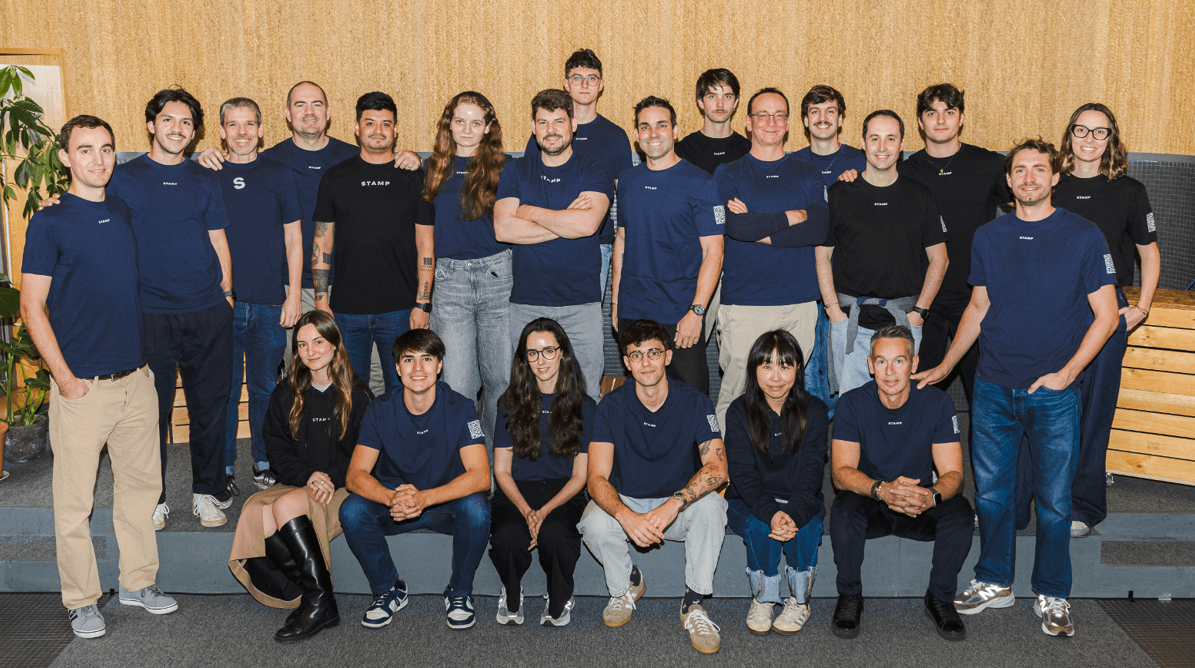
Spanish fintech startup STAMP has raised €4 million in fresh funding to accelerate the modernization of the global Tax Free shopping industry and expand its next generation of payment and artificial intelligence–based services.
The funding round was led by Dozen, with participation from EBISU Digital, Barça Innovation Hub, and a group of international business angels. Among them are investor Andreas Mihalovits and professional footballer Thibaut Courtois, who invested through his venture vehicle NXTplay.
“This funding isn’t about the money — it’s about having the right people and partners to change how global commerce works,” said Abel Navajas, chief executive officer of STAMP in a social media post. “We’ve built a global team by design, because diversity isn’t a metric for us, it’s an operational necessity.”
The CEO further said STAMP is proud to have the backing of investors such as Dozen, EBISU Digital, Barça Innovation Hub and NXTPLAY, along with individual investors who bring strategic and operational experience to the company’s growth.
In addition to private capital, STAMP has secured public funding and grants from Spain’s Ministry of Industry and Tourism, as well as from regional and municipal institutions including the City of Valencia, the Community of Madrid, and the City of Madrid. The public backing reflects growing institutional support for digitalization initiatives tied to tourism, commerce modernization, and cross-border retail.
Reworking a Complex Tax Refund System
STAMP is targeting inefficiencies that have long characterized traditional VAT refund systems used by non-EU shoppers. Under existing models, consumers typically reclaim taxes after completing purchases, relying on intermediaries and navigating complex, time-consuming processes that often discourage participation.
The company’s platform instead applies Tax Free benefits directly at the point of sale, embedding VAT refunds into the payment flow itself while remaining compliant with European fiscal regulations. By digitizing the process, STAMP aims to reduce friction for shoppers and administrative burden for merchants.
“The Tax Free system has historically functioned more like an administrative procedure than a real consumer benefit,” said Abel Navajas, STAMP’s chief executive officer. “When that friction is removed, customer behavior changes, and merchants regain control over both the shopping experience and their margins.”
Adapting to National Tax Frameworks
STAMP’s model is designed to adjust to the specific tax rules of each country in which it operates. In markets such as Italy, where regulations permit VAT-exempt purchases at checkout, eligible transactions are completed without tax applied. In other markets, including Spain, VAT remains on the invoice, but shoppers receive an immediate discount equivalent to the tax amount at the moment of payment.
Behind the scenes, STAMP validates each transaction, ensures traceability, and manages tax recovery processes, including the detection and handling of potential fraud. This structure allows merchants to reimburse tax authorities without assuming fiscal risk themselves, a factor the company says is key to broader adoption.
Tax Free as a Commercial Tool
By simplifying access to Tax Free benefits, STAMP positions its platform as more than a compliance solution. The company argues that integrating tax refunds into payments enables retailers to use Tax Free as a commercial lever, supporting higher conversion rates, larger basket sizes, and improved experiences for international shoppers.
Through its combined Tax Free and payments infrastructure, STAMP connects European retailers with global travelers and acts as a strategic payments and marketing partner for platforms such as WeChat and Alipay, which are widely used by Asian tourists.
Expansion and AI Development Ahead
STAMP said the new funding will primarily support expansion across Spain, Italy, and Portugal, markets with high volumes of international tourism and cross-border retail activity. The company also plans to invest in the continued development of its product portfolio, with a focus on advanced international payment capabilities.
A portion of the funds will be directed toward launching a new artificial intelligence–based product, which STAMP says will further enhance automation, security, and fraud prevention across the Tax Free process.
According to Navajas, the investment strengthens STAMP’s ability to execute its roadmap and advance its broader mission of enabling merchants in Southern Europe to better serve international customers. “Our goal is to turn Tax Free into a tangible purchase incentive rather than an afterthought,” he said.
As global travel continues to rebound and retailers seek new ways to attract high-spending visitors, STAMP is betting that modernizing an outdated tax refund system can unlock both commercial and operational gains for merchants and shoppers alike.
For more news and reports on emerging technologies, including AI, robotics, cybersecurity, blockchain, gaming and the evolving gig economy, visit the home page of The Gignomist.