
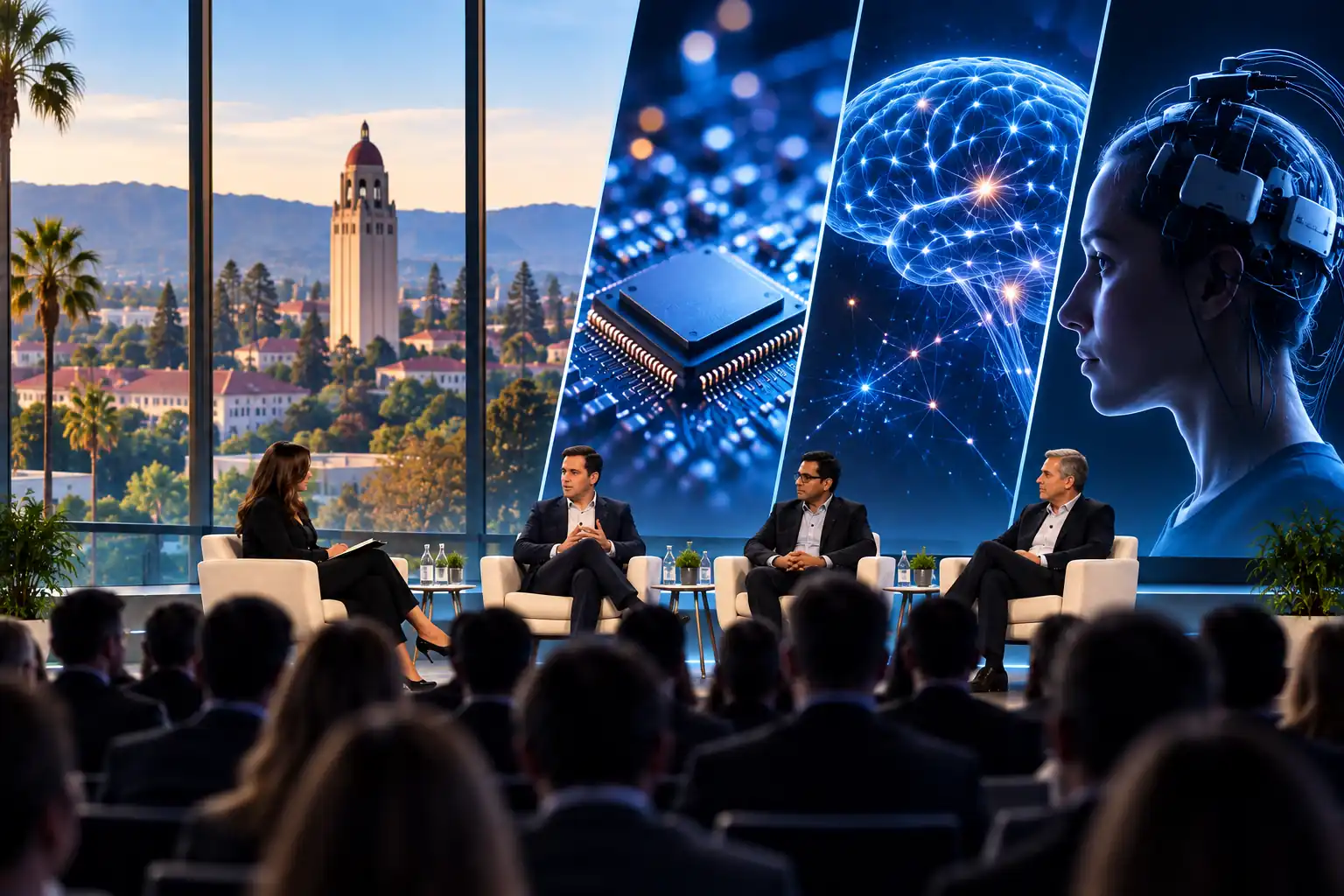
StrictlyVC’s final event of 2025 brought venture investors and deep-tech founders together in Palo Alto on December 3 for discussions spanning semiconductor manufacturing, brain-computer interfaces, wearable computing and the changing investment case for consumer technology.
Held at Playground Global, the event featured former Intel CEO Pat Gelsinger alongside executives and investors from xLight, Science Corporation, Sandbar, Goodwater Capital, Scribble Ventures and True Ventures.
Rather than treating venture capital as the central story, the program highlighted a broader shift in startup investing: some of the technology industry’s most ambitious opportunities increasingly depend on difficult physical engineering, specialized hardware, scientific research and large amounts of capital.
That made StrictlyVC Palo Alto a useful snapshot of where parts of Silicon Valley were looking beyond conventional software and generative AI applications.
Semiconductor Manufacturing Put Deep Tech at the Center
One of the event’s central discussions paired Pat Gelsinger, former Intel CEO and general partner at Playground Global, with Nicholas Kelez, CEO and CTO of xLight.
Their session focused on semiconductor manufacturing and xLight’s attempt to develop a new laser system for advanced chip lithography.
Lithography is one of the critical stages of semiconductor production. Manufacturers use highly sophisticated equipment to project increasingly small circuit patterns onto silicon wafers, allowing more transistors to be packed onto advanced chips.
The technological and geopolitical importance of that equipment has increased as governments compete to expand domestic semiconductor manufacturing.
xLight is approaching the problem through free-electron laser technology derived from particle-accelerator research. Kelez previously spent years working on accelerator technology at U.S. national laboratories before applying that expertise to semiconductor equipment.
That makes the company an example of a broader category of deep-tech startup: businesses attempting to commercialize technologies originating in advanced scientific research rather than building primarily on existing software platforms.
The semiconductor discussion also reflected the importance of manufacturing equipment in the wider AI infrastructure boom. Artificial intelligence has increased demand for advanced processors, but producing those chips requires an extensive supply chain extending far beyond chip designers themselves.
Wearable Computing Is Moving Beyond Screens
Another StrictlyVC session examined a very different hardware problem: how people interact with computers.
Mina Fahmi, co-founder and CEO of Sandbar, appeared alongside True Ventures partner Toni Schneider to discuss wearable technology and new computing interfaces.
Sandbar is developing Stream Ring, a wearable device designed to capture quietly spoken input and convert it into digital interactions.
Fahmi and co-founder Kirak Hong previously worked at Meta following the acquisition of their earlier company, CTRL-labs, giving the team experience in technologies intended to create new ways for humans to communicate with computers.
The larger question extends beyond one device.
Smartphones made touchscreens the dominant interface for consumer computing. Artificial intelligence is now encouraging companies to reconsider whether future interactions always need to begin with opening an application and looking at a screen.
Voice interfaces, wearable devices, smart glasses and other ambient-computing products are competing to reduce that friction.
Whether consumers actually adopt those new interfaces at scale remains uncertain, but the investment interest demonstrates that AI’s hardware consequences extend beyond GPUs and data centers.
Brain-Computer Interfaces Pushed the Discussion Further
Science Corporation co-founder and CEO Max Hodak brought another dimension to the program: technologies designed to establish more direct connections between computing systems and the human nervous system.
Hodak previously co-founded Neuralink and now leads Science, which is developing technologies including retinal implants and brain-computer interfaces.
The field has attracted substantial investment because successful neural interfaces could eventually create new options for people affected by paralysis, vision loss and other medical conditions.
But brain-computer interfaces also illustrate why deep-tech companies operate differently from conventional software startups.
Progress depends on biology, hardware, clinical testing, manufacturing and regulatory approval. Development timelines can therefore be considerably longer, while technical failure can be more expensive.
That creates a venture-capital challenge.
Investors must determine whether potentially transformative outcomes justify funding companies whose technologies may require years of research and validation before reaching large commercial markets.
Venture Investors Questioned Where the Next Consumer Opportunities Will Come From
The Palo Alto program also turned to the investment environment itself.
Goodwater Capital co-founder and managing partner Chi-Hua Chien and Scribble Ventures founder Elizabeth Weil discussed consumer technology at a time when much of Silicon Valley’s attention and capital had been directed toward enterprise artificial intelligence.
Both investors brought experience across consumer and technology companies, allowing the discussion to examine whether the industry’s concentration on enterprise AI risks overlooking another generation of consumer businesses.
That question remains particularly relevant because AI has produced an unusual venture market.
At one end are extraordinarily capital-intensive companies developing foundation models, semiconductors and computing infrastructure. At the other are startups that can use existing models and software tools to launch products with comparatively small teams.
Gignomist has examined this divide in its analysis of how AI startup funding is increasingly concentrating in mega-rounds.
The StrictlyVC program suggested another layer to that market: investors are still looking for opportunities where difficult engineering or distinctive consumer experiences can create defensibility beyond simply adding an AI model to an existing software category.
Why Playground Global Was a Relevant Venue
The event was hosted by Playground Global, a venture firm whose investment strategy has increasingly emphasized deep technology.
That setting complemented a program dominated by semiconductor equipment, neural interfaces and emerging hardware.
StrictlyVC itself began as an independent venture-capital newsletter and event series founded by journalist Connie Loizos before becoming part of TechCrunch. Its events use a smaller-format model centered on conversations between investors, founders and technology executives rather than the much larger exhibition structure associated with major technology conferences.
The official StrictlyVC Palo Alto event program listed tickets at $200 and scheduled sessions from the late afternoon through the evening, with networking alongside the main interviews.
The December 3 gathering was also the final StrictlyVC event of 2025. TechCrunch’s current events archive now classifies Palo Alto as a past event, with the series continuing through events including San Francisco, Athens and Los Angeles in 2026.
StrictlyVC Palo Alto Reflected a Broader Shift Toward Harder Technology
The most useful takeaway from the Palo Alto gathering was not simply the collection of investors and founders in attendance.
It was the type of companies represented.
Semiconductor manufacturing equipment, wearable interfaces and neural technology all require more than rapid software iteration. They involve physical engineering, scientific expertise, manufacturing constraints and, in some cases, lengthy regulatory pathways.
That has implications for venture capital.
Software remains attractive partly because successful products can often scale without constructing factories or navigating medical-device approvals. Deep-tech companies can require substantially more time and capital before reaching comparable scale.
At the same time, advances in AI, semiconductor demand, biotechnology and government support for strategic technologies are expanding the commercial opportunities available to companies tackling those harder problems.
Gignomist’s reporting on Commit Capital’s $15 million fund for technical founders illustrates a different response to the same shift: some investors are changing not only what they fund but also how closely they work with technical teams.
StrictlyVC Palo Alto therefore captured an important tension in the current startup market.
Artificial intelligence remains the dominant technology investment theme, but some investors are looking further down the technology stack — toward the chips, scientific breakthroughs, physical devices and new human-computer interfaces that could determine what the next generation of computing can actually do.