
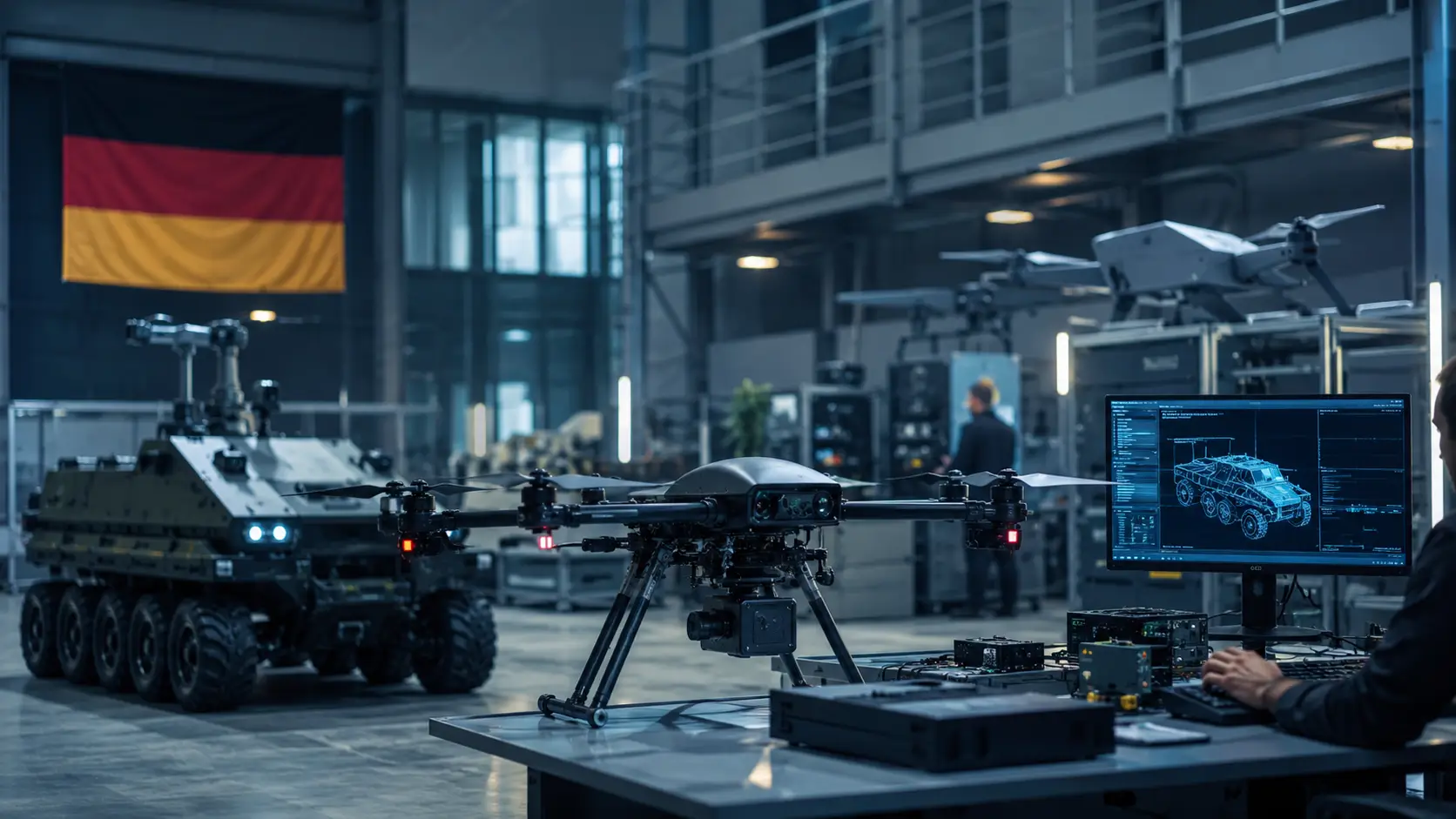
Germany is expanding government financing and procurement support for defense startups as Berlin looks to keep promising young companies at home and accelerate development of technologies increasingly viewed as important to European security.
The measures are part of Germany’s new Startup and Scaleup Strategy, approved by the federal cabinet July 22. The plan contains more than 150 measures across eight policy areas and, for the first time, explicitly brings security and defense companies into the government’s broader startup framework.
Rather than relying on a single new defense fund, the strategy combines existing government-backed investment programs, potential direct equity participation, easier access to public contracts and expanded growth financing for startups and scale-ups.
The policy comes as Germany sharply increases defense spending while European investors pour more capital into companies developing military artificial intelligence, drones, autonomous systems, robotics and software-defined defense technologies.
Defense Startups Enter Germany’s Main Startup Strategy
Germany’s Economy Ministry said startups and scale-ups in the security and defense sector will now receive greater access to government startup-support programs.
The wider strategy is designed to make companies easier to establish, help them raise growth capital and make it more attractive for successful startups to remain in Germany rather than moving operations or seeking most of their late-stage financing abroad.
Financing is one of the government’s main priorities.
Germany has already been building the infrastructure for that effort through the Deutschlandfonds, launched in December 2025 to mobilize public and private investment in strategically important sectors.
Under the Deutschlandfonds structure, state-owned development bank KfW can participate alongside private investors in German startups. The government previously said individual co-investments could reach as much as €50 million, with €1 billion allocated for startup and scale-up investments through 2030.
Germany is also increasing funding connected with the Zukunftsfonds, its government-backed venture-capital program, with security and defense technology among the areas targeted for additional growth capital.
Government Contracts Become Another Tool for Startup Growth
Berlin’s strategy goes beyond equity investment.
Germany has also changed federal procurement rules to make it easier for young companies to sell products and services to the government.
Rules that took effect July 1 allow simplified direct federal contracts of up to €100,000 for qualifying startups during their first four years. Other procurement procedures allow government agencies to negotiate directly with younger companies under certain conditions.
The policy matters particularly for defense and security startups because government agencies and armed forces are often their most important potential customers.
A large public contract can provide something venture funding alone cannot: a paying customer and evidence that a technology can operate at institutional scale.
That approach could help bridge the gap between developing a prototype and becoming a sustainable defense supplier.
Germany’s Startup Boom Meets a Scale-Up Funding Problem
Germany is not suffering from a shortage of newly created companies.
Data released by the German Startup Association and startupdetector showed that 3,053 startups were founded during the first half of 2026, up 52% from the second half of 2025.
The challenge increasingly comes later.
Companies developing advanced hardware, artificial intelligence, robotics and defense systems often need substantially more capital than conventional software startups as they move into manufacturing and large-scale deployment.
German policymakers have argued that insufficient domestic growth capital can push promising companies toward investors and markets outside Germany.
The new strategy is intended partly to prevent that financing gap from causing strategically important technology companies to relocate or become dependent on overseas capital.
Helsing Shows How Large Defense Tech Has Become
The expansion of Germany’s defense-startup policy comes as European defense technology companies attract investment rounds once associated mainly with the largest Silicon Valley startups.
German defense technology company Helsing announced a $1.8 billion Series E financing round July 13, valuing the company at $18 billion.
Investors included Dragoneer Investment Group, Lightspeed Venture Partners, Goldman Sachs Alternatives, JPMorganChase, CPP Investments, General Catalyst, Iconiq and others.
Helsing said the funding would support development and deployment of AI platforms for defense systems.
The scale of the round illustrates both the opportunity and the financing demands facing Europe’s startup and technology ecosystem. Companies seeking to build autonomous aircraft, military AI systems, drones or robotics platforms can require billions of dollars as they move from software development into production and deployment.
Defense Spending Creates a Larger Domestic Market
Germany’s industrial strategy is also being reshaped by a rapid increase in military expenditure.
The federal government plans €109.7 billion in defense spending through the Defense Ministry’s 2027 budget, in addition to resources available from the Bundeswehr special fund.
Germany intends to increase defense spending further through 2029 as it works toward NATO’s 3.5% of GDP defense-spending target.
That spending creates a potentially much larger home market for German defense technology suppliers.
For startups, however, access to government procurement can matter as much as the overall size of the military budget. Smaller technology companies have historically struggled with long procurement cycles, regulatory requirements and contracting systems designed around established suppliers.
Germany’s recent procurement reforms are intended to reduce some of those barriers.
Why the Strategy Matters
Germany’s policy represents a broader change in how European governments view defense startups.
Young technology companies are increasingly being treated not simply as venture-backed businesses but as potential components of national industrial and security policy.
Artificial intelligence, autonomous vehicles, drones, cybersecurity systems, sensors and battlefield software are becoming more important to military planning, while the war in Ukraine has demonstrated how rapidly commercially developed technology can reach operational use.
For Germany, the challenge is therefore not only producing more startups. It is creating enough financing, customers and procurement opportunities to allow the strongest companies to become major industrial businesses without leaving the country.
The government’s new startup strategy does not guarantee that Germany will close its scale-up funding gap. But by combining public capital with procurement reform and expanded defense-industry eligibility, Berlin is making defense technology a formal part of its startup and industrial policy rather than treating it as a separate niche.
For more news and reports on emerging technologies, including AI, robotics, cybersecurity, blockchain, gaming and the evolving gig economy, visit the home page of The Gignomist.