

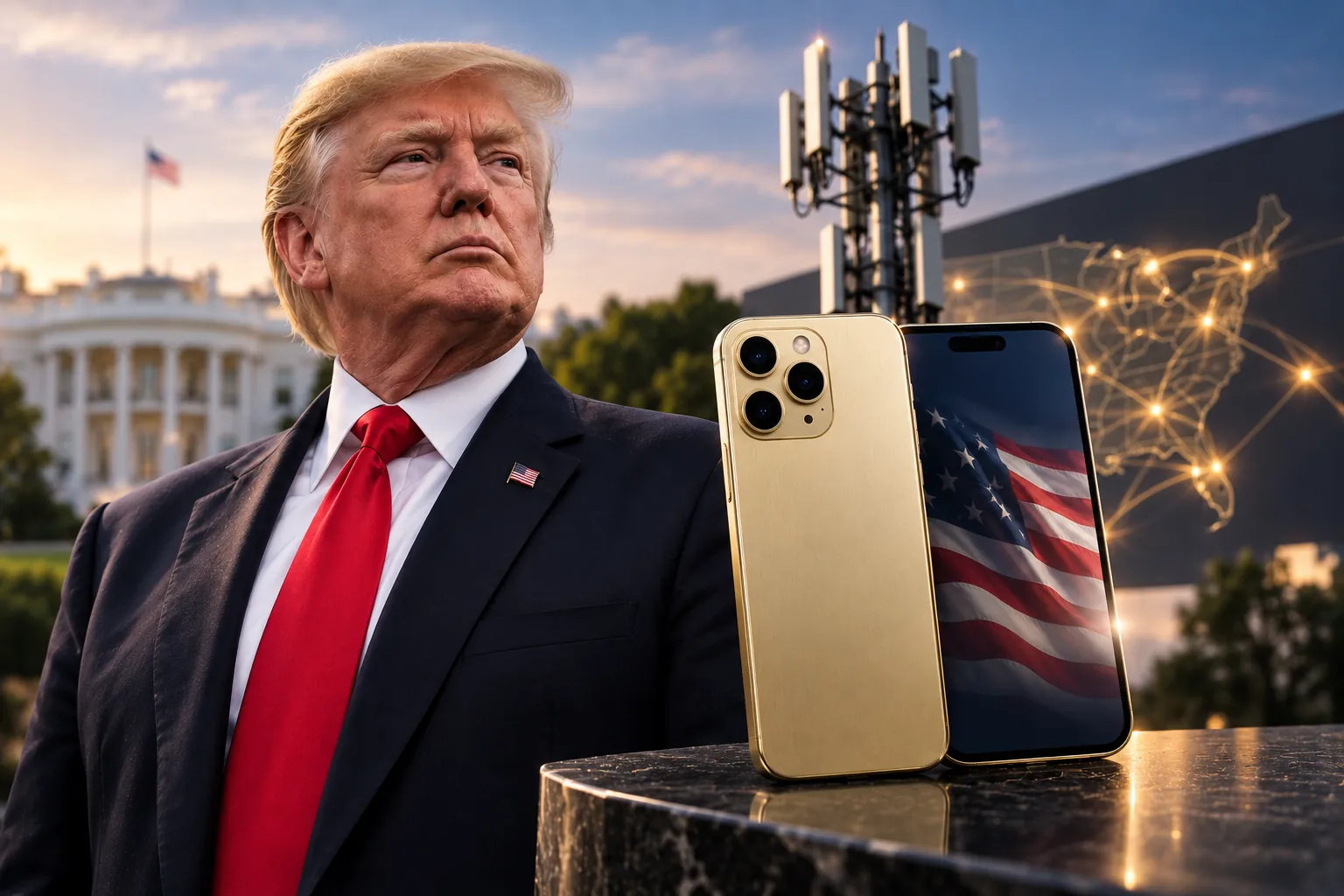
Trump Mobile entered the U.S. wireless market in June 2025 with a politically branded $47.45 monthly service plan and a $499 gold-colored smartphone promoted around American manufacturing. Nearly a year later, the wireless service remained available and the long-delayed T1 Phone finally began shipping, but several elements of the original pitch had changed.
The T1 missed multiple expected release dates before Trump Mobile said in May 2026 that shipments were beginning. Its marketing also moved away from the original “Made in the USA” message, with shipped devices described as assembled in the United States instead.
Meanwhile, the $47.45 wireless plan remains central to the business. It advertises unlimited talk, text and data, but current fine print specifies that the first 20GB of data is provided at high speed.
The evolution of Trump Mobile illustrates something more significant than the launch of another politically branded product: the difference between creating a wireless brand, operating a mobile service and building a modern smartphone supply chain.
Trump Mobile Launched With Two Distinct Products
Donald Trump Jr. and Eric Trump unveiled Trump Mobile on June 16, 2025, exactly 10 years after Donald Trump launched his first presidential campaign.
The announcement combined two products that are easy to conflate.
The first was a wireless service called the 47 Plan, priced at $47.45 per month. The second was the T1 Phone, a gold-colored Android smartphone initially priced at $499.
Trump Mobile promoted the plan as offering 5G connectivity through the major U.S. wireless networks rather than announcing construction of a new national cellular network.
That distinction is important.
Entering the wireless business does not necessarily require a company to construct cell towers, acquire nationwide spectrum licenses and build the physical infrastructure operated by companies such as AT&T, T-Mobile and Verizon.
Companies can instead sell wireless service using capacity provided by established network operators, a business structure generally known as a mobile virtual network operator, or MVNO.
The approach lowers one of the largest barriers to entering telecommunications: building a nationwide network.
Trump Mobile could therefore establish a consumer wireless brand much faster than a new facilities-based carrier could.
Building a smartphone proved more complicated.
The $499 T1 Phone Missed Its Original Launch Window
When the T1 was unveiled, the phone was expected to become available later in 2025.
That timetable slipped repeatedly.
The device did not arrive during its original August launch window, and subsequent expected release dates also passed without a broad rollout. By early 2026, questions were growing about when customers who had placed $100 deposits would receive the handset.
The situation changed in May.
Trump Mobile said preordered T1 devices had begun shipping, with CEO Pat O’Brien telling Reuters that deliveries were starting and would continue as orders were fulfilled.
The phone that emerged differed in important ways from the product initially marketed.
Current Trump Mobile specifications advertise a 6.78-inch AMOLED display with a 120Hz refresh rate, a Snapdragon mobile platform, a 5,000mAh battery, a 50-megapixel front camera and a 50-megapixel telephoto camera.
The company’s own website nevertheless warns that product images are illustrative and that final appearance and specifications may vary.
That history makes the eventual shipment significant, but it also makes the T1 a useful case study in how difficult hardware launches can be compared with launching a branded service.
“Made in USA” Became “Assembled in USA”
The most consequential change involved the T1’s manufacturing story.
At launch, the phone was promoted as being made in the United States, an unusually ambitious claim for a modern smartphone.
Smartphone manufacturing depends on a complex international supply chain involving processors, displays, memory, camera sensors, radio components, batteries and numerous other specialized parts.
Producing all or virtually all of those components domestically would be considerably more difficult than performing final device assembly in the United States.
Trump Mobile subsequently moved away from the original manufacturing language.
By the time devices began appearing in May 2026, CEO Pat O’Brien said the initial phones were assembled in the United States. Reports examining early units also found packaging describing the device as “Proudly Assembled in USA.”
That is not equivalent to saying a product is made in America.
Under the Federal Trade Commission’s Made in USA standard, an unqualified U.S.-origin claim generally requires a product to be “all or virtually all” made domestically. The FTC separately recognizes qualified claims about specific U.S. processes or assembly.
Trump Mobile has not publicly provided a complete component-by-component supply-chain breakdown establishing where the major parts inside the T1 are manufactured.
That means claims about the phone’s precise domestic content should be treated cautiously.
The T1’s Origins Have Drawn Scrutiny
The change in manufacturing language attracted attention beyond technology publications.
In May 2026, U.S. Senator Mark Warner sent Trump Mobile CEO Pat O’Brien a letter questioning the company’s marketing, the T1’s supply chain, preorder handling and the origins of major components.
The letter asked whether the T1 was a white-label device manufactured by another original equipment manufacturer and requested information about the origins of its motherboard, processor, display, cameras and other components.
It also questioned whether Trump Mobile could substantiate claims about U.S. manufacturing.
The questions do not themselves establish that Trump Mobile violated consumer-protection law, and scrutiny from a senator should not be confused with a regulatory finding.
But they highlight the core unanswered technical question surrounding the device: how much of the T1 is actually manufactured in the United States, as opposed to assembled domestically using imported components?
That distinction matters because American manufacturing was a central element of the phone’s original marketing.
What the $47.45 Trump Mobile Plan Actually Includes
While the handset attracted most of the attention, Trump Mobile’s wireless plan is arguably the more conventional part of the business.
The company’s current service information lists the 47 Plan at $47.45 per month before taxes and fees.
It includes unlimited talk and text, unlimited data, international calling and additional services including telehealth, device protection and roadside assistance.
There is an important qualification to “unlimited data.”
Trump Mobile’s current fine print says the first 20GB is at high speed.
That distinction is important for consumers comparing wireless plans. “Unlimited” does not necessarily mean unlimited data at the highest available network speed.
The additional benefits are also not all operated directly by Trump Mobile. Its website states that device protection, roadside assistance, telehealth and pharmacy-related benefits are provided and administered by independent third parties.
Trump Mobile Is Not Operated Directly by the Trump Organization
The branding can also create confusion about the corporate structure.
Trump Mobile prominently features the Trump name and was introduced publicly by Donald Trump Jr. and Eric Trump, but its own legal disclosure draws a distinction between the service and the Trump Organization.
The current Trump Mobile website states that Trump Mobile and its products and services are not designed, developed, manufactured, distributed or sold by the Trump Organization or its affiliates or principals.
Instead, T1 Mobile LLC uses the Trump name and trademark under a limited licensing agreement.
The site also says 1Wireless collaborates with Trump Mobile to market its service offerings and is responsible for the website.
That structure means describing Trump Mobile simply as a cellular carrier “owned by the Trump family” would be imprecise without further evidence about the ownership of T1 Mobile LLC.
A more accurate description is a Trump-branded wireless venture operating under a trademark licensing arrangement.
Why Launching a Wireless Brand Is Easier Than Building a Smartphone
The first year of Trump Mobile exposed the different economics behind its two main products.
Wireless resellers can enter the market without constructing a nationwide radio network. They can focus on customer acquisition, branding, pricing and service bundles while relying on established carriers for much of the underlying connectivity.
Smartphones are different.
Even companies with enormous financial resources rely on global supply chains built over decades. Processors may be designed in one country, fabricated in another and packaged elsewhere. Displays, memory, cameras and batteries can come from different suppliers before final assembly takes place.
Recreating that ecosystem domestically is not simply a matter of opening a final assembly line.
It requires suppliers, semiconductor fabrication, component manufacturing, specialized machinery, logistics and enough production volume to make the economics work.
The T1’s changing manufacturing language therefore points to a much broader challenge facing attempts to move electronics production to the United States.
Final assembly and domestic manufacturing are not interchangeable concepts.
The $47.45 Price Also Defines Trump Mobile’s Market Position
Trump Mobile’s wireless service is not primarily competing on price alone.
At $47.45 per month for a single line, the plan occupies a market in which consumers can find numerous prepaid and MVNO alternatives.
Trump Mobile instead differentiates itself through political and lifestyle branding, bundled benefits and its association with the Trump name.
That is a different customer-acquisition strategy from attempting to become the cheapest wireless provider.
The number itself reinforces the branding: $47.45 references Donald Trump’s presidencies as the 45th and 47th president of the United States.
That makes Trump Mobile an example of brand extension into a highly competitive technology service.
The key business question is whether that identity can generate enough customer loyalty to offset the intense price competition that characterizes the U.S. wireless market.
Trump Mobile’s First Year Changed the Story
When Trump Mobile was announced in June 2025, the obvious headline was that the Trump brand was entering telecommunications.
A year later, that is no longer the most useful way to understand the business.
The wireless service survived beyond the initial announcement and continues to market its $47.45 plan. The T1 Phone eventually began shipping after extensive delays. But the handset’s rollout also brought changing specifications, evolving manufacturing language and unanswered questions about the origins of its components.
Most importantly, the corporate disclosures make clear that Trump Mobile is a licensed Trump-branded venture rather than a smartphone and network operation directly run by the Trump Organization.
Those distinctions make the story more instructive than the original launch announcement.
Trump Mobile demonstrates how quickly a recognizable brand can enter the wireless-service market using existing infrastructure — and how much harder it is to deliver a new smartphone while making ambitious claims about domestic manufacturing.