

SAN FRANCISCO — OpenAI has expended its budget-friendly ChatGPT Go plan, priced under $5, to 18 new countries across Asia, marking a major step in the company’s regional growth strategy.
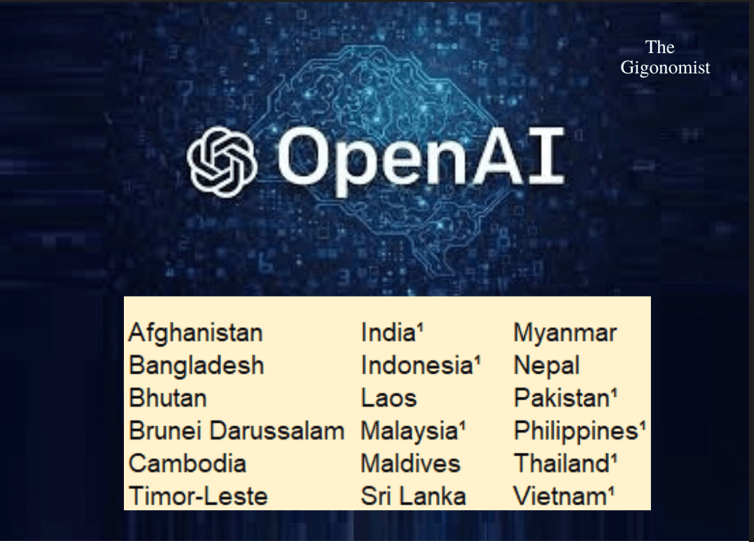
The plan is now available in Afghanistan, Bangladesh, Bhutan, Brunei Darussalam, Cambodia, Laos, Malaysia, Maldives, Myanmar, Nepal, Pakistan, the Philippines, Sri Lanka, Thailand, East Timor, and Vietnam.
In Malaysia, Thailand, Vietnam, the Philippines, and Pakistan, users can subscribe using local currencies. In other countries, the plan costs about $5 in U.S. dollars, with final pricing varying by tax regulations.
ChatGPT Go offers higher daily usage limits for messages, image generation, and file uploads, along with double the memory of the free tier, allowing more tailored responses.
OpenAI said the expansion follows a fourfold increase in weekly active users across Southeast Asia. The Go plan first launched in India in August and later rolled out in Indonesia in September, where paid subscriptions have since doubled.
The move intensifies OpenAI’s competition with Google, which introduced its Google AI Plus subscription in Indonesia in September before expanding to more than 40 countries. Google’s plan, similarly priced, gives users access to Gemini 2.5 Pro and creative tools like Flow, Whisk, and Veo 3 Fast, as well as 200 GB of cloud storage.
The timing of OpenAI’s rollout coincides with its DevDay 2025 conference in San Francisco, where CEO Sam Altman announced ChatGPT has surpassed 800 million weekly active users, up from 700 million in August. The company also introduced new in-app tools that transform ChatGPT into a full-fledged ecosystem similar to an app store, featuring integrations with Spotify, Zillow, and Coursera.
Nick Turley, head of ChatGPT, said the goal is to make the platform “more like an operating system where you can come and use applications — whether it’s writing, coding, or interacting with services.”
Despite OpenAI’s $500 billion valuation, the company reported a $7.8 billion operating loss in the first half of 2025 due to high infrastructure spending. The new low-cost subscription model is seen as a critical move toward profitability while strengthening its foothold in fast-growing Asian markets.