
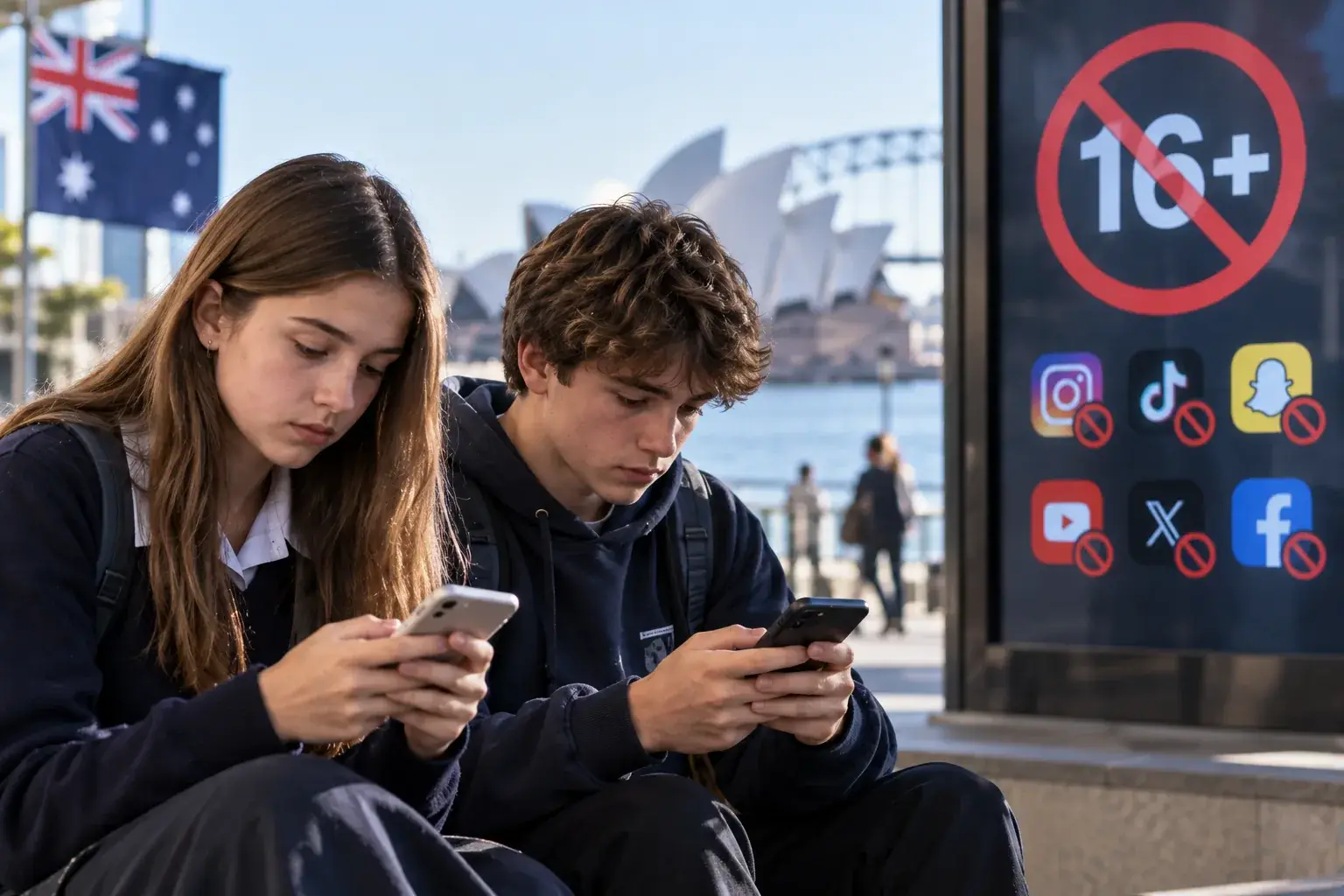
Australia’s world-first social media restrictions for children under 16 are now in force, turning one of the world’s most closely watched online-safety experiments from legislation into a test of whether governments can meaningfully enforce age limits across global technology platforms. Since December 10, 2025, major services including Facebook, Instagram, TikTok, Snapchat, YouTube, Reddit and X have been required to take reasonable steps to prevent Australians under 16 from creating or keeping accounts.
The initial numbers look dramatic. Platforms reported removing, deactivating or restricting access to about 4.7 million under-16 accounts, while companies that systematically fail to comply can face penalties of up to A$54.6 million. Yet Australia’s first longitudinal evidence presents a more complicated picture: three months after implementation, 42.1% of children aged 10 to 15 still reported having an account on at least one restricted platform, while more than 81% continued using at least one of those services in some form.
That gap is becoming the defining issue for Australia’s experiment. The law has clearly changed account ownership and platform behavior, but it has not removed social media from children’s digital lives. The longer-term question is whether stronger age assurance can produce meaningful changes in online exposure and wellbeing without creating disproportionate privacy, access or social costs.
Australia’s Social Media Rules Are Now Active
Australia passed the Online Safety Amendment (Social Media Minimum Age) Act in November 2024, giving platforms roughly a year to prepare before the minimum-age obligation took effect on December 10, 2025. The law places responsibility on technology companies rather than children or their parents.
Age-restricted platforms must take “reasonable steps” to prevent Australians under 16 from creating new accounts or keeping existing ones. Children are not fined for accessing social media, and parents are not penalized for helping them use online services.
The eSafety Commissioner’s current guidance identifies Facebook, Instagram, Snapchat, Threads, TikTok, Twitch, X, YouTube, Reddit and Kick among the services subject to the restrictions. Other platforms have separately assessed themselves as falling within the regime, including Lemon8, Wizz and Yubo.
The system is therefore broader than the small group of social networks initially associated with the legislation.
It Is More Accurately an Account Restriction Than an Internet Ban
The term “social media ban” is convenient but can create the wrong impression about what Australian teenagers are actually prohibited from doing. Under-16s are not banned from accessing the internet or from seeing all social-media content.
They can still view publicly accessible material that does not require them to log in. They can also use services that do not meet the legal definition of an age-restricted social media platform or that fall within an exclusion.
Discord, Google Classroom, Messenger, Pinterest, Roblox, Steam, WhatsApp and YouTube Kids are among services eSafety has said are not currently covered in the same way. The policy is therefore aimed specifically at account-based social-media participation.
That distinction reflects the government’s concern about platform features associated with logged-in users, including personalized recommendation systems, notifications, social feedback and other mechanisms designed to increase engagement.
It also explains why children can continue consuming substantial amounts of online content even after losing a social-media account.
Platforms Reported Removing 4.7 Million Accounts
The first major implementation number arrived in January 2026.
Australia’s eSafety Commissioner reported that age-restricted platforms had removed, deactivated or otherwise restricted access to approximately 4.7 million accounts identified as belonging to users under 16. The figure demonstrated that the law was not merely symbolic.
Platforms had begun changing account access at substantial scale, while age-assurance systems were being used to determine whether users met the new minimum. But account removals alone cannot establish whether the policy is working.
One teenager may have several accounts across different platforms. Some removed accounts may be inactive, while other children may continue accessing content without logging in or retain accounts that platforms have not identified correctly.
Australia therefore commissioned a much longer evaluation rather than relying only on platform-reported enforcement figures.
Account Ownership Fell, but Far From Disappeared
The first major results from that evaluation arrived in July 2026.
eSafety is following more than 4,000 children and families over two years, comparing their experiences before and after implementation. Its first three-month follow-up provides the clearest evidence so far of what changed.
Before the restrictions took effect, 52.4% of children aged 10 to 15 reported holding an account on at least one age-restricted platform. Three months later, that had fallen to 42.1%.
The reduction was statistically significant and suggests the law is changing account ownership. Declines were recorded particularly on YouTube, Snapchat and TikTok, with smaller decreases on Instagram and Facebook. But the result also exposes the scale of the enforcement problem.
More than four in ten children in the age group still reported having at least one account on a platform where companies are supposed to take reasonable steps to prevent them from doing so.
Most Children Still Used Restricted Platforms
The difference becomes even larger when account ownership is separated from actual use. Before implementation, almost 86% of children in the study reported using at least one age-restricted social platform. After three months, that figure was still above 81%.
Daily-or-more-frequent social-media use also changed relatively little, falling from roughly 61% to around 58%. Those numbers do not necessarily mean platforms are violating the law because the legislation regulates accounts rather than every form of access.
Children may watch public YouTube content without logging in. They may use shared accounts or encounter social content through other routes. But the results show why describing the policy simply as removing social media from children’s lives is inaccurate. Australia has restricted under-16 accounts. It has not eliminated children’s exposure to social platforms
Age Assurance Is the Central Technical Problem
Why were so many under-16 accounts still active?
eSafety’s research points to a surprisingly straightforward explanation: many children said platforms simply had not checked their age.
About half of children who retained accounts reported that they had not undergone an age check. Others had an account age recorded as 16 or older or said an age-assurance system had incorrectly classified them. More sophisticated circumvention appeared less common.
Relatively small numbers reported using another person’s identification, obtaining parental help to evade restrictions, opening replacement accounts after deactivation or using a VPN.
That finding shifts attention from teenagers defeating sophisticated security systems toward whether platforms are applying age assurance consistently enough in the first place.
It also demonstrates why Australia’s law deliberately uses a “reasonable steps” standard rather than prescribing one universal identification method.
Australia Did Not Require Everyone to Upload an ID
Privacy was one of the major controversies surrounding the original legislation.
Requiring every social-media user to submit a passport, driver’s licence or other identity document could create a large new repository of sensitive personal information merely to determine whether someone is old enough to use Instagram or TikTok. Australia’s system does not mandate that approach.
Platforms can use multiple signals and age-assurance techniques. Depending on the service and circumstances, those can include information already associated with an account, behavioral signals and age-estimation technologies.
eSafety guidance notes that platforms may consider signals such as activity patterns, connections with apparently underage users, membership in youth-focused communities and visual or audio age estimation. The technical challenge is balancing two competing goals.
Age checks need to be accurate enough to identify children while avoiding unnecessary collection of sensitive information from every adult.
False positives also matter. Adults incorrectly identified as under 16 need a practical appeals process, while children incorrectly classified as adults undermine the effectiveness of the system.
Five Major Platforms Drew Compliance Scrutiny
Australia’s regulator has not treated the initial account removals as proof that implementation is complete. Its March 2026 compliance update identified continuing concerns across the major platforms and focused further investigative work on Facebook, Instagram, Snapchat, TikTok and YouTube.
The regulator said a substantial proportion of Australian children were still retaining accounts, creating new ones or passing age-assurance systems despite being under 16. That distinction matters for evaluating the policy fairly.
A law can produce millions of account removals while still being implemented inconsistently. Both things can be true simultaneously.
Australia’s enforcement model therefore depends on continuing regulatory pressure rather than a one-time purge of underage accounts. Companies that fail to take reasonable steps can face court-imposed penalties reaching A$54.6 million.
Children Appear to Be Moving Some Activity Elsewhere
The early evaluation also found evidence that children’s digital behavior may be shifting rather than simply shrinking. Use of messaging services increased, as did the frequency of online gaming.
Researchers cautioned that it is too early to determine whether those changes were directly caused by the social-media restrictions or whether they reflect wider changes in children’s digital habits. But substitution is an important issue for regulators.
If young people leave one restricted platform and move to another digital environment with similar social features, some of the intended safety benefits may be reduced.
That is one reason Australia’s rules are based on characteristics of services rather than a permanently fixed list of company names. Platforms can change. New services can emerge. Regulators may reassess whether a service falls within the law as its features and purpose evolve.
One Unexpected Result Was Lower Parental Awareness
Perhaps the most interesting early finding has little to do with account numbers.
Among children who said they used social media, roughly one in four parents were unaware of that use before the restrictions began. Three months later, the proportion had increased to approximately one in three.
The effect was particularly noticeable among parents of children aged 10 to 12 and parents of girls. researchers have not established why.
Children may be becoming more secretive about social-media use, or some parents may assume their children are no longer accessing restricted platforms because the national age rule is now in place. Either possibility matters.
A policy designed to protect children could have an unintended effect if it causes parents to underestimate their children’s online activity.
eSafety has therefore identified parental awareness as an issue requiring continued monitoring rather than drawing a firm conclusion from the early result.
The Evidence on Wellbeing Is Not Yet Available
Australia’s law was justified largely through concerns about children’s exposure to addictive design features, harmful content and social pressures.
Three months is not enough time to establish whether the policy improves mental health or broader wellbeing. eSafety explicitly warns against using its initial evaluation to make that conclusion.
Almost two-thirds of participating children reported that the restrictions had produced no impact on their lives at the three-month stage. Among those who did notice effects, experiences were mixed: some reported reduced pressure or social-media use, while others raised concerns about communication and connection.
Parents reported similarly mixed experiences. Some said the restrictions supported family rules, reduced screen time or improved offline engagement. Others raised concerns about isolation or children becoming more secretive. The two-year evaluation will therefore matter considerably more than the early implementation numbers.
Australia’s Experiment Is Already Influencing Other Governments
Whatever its eventual effectiveness, Australia’s policy has changed the international debate over children’s access to social media.
Governments elsewhere are now considering stronger age restrictions, while the European Union is developing age-verification infrastructure and debating additional protections for children online. Australia’s approach is especially significant because responsibility rests directly with platforms.
Instead of asking every parent to enforce a household rule independently, the legislation changes the default: covered services are expected to prevent under-16 accounts across the country.
That model could become influential if evidence eventually shows meaningful improvements in children’s wellbeing. But other governments will also be watching Australia’s implementation problems.
If age assurance remains inconsistent, children simply shift services or privacy costs become excessive, those problems will be relevant to countries considering similar systems.
Australia Has Moved From Political Debate to a Real-World Test
The most important change since Australia first passed its under-16 social-media legislation is that the debate now has evidence.
Millions of accounts have been removed or restricted. Reported account ownership among children aged 10 to 15 has fallen from 52.4% to 42.1%. Yet more than 81% still reported using at least one age-restricted social-media service three months after implementation. Those figures support neither an easy declaration of success nor an easy declaration of failure.
They show that the law is changing behavior while also revealing how difficult age-based internet regulation is to enforce.
The first eSafety longitudinal evaluation also identifies issues that were much harder to see when the policy existed only on paper: incomplete age checks, continued account ownership, migration toward messaging and gaming, and declining parental awareness of children’s social-media use. Australia’s experiment therefore has entered a more important phase.
The question is no longer whether a government can pass a law establishing 16 as a social-media account age. Australia has already done that.
The question is whether platforms can enforce it accurately enough to produce measurable improvements in children’s online experiences—and whether those benefits ultimately outweigh the privacy, access and behavioral trade-offs created by age assurance. That answer will require more than counting deleted accounts.