

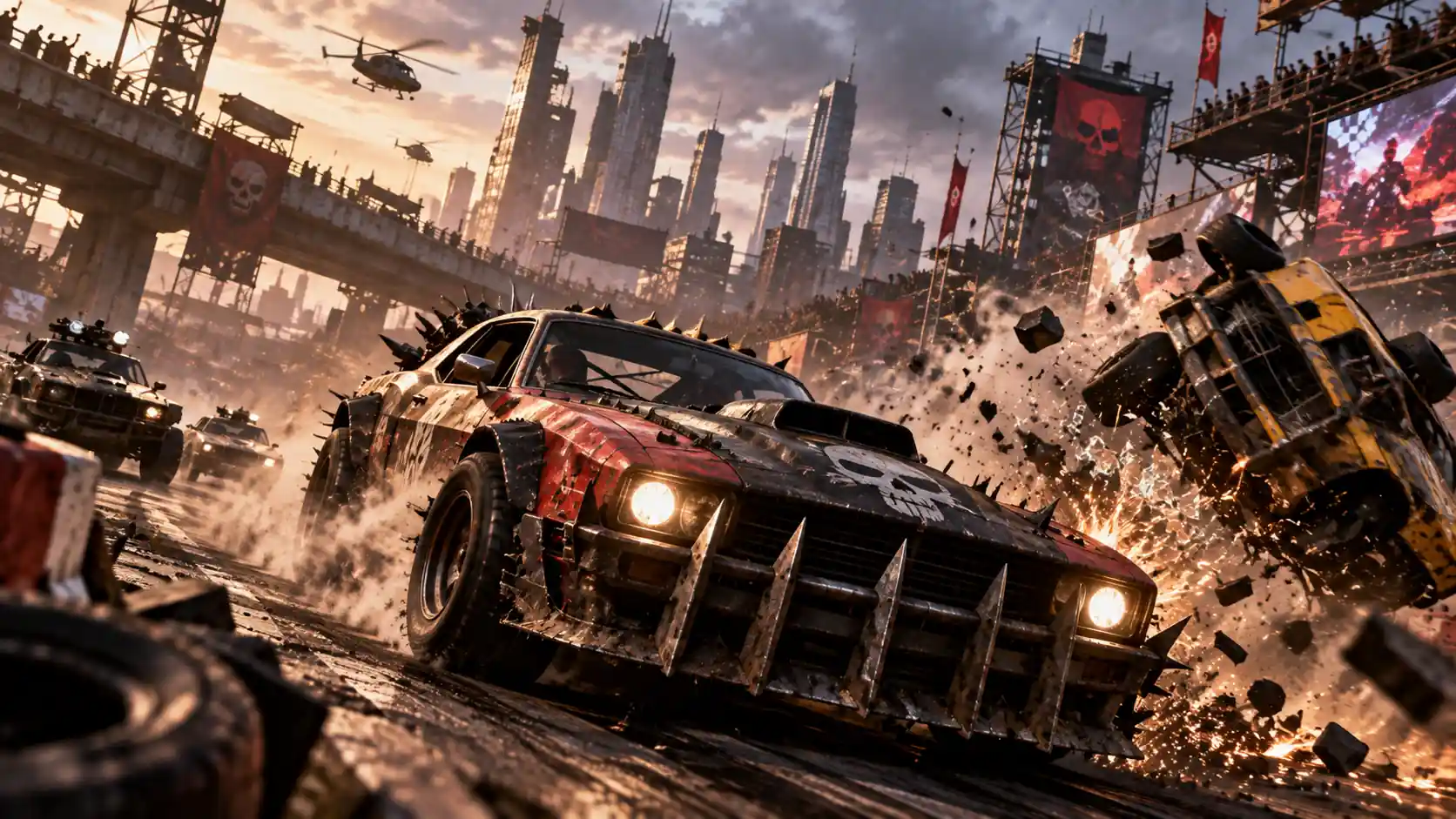
Carmageddon returned in February 2026 after roughly a decade away, but developer 34BigThings did not attempt to recreate the controversial vehicular-combat formula exactly as players remembered it. Instead, Carmageddon: Rogue Shift turned the franchise into a single-player roguelite racer built around branching runs, vehicle upgrades, mounted weapons, permanent progression and hordes of mutated enemies.
Released on February 6 for PlayStation 5, Xbox Series X|S, Nintendo Switch 2 and PC, Rogue Shift represents both a revival and an experiment. It retains Carmageddon’s emphasis on destructive driving but replaces much of the original games’ free-form chaos with structured events and a repeatable roguelite campaign. The result has divided players and critics, making the game’s reception almost as interesting as the decision to revive the franchise in the first place.
Several months after launch, Rogue Shift shows the challenge facing studios that revive older game properties. Modernizing a dormant franchise can attract new players, but changing too much can weaken the identity that made the original valuable enough to revive.
Carmageddon Returned on February 6, 2026
Developed and published by Turin-based 34BigThings, Carmageddon: Rogue Shift launched simultaneously across current-generation consoles and PC. The studio is best known for the high-speed Redout racing series and describes Rogue Shift as a spin-off rather than a conventional mainline sequel.
That distinction matters. Classic Carmageddon games were known for violent vehicular combat, open environments and the freedom to approach events in unconventional ways. Rogue Shift takes pieces of that identity and places them inside a much more structured progression system.
According to 34BigThings’ official game description, each campaign creates a randomly generated graph containing events, shops, challenges and bosses. Players earn credits during a run, repair and modify their vehicles between events, and gradually assemble combinations of weapons and perks capable of surviving increasingly difficult encounters.
Destroying a vehicle ends the current attempt, but not all progress disappears. Beatcoins earned during play can unlock permanent bonuses and additional content through the Black Market, creating the repeated failure-and-progression loop associated with roguelites.
The Biggest Change Is the Roguelite Structure
The roguelite design fundamentally changes how Carmageddon works.
Rather than progressing through a fixed sequence of races, players choose paths through a branching campaign. One route might provide an opportunity to repair a damaged vehicle, while another can lead toward equipment, a challenge or a more dangerous event with potentially better rewards.
That forces players to manage resources rather than concentrating only on winning individual races. Surviving with a damaged vehicle can sometimes matter more than maximizing destruction because losing the car ends the run and sends the player back into another attempt.
Randomized upgrades further change the experience. A player cannot necessarily reproduce the same vehicle build every time, so weapons and perks available during a particular run influence which strategy makes sense.
It is a familiar structure for roguelite players, but an unusual one for a franchise historically associated with chaotic vehicular combat.
Rogue Shift Has 15 Cars, 13 Weapon Classes and More Than 80 Perks
The progression system is supported by a relatively broad selection of equipment. Rogue Shift includes 15 upgradeable vehicles, spanning front-, rear- and all-wheel-drive configurations, along with 13 weapon classes and more than 80 perks.
Weapons include shotguns, miniguns, missile launchers, railguns and lasers. Perks can then be combined with vehicle and weapon choices to create different builds, giving players reasons to experiment across repeated campaign attempts.
Cars also feature visual damage, while weather and the day-night cycle alter the appearance and conditions of events. Elite encounters and boss fights provide larger challenges between ordinary races.
The design is clearly intended to make combinations more important than any single vehicle. A run becomes partly about discovering which perks reinforce a particular weapon or driving strategy before difficulty overwhelms the player’s build.
That system provides Rogue Shift with replayability, although reception suggests that progression variety has not completely solved repetition elsewhere in the game.
Zombies Replace One of Carmageddon’s Most Controversial Features
The setting also changes significantly.
Rogue Shift takes place in 2050 after war and natural disasters have devastated civilization. A food supplement called MiVis, originally introduced to address shortages, has caused cellular mutations that transform humans into aggressive creatures known as the Wasted.
The Wasted swarm streets after dark and can attack vehicles in large numbers. More dangerous mutations appear as runs progress, providing targets that function differently from rival cars.
Replacing ordinary pedestrians with fictional monsters changes the tone of the franchise. The original Carmageddon became notorious in the 1990s partly because players could run over pedestrians, generating censorship disputes and helping establish the series’ provocative reputation.
Rogue Shift retains the spectacle of plowing through large groups with a vehicle, but reframes the targets as post-apocalyptic enemies. That allows 34BigThings to preserve some of the series’ excessive destruction while moving away from one of its most controversial elements.
It also contributes to the disagreement over whether the new game still feels sufficiently like Carmageddon.
The Original Carmageddon Was Built Around Freedom
The first Carmageddon, released in 1997, stood apart from conventional racing games because winning the race was only one possible objective. Players could complete events through racing, destroying competitors or eliminating pedestrians across relatively open environments.
That freedom was central to its identity. The game was less interested in clean racing lines than in creating a destructive playground where vehicles, environments and opponents became part of the same chaotic system.
Later entries expanded and modified the formula, culminating in Carmageddon: Max Damage in 2016. The franchise then remained largely dormant for roughly a decade.
34BigThings therefore faced a difficult design problem. Simply reproducing a 1990s formula could have created a game dependent primarily on nostalgia, while completely reinventing it risked losing the features existing fans associated with the name.
Rogue Shift deliberately chose reinvention.
34BigThings Built the Game Over Four Years
The developer says development began in 2021, shortly after the COVID-19 pandemic disrupted the games industry. The project took approximately four years and was designed from the beginning as a spin-off rather than a direct continuation of the main series.
34BigThings described its approach as combining respect for Carmageddon with a willingness to alter the formula. Its solution was to combine arcade driving with a faster combat system and roguelite progression.
The studio’s experience with Redout made the driving component a logical fit. But Rogue Shift required additional systems around weapons, procedural progression and vehicle builds that distinguish it from a conventional racing title.
The development also occurred during substantial corporate change. 34BigThings had been acquired by Embracer Group in 2020 and placed under Saber Interactive, before later changes across Embracer’s businesses altered that structure.
In June 2026, the studio described itself as entering a new independent phase after navigating those corporate changes without large-scale workforce cuts.
Critical Reception Has Been Mixed
The reinvention has not produced a clear critical consensus.
On PlayStation 5, Carmageddon: Rogue Shift currently holds a 63 Metascore, categorized as “Mixed or Average.” The PC version has scored somewhat better, at 69. Reviews generally agree that the basic vehicle-combat mechanics can be entertaining while disagreeing about whether the game has enough variety to sustain its roguelite structure.
Game Informer scored the game 78 on PS5, describing the genre combination as an enjoyable callback to explosive racing games even if it was not necessarily the full Carmageddon revival longtime players expected. Other reviews were considerably less enthusiastic.
A recurring criticism is limited event variety. A roguelite asks players to repeat its fundamental gameplay loop many times, making diversity especially important. Randomized paths and upgrades can change how a run develops, but they cannot completely disguise repeated tracks, objectives or encounters if the underlying content pool feels narrow.
That exposes one of Rogue Shift’s central design tensions: the progression system encourages repetition while some reviewers argue the game does not contain enough variety to make that repetition consistently rewarding.
Players Have Reached a Similar Verdict
Steam’s player data paints a comparable picture. As of September 2026, approximately 62% of roughly 750 user reviews are positive, leaving the game’s overall rating in Steam’s “Mixed” category.
That is noteworthy because the disagreement is not simply critics versus players. Both groups appear to recognize strengths in the core concept while expressing reservations about execution or longevity.
Some players enjoy the combination of arcade racing, weapons and roguelite progression. Others argue that the structured races and zombie enemies move the game too far away from what made earlier Carmageddon titles distinctive.
Those responses illustrate a broader problem with franchise revivals. The brand can generate initial attention, but it also establishes expectations. A new intellectual property could introduce exactly the same mechanics without being compared constantly with games released decades earlier.
Using the Carmageddon name makes history part of the product.
Post-Launch Updates Have Tried to Address Feedback
34BigThings did not treat February’s release as the end of development. The studio published a post-launch roadmap and has continued updating the game, including fixes, vehicle additions and gameplay improvements.
The developer’s third major patch added content explicitly inspired by older Carmageddon design, including Arena events and an “Old Fashioned Way” mode. Other updates have addressed cameras, controls, weapons, challenges and technical issues.
That direction is revealing. Some post-launch additions effectively move Rogue Shift closer to the franchise identity that parts of the audience felt was missing at release.
Continued patches can improve individual systems, but they also demonstrate the advantage modern developers have when reviving older franchises. A game no longer has to remain permanently defined by its launch version.
Whether updates can materially change Rogue Shift’s long-term reception will depend on how much depth and variety they add rather than simply how many bugs they fix.
Rogue Shift Is More Spin-Off Than Traditional Revival
The most useful way to understand Rogue Shift is probably the way 34BigThings itself describes it: as a spin-off.
Players expecting a modern recreation of the original Carmageddon may find the structured tracks, roguelite progression and zombie-heavy setting too different. Players approaching it primarily as an arcade combat racer have fewer historical expectations to overcome.
That difference explains why assessments of the game can diverge even when reviewers agree about its mechanics. The question is not only whether the driving and combat are entertaining; it is whether those systems constitute a convincing Carmageddon game.
There is no objective answer to that identity question. What can be established is that 34BigThings deliberately chose not to reproduce the old formula wholesale.
The studio used the franchise as the foundation for a different kind of vehicular-combat game.
Carmageddon’s Return Shows the Risk of Reviving Old Game Franchises
The business logic behind reviving an established name is easy to understand. Familiar intellectual property can attract attention in a crowded market and reconnect publishers with players who already recognize the franchise. But nostalgia creates constraints alongside those advantages.
Change too little and a revival can appear dated. Change too much and the project can seem disconnected from the brand whose recognition helped justify bringing it back.
Carmageddon: Rogue Shift sits almost exactly in the middle of that problem. Its cars, weapons, destruction and exaggerated violence clearly draw from the original series, while its campaign structure, progression systems and post-apocalyptic enemies push the experience in another direction.
The mixed reception suggests that modernization alone does not guarantee a successful revival. A returning franchise also needs to identify which elements of its original design are essential to its identity and which can be replaced without losing what existing players valued.
What Rogue Shift Means for Carmageddon
Carmageddon: Rogue Shift succeeded at one thing before any review score was published: it put a dormant franchise back into active development.
The game launched across four major platforms, gave 34BigThings an opportunity to reinterpret vehicular combat through contemporary roguelite mechanics and has continued receiving post-launch updates. It also demonstrated that Carmageddon can exist outside a straightforward recreation of its 1990s design.
Its reception shows the limits of that approach. The combat-driving foundation has attracted praise, but repetitive content and the distance from the classic formula have prevented the revival from earning broad critical enthusiasm. The PS5 Metascore and mixed Steam rating make that divide measurable rather than anecdotal.
That leaves Rogue Shift in an interesting position. It is neither a failed attempt to reproduce old Carmageddon nor the definitive modern successor to it. It is an experiment in deciding how much of an old franchise can change while still carrying the same name.
For 34BigThings, the next question is whether the lessons from that experiment remain confined to a spin-off or become the foundation for whatever Carmageddon does next.