

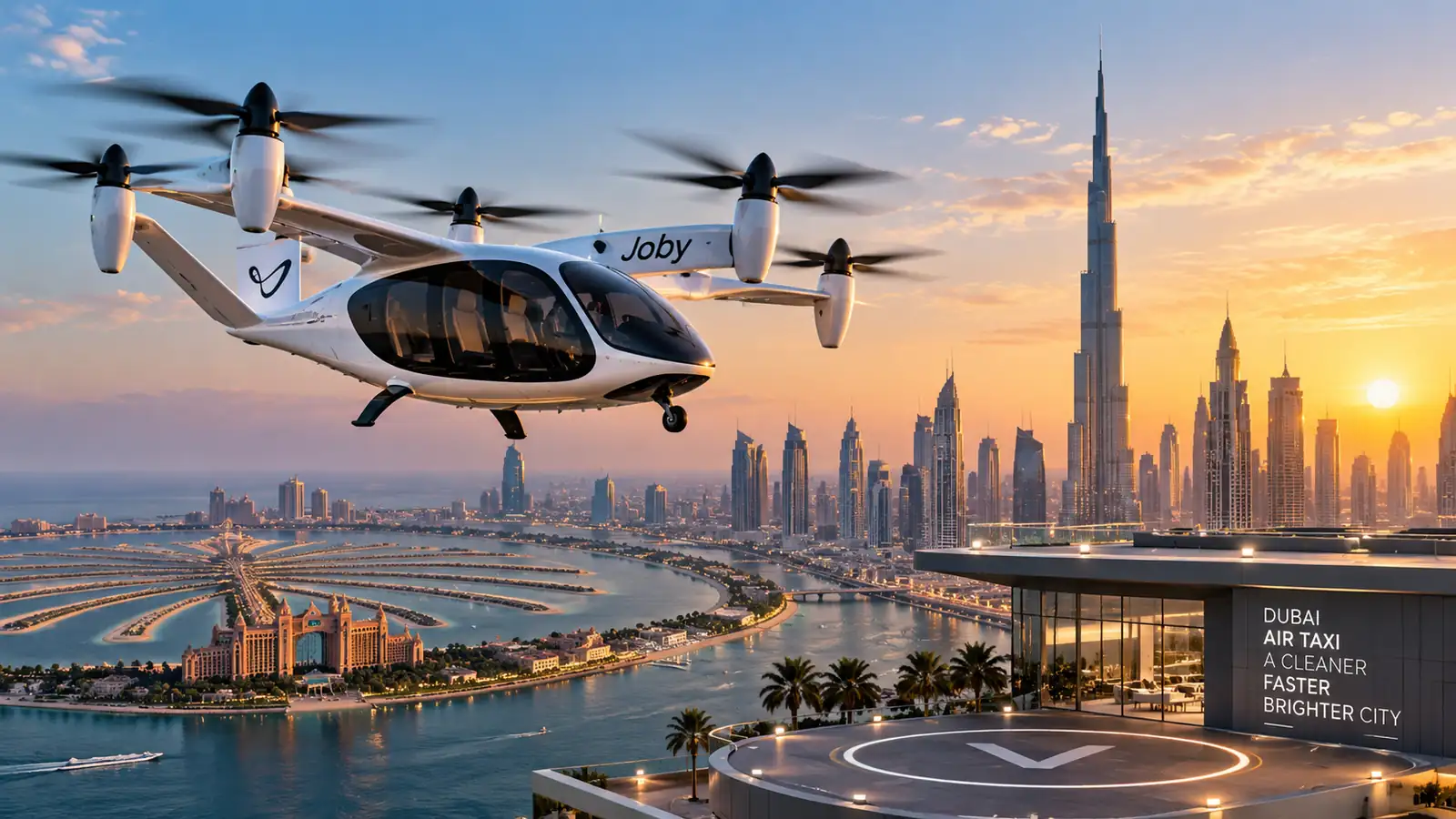
Dubai’s plan to introduce electric air taxis has moved beyond an announcement into flight testing, vertiport construction and preparations for commercial operations, with Joby Aviation working toward launching passenger service in the emirate.
The project centers on Joby’s electric vertical take-off and landing aircraft, or eVTOL, designed to carry four passengers and a pilot. Dubai’s Roads and Transport Authority (RTA) says the aircraft can reach speeds of about 320 kilometers per hour and has a range of roughly 160 kilometers.
The potential time savings remain one of the project’s most visible selling points. RTA estimates that a future journey between Dubai International Airport and Palm Jumeirah could take about 10 minutes by air taxi, compared with roughly 45 minutes by car.
But the more significant development is what has happened since Dubai first announced the service: the city and its partners have begun assembling the aircraft testing, physical infrastructure, operating network and regulatory framework required to turn eVTOL technology into a functioning transport service.
Dubai’s Electric Air Taxi Plan Has Moved Into Flight Testing
Dubai entered into an agreement with Joby in 2024 to establish an electric air taxi service, with the company receiving exclusive rights to operate air taxis in the emirate for six years.
The project has since progressed into local flight testing.
In November 2025, Joby completed a 17-minute piloted flight from its test facility in Margham to Al Maktoum International Airport. The flight demonstrated point-to-point operation in UAE airspace rather than keeping the aircraft within a single test location.
Earlier testing also examined how the aircraft performs under Dubai’s environmental conditions — an important consideration for battery-electric aviation operating in extreme heat.
The RTA’s latest air-taxi project updates show that the program has consequently become more than a demonstration of eVTOL technology. Authorities are working on the infrastructure, certification and operating arrangements needed for passenger service.
How Joby’s Electric Air Taxi Works
Unlike a conventional aircraft, Joby’s eVTOL does not require a traditional runway.
The aircraft uses electric propulsion and can take off and land vertically before transitioning to forward flight. That allows it to operate from purpose-built facilities known as vertiports positioned closer to urban destinations.
Joby’s aircraft is designed for a pilot and four passengers.
The concept is not intended to replace Dubai’s metro, buses or conventional taxis. Instead, air taxis could provide a higher-speed option for selected routes where road travel is substantially longer than a direct flight.
That explains why the airport-to-Palm Jumeirah example is important. RTA currently estimates that the route could be completed in approximately 10 minutes by air taxi versus around 45 minutes by car.
The estimate should not, however, be interpreted as a guaranteed door-to-door journey time. Passenger processing, transfers to and from vertiports, weather, airspace management and eventual operating procedures will all influence the practical travel time once commercial operations begin.
Dubai Is Building a Physical Network for Air Taxis
Infrastructure is one of the biggest differences between an experimental eVTOL flight and a commercially useful transportation service.
Skyports Infrastructure is developing Dubai’s vertiport network, with the primary facility located near Dubai International Airport.
According to RTA, the DXB vertiport covers approximately 3,100 square meters across four floors. Plans include take-off and landing areas, aircraft parking and charging facilities, passenger areas and vehicle parking.
The facility is designed to accommodate approximately 42,000 air-taxi landings and around 170,000 passengers annually.
Additional stations are planned across Dubai, creating an initial network connecting the airport with major business, residential and tourism destinations.
Joby subsequently announced vertiport locations at the American University in Dubai, Atlantis The Royal and Dubai Mall as the network’s development progressed.
The infrastructure component matters because eVTOL commercialization depends on considerably more than aircraft performance. Operators also need charging, maintenance, passenger handling, airspace coordination and strategically located landing sites if short urban flights are to provide meaningful time savings.
Joby’s Six-Year Exclusivity Makes Dubai a Strategic Market
The commercial arrangement behind the project is also notable.
Under Joby’s agreement with RTA, the company has exclusive rights to operate air taxis in Dubai for six years.
That gives Joby an unusually important position in one of the earliest markets attempting to integrate electric vertical-flight aircraft into an urban transportation system.
Joby has established a local operating entity and is building an operational workforce for the Dubai service. RTA has said the company intends to recruit most of its operational and pilot team from within the UAE.
For Joby, Dubai therefore represents more than an overseas aircraft demonstration. It is a potential proving ground for the company’s broader business model of operating aircraft as a transportation service.
Joby’s current corporate filings also make clear that commercial deployment remains dependent on regulatory approvals. The company says its Dubai agreement establishes a pathway for local approval through the UAE’s General Civil Aviation Authority (GCAA), potentially using certification work conducted with U.S. regulators.
In its latest regulatory filing discussing certification and Dubai operations, Joby cautions that it still needs the authorizations and certifications required for aircraft production and commercial service, and that delays could affect its projected launch timetable.
That qualification is important. Successful test flights and completed vertiports do not by themselves authorize fare-paying passenger operations.
Certification Remains the Critical Hurdle
Dubai’s progress demonstrates how far advanced air mobility has moved from concept aircraft, but regulation remains one of the biggest barriers separating demonstration flights from routine passenger transportation.
Aircraft must satisfy aviation safety requirements, while commercial operations require additional approvals covering areas such as operators, pilots and infrastructure.
Joby is pursuing what RTA describes as a parallel certification and qualification strategy in the UAE. The process uses data validated through Joby’s work with the U.S. Federal Aviation Administration while allowing the GCAA to evaluate the aircraft for Dubai operations.
This regulatory pathway could make Dubai an important test of whether eVTOL companies can move from aircraft development into sustained commercial operations.
It will also test the economics.
Fast airport transfers are technically attractive, but commercial viability will ultimately depend on factors including ticket prices, aircraft utilization, charging turnaround, maintenance costs, passenger demand and how efficiently the service connects with existing transportation.
Dubai Could Become a Test Case for Urban Air Mobility
Dubai is simultaneously pursuing several forms of next-generation transportation, including autonomous taxis and expanded public transit infrastructure.
Air taxis fit into that broader strategy as a premium, high-speed mobility layer rather than a substitute for high-capacity public transportation.
For the eVTOL industry, the significance extends beyond Dubai.
Electric air-taxi developers have spent years demonstrating aircraft prototypes and accumulating flight-test data. The harder stage is building a complete commercial ecosystem around those aircraft: certification, vertiports, charging infrastructure, pilots, maintenance, airspace integration and enough passenger demand to support recurring operations.
The UAE’s push toward next-generation mobility comes alongside its growing role as a technology hub. Abu Dhabi has also hosted Web3 leaders at the high-impact Global Blockchain Show and Global Gaming Show 2025, highlighting the country’s broader ambitions across blockchain, gaming and emerging technologies.
Dubai is now attempting to put those pieces together.
The original promise of reducing a roughly 45-minute road journey to around 10 minutes remains an attention-grabbing illustration of what eVTOL aircraft could offer. But the more important question is no longer whether Joby can fly an electric aircraft over Dubai.
It is whether Dubai and Joby can turn those flights into a safe, regulated and economically sustainable transportation service used by paying passengers.
The construction of vertiports, completion of local flight testing and development of a UAE certification pathway suggest that question is getting closer to a real-world answer.