
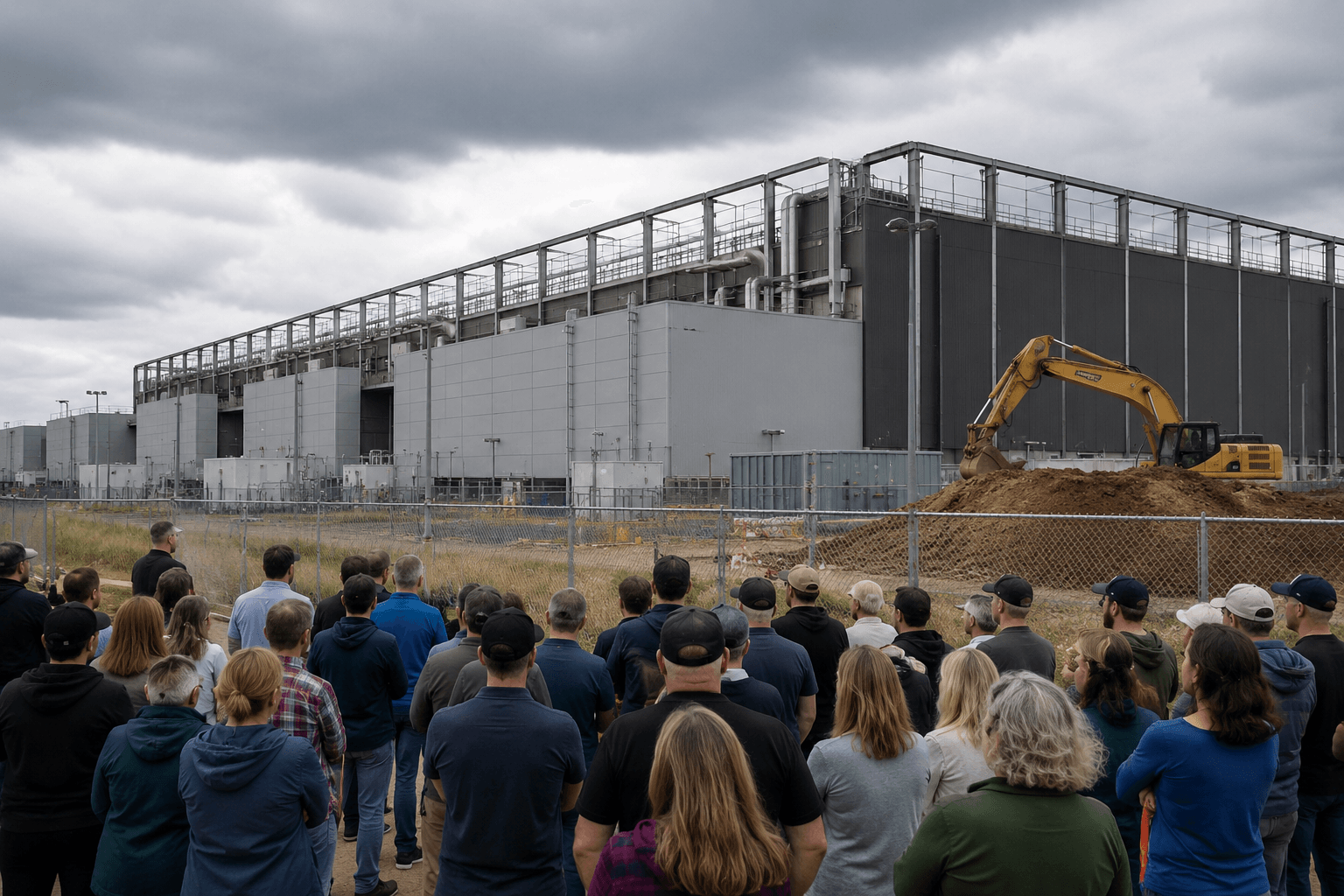
Public opposition to data center construction is becoming a significant constraint on the U.S. artificial intelligence infrastructure boom, as concerns over electricity demand, utility costs, land use and local decision-making move from community meetings into state policy and national politics.
Resistance that was already visible through nationwide protests in July has continued to grow. New polling shows majorities across political parties opposing data centers near their communities, while states are beginning to impose stronger requirements on developers.
The backlash comes as technology companies race to secure the computing capacity needed for artificial intelligence and cloud services — a buildout that is also reshaping forecasts for U.S. electricity consumption.
The result is an increasingly difficult policy question: how quickly can the United States expand the infrastructure needed for AI while convincing communities that they will not bear a disproportionate share of the costs?
Opposition to Local Data Centers Is Growing
Public skepticism is becoming measurable.
A nationally representative survey released Aug. 11 by the University of Pennsylvania’s Annenberg Public Policy Center found that 61% of U.S. adults opposed construction of new data centers in their area, up from 49% in a survey completed earlier in the year.
The opposition crossed political lines. The survey found that 69% of Democrats, 54% of Republicans and 53% of independents opposed new local data centers.
Opposition was even higher among adults under 30, at 70%.
Those findings followed a Reuters/Ipsos survey reported in July that found only about one-third of Americans supported the current pace of data center development and just 14% would welcome a facility in their own community.
The resistance is not necessarily the same as opposition to artificial intelligence itself.
The Annenberg survey found that views of AI’s broader impact had remained relatively stable while opposition to having data centers nearby increased substantially. That suggests communities are increasingly separating enthusiasm or concern about AI technology from questions about where its physical infrastructure should be built.
Electricity Demand Helps Explain the Backlash
The scale of the infrastructure involved is one reason data centers are attracting more attention.
Lawrence Berkeley National Laboratory’s United States Data Center Energy Usage Report: 2025 Update, published in June 2026, estimates that data centers could account for 11.8% of total U.S. electricity consumption by 2030.
Because future AI adoption and equipment deployment remain uncertain, researchers modeled a range of scenarios. Those estimates put data centers at between 9.5% and 15.3% of total U.S. electricity use by the end of the decade.
That represents a major change in the electricity system.
An earlier Berkeley Lab analysis estimated U.S. data centers consumed approximately 176 terawatt-hours of electricity in 2023, equal to about 4.4% of total U.S. electricity consumption.
AI is not the only source of increasing electricity demand. Manufacturing, electrification and other economic activity are also contributing. But the rapid growth and concentrated power requirements of large data center campuses can create particular challenges for utilities and communities.
The debate therefore extends beyond whether sufficient electricity exists nationally. Residents and regulators are also asking who will pay for new generation and grid infrastructure required to serve very large customers.
Community Opposition Is Becoming a Policy Issue
The conflict is no longer limited to demonstrations and planning-board meetings.
Pennsylvania Gov. Josh Shapiro signed an executive order on Aug. 18 establishing additional requirements for data center development in the state.
Under the order, Pennsylvania’s Department of Environmental Protection is directed to review qualifying permit applications only when developers have made legally binding commitments to comply with the state’s Responsible Infrastructure Development, or GRID, requirements and have received local approval.
The requirements address energy affordability, environmental protection, workforce and economic development, transparency and community engagement.
Pennsylvania also removed AI data center proposals from its Fast Track permitting program and prohibited state agencies under the governor’s authority from entering nondisclosure agreements with data center developers.
The move illustrates how public concerns can translate into concrete changes in the approval process.
Developers are increasingly being asked not simply how much money a project will invest, but how it will affect electricity rates, infrastructure, natural resources and the communities surrounding it.
Economic Benefits Remain Part of the Argument
Data centers can bring substantial capital investment and construction activity, which helps explain why states and municipalities have competed to attract them.
Supporters also view domestic computing infrastructure as strategically important for U.S. leadership in artificial intelligence, cloud services and other digital industries.
But the local economic calculation is more complicated than headline investment figures alone.
A multibillion-dollar facility can require extensive construction and supporting infrastructure while employing a comparatively smaller permanent workforce once operational. Communities therefore increasingly want to understand the long-term tax revenue, employment and infrastructure benefits alongside the project’s resource requirements.
That tension helps explain why the political divide over data centers does not fit neatly into traditional party lines.
National politicians and state officials want the investment and computing capacity associated with the AI economy, while local voters may be more concerned about a specific project’s effect on their electricity system, neighborhood or local government.
The AI Boom Is Becoming an Infrastructure Debate
The controversy also highlights something easily obscured by discussions about AI software: expansion of artificial intelligence depends on physical infrastructure.
Training and operating increasingly capable AI systems requires servers, networking equipment, cooling systems, electricity generation and transmission capacity, along with the land and buildings that contain them.
As investment grows, those physical requirements become more visible to communities that may never interact directly with the companies developing AI models.
The Department of Energy’s latest data center resource materials cite Berkeley Lab’s estimate that data centers could account for about 11.8% of U.S. electricity consumption by 2030.
At that scale, questions about AI development become intertwined with energy planning, utility regulation, permitting and local economic policy.
What Data Center Developers Now Have to Prove
The emerging challenge for developers is therefore not simply obtaining enough land and electricity.
Companies increasingly need to demonstrate that projects can coexist with the communities hosting them.
That can include clearer disclosure of electricity and water requirements, credible plans for infrastructure costs, meaningful local participation during permitting and a more transparent explanation of permanent economic benefits.
Communities, meanwhile, face their own tradeoffs. Blocking projects may protect local resources or avoid infrastructure pressures, but it can also mean giving up investment, tax revenue and participation in a rapidly expanding technology industry.
The U.S. data center boom is unlikely to disappear while demand for AI computing continues to grow. What is changing is the assumption that the infrastructure can expand without significant public scrutiny.
The next stage of America’s AI buildout may therefore depend as much on energy policy, local consent and public trust as it does on processors and computing capacity.