

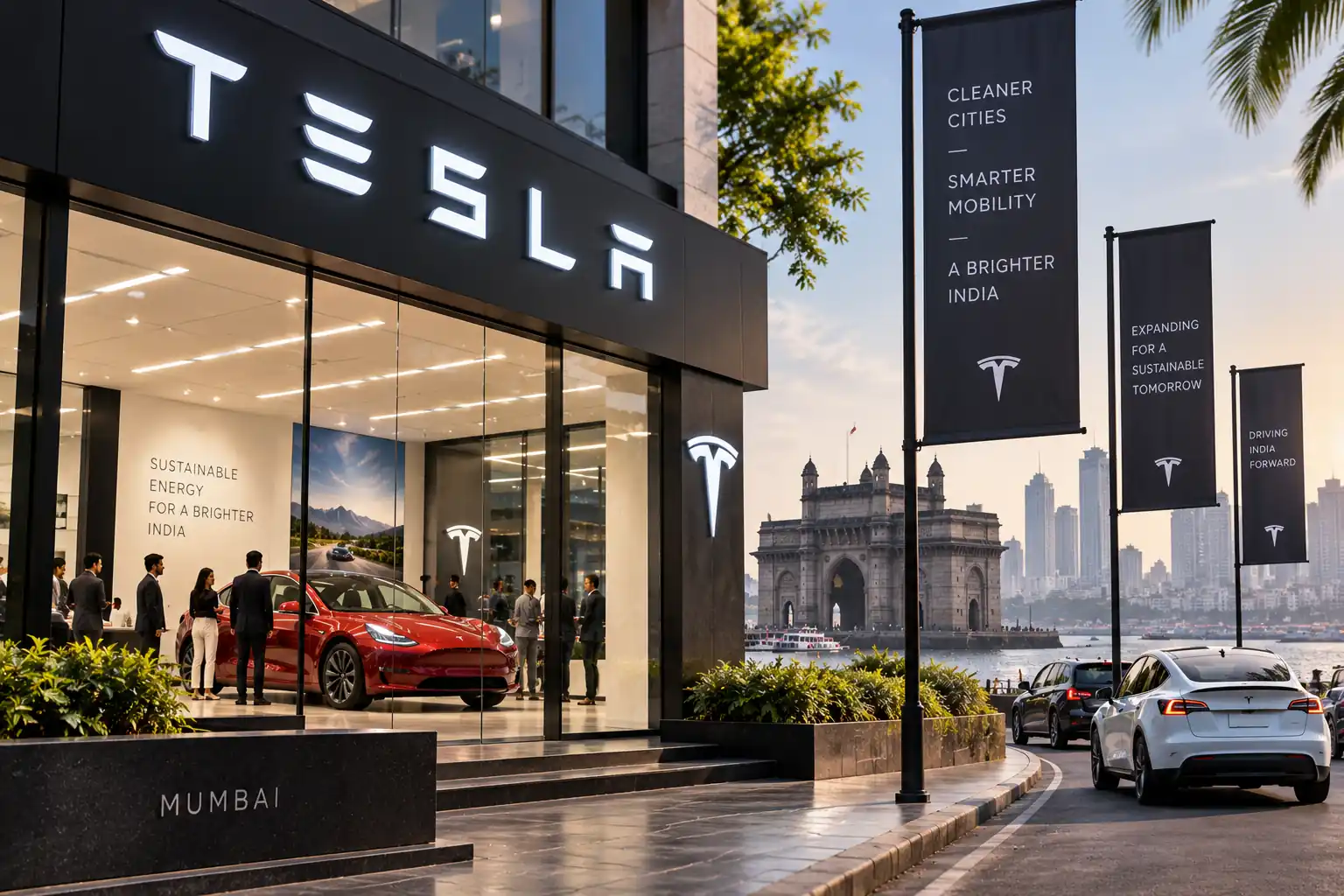
Tesla’s long-awaited entry into India became official on July 15, 2025, when the company opened its first experience center in Mumbai’s Bandra Kurla Complex and began selling the Model Y. The launch ended years of speculation over when Elon Musk’s electric-vehicle company would enter the world’s third-largest automobile market, but it did not immediately bring the local manufacturing commitment Indian policymakers had spent years trying to secure. Instead, Tesla began with imported vehicles, premium pricing and a retail-first strategy aimed at affluent urban buyers.
A little over a year later, Tesla’s India business is broader than that first showroom announcement suggested. The company now lists customer-facing locations in Mumbai, New Delhi, Gurugram, Bengaluru and Hyderabad, while its official India pages continue to promote the Model Y as its core product. Tesla has also adjusted its India offer over time, including new Model Y variants and financing options intended to reduce the upfront barrier for buyers, but the central challenge remains unchanged: imported Teslas face a very different cost structure in India than vehicles produced locally.
The result is an India strategy that is more substantial than a one-off showroom launch, but still cautious. Tesla has established retail and service infrastructure, demonstrated that it intends to stay in the market, and created a base from which it can expand. What it has not yet done is transform India into a major manufacturing hub or mass-market growth engine.
Tesla’s Mumbai Showroom Marked the Formal Start of Sales
Tesla’s first India location opened in the Bandra Kurla Complex, one of Mumbai’s main commercial districts. Reuters reported ahead of the launch that Tesla had imported roughly $1 million worth of vehicles, chargers and merchandise, with the company initially bringing in Model Y vehicles and charging equipment from abroad. The launch represented Tesla’s first direct consumer retail operation in India after years in which its presence had largely consisted of policy discussions, executive meetings and speculation over potential factory investment.
The choice of Mumbai was strategic. Bandra Kurla Complex is one of India’s most prominent business districts, giving Tesla access to a concentration of high-income consumers, corporate buyers and financial-sector professionals who are more likely to consider an expensive imported EV. Tesla followed that opening with plans for New Delhi, reinforcing that its first phase would focus on major metropolitan markets rather than attempting nationwide coverage from the outset.
That initial retail model also allowed Tesla to enter India without waiting for a manufacturing decision. Opening a showroom and importing a limited number of vehicles carries far less capital risk than constructing a factory, building a local supplier network and committing to large production volumes before demand is proven.
The Model Y Entered India at a Premium Price
Tesla launched the Model Y in India at a price equivalent to roughly $70,000 for the entry version at the time, significantly higher than pricing in some other major markets. The premium reflected India’s import duties on fully built electric vehicles, which have long been one of the main sticking points between Tesla and the Indian government. Reuters noted that the price placed Tesla more directly against premium brands such as BMW, Mercedes-Benz and Kia than against domestic mass-market EV companies.
That positioning matters because India’s EV market is highly price-sensitive. Domestic manufacturers such as Tata Motors and Mahindra compete at much lower price points, meaning Tesla’s imported Model Y was never likely to be a high-volume product immediately. Instead, the company entered the market in a premium niche where brand recognition, technology and charging performance could matter more than absolute affordability.
Tesla’s current India pages show that the company continues to center its sales strategy on the Model Y. The latest version offers up to 500 kilometers of WLTP range in rear-wheel-drive form, while Tesla has also introduced a larger Model Y L variant with up to six seats and a claimed WLTP range of 681 kilometers.
Tesla Has Expanded Beyond Mumbai
The biggest reason the old article now needs a full rewrite is that Tesla’s India footprint has moved well beyond a single showroom. Tesla’s official store directory currently lists the Mumbai Bandra Kurla Complex location, an Aerocity experience center in New Delhi, a Tesla Centre in Gurugram, a VR Bengaluru experience center and a retail site in Hyderabad. That gives the company a presence across several of India’s most important technology, financial and corporate hubs.
This geographic expansion suggests Tesla is testing demand city by city rather than making a single national bet. Mumbai gives the company access to India’s financial capital, Delhi and Gurugram provide proximity to government and corporate buyers, Bengaluru is the country’s leading technology center, and Hyderabad is another major software and business hub. Together, those locations create a logical premium-market footprint even without a domestic production base.
The approach also gives Tesla time to learn what Indian buyers prioritize. Charging access, service coverage, vehicle financing, resale expectations and road conditions all influence EV adoption, and those factors can vary substantially across cities. A gradual rollout lets Tesla gather operating data before deciding whether more aggressive investment is justified.
Tesla Has Tried to Lower the Ownership Barrier
Tesla has also begun adjusting the commercial proposition around the Model Y. In 2026, the company advertised the Model Y Premium Rear-Wheel Drive in India at ₹50.89 lakh and promoted financing with monthly payments beginning around ₹39,990 under specified terms, including a down payment and long loan tenor. Tesla framed the offer around total ownership cost, arguing that lower fuel and maintenance expenses could offset part of the vehicle’s premium purchase price.
That financing push is important because India’s premium-car market remains small relative to the overall passenger-vehicle sector. Reducing the apparent monthly cost can make a high-priced EV more accessible to buyers who might otherwise compare the vehicle only on sticker price. It also signals that Tesla is moving from simple market entry toward more conventional retail tactics designed to convert interest into actual sales.
However, financing cannot fully solve the structural cost disadvantage created by import duties. As long as vehicles are imported rather than locally assembled or manufactured, Tesla’s pricing will remain constrained by taxes, logistics and currency effects that domestic producers can partly avoid.
Local Manufacturing Is Still the Central Strategic Question
The largest unresolved issue in Tesla’s India strategy remains manufacturing. India has repeatedly sought to encourage Tesla to produce vehicles locally, and the government has introduced policy measures intended to attract global EV makers willing to invest in domestic manufacturing. Tesla, however, entered the country by importing vehicles rather than committing immediately to an Indian factory. Reuters reported at the time of the 2025 launch that the company had ruled out local manufacturing in the near term.
That decision keeps Tesla flexible, but it also limits how aggressively the company can compete on price. Building locally could reduce import-related costs and potentially make India a production base for other regional markets, but a factory would require substantial capital and confidence that demand can support the investment. Tesla must therefore balance the opportunity presented by India’s large auto market against the risk of overcommitting before the premium EV segment is deep enough.
The manufacturing question is also strategic for India. Policymakers do not merely want more imported EVs; they want investment in factories, suppliers, engineering and jobs. That creates a tension between Tesla’s preference for capital efficiency and India’s desire to capture more of the economic value associated with EV production.
India Is Attractive, but It Is Not an Easy Tesla Market
India’s overall automobile market is enormous, but EV adoption remains uneven and the premium segment represents only a small share of total sales. Tesla therefore enters a market with long-term growth potential but immediate constraints around purchasing power, charging infrastructure and pricing. The company’s global brand gives it an advantage in awareness, yet it does not eliminate those structural challenges.
Competition is also intensifying. Tata Motors, Mahindra and other domestic manufacturers have expanded electric lineups, while global brands including BMW, Mercedes-Benz, Hyundai, Kia and BYD are competing for higher-income EV buyers. Tesla’s advantage lies in its brand, software integration, charging technology and established global EV reputation, but competitors can respond with locally tailored pricing, dealer networks and products designed specifically for Indian conditions.
The Model Y’s imported price therefore places Tesla in a narrower customer segment than its global sales volumes might imply. India may ultimately become a major Tesla market, but that outcome depends on whether the company can broaden affordability without eroding margins or making a manufacturing commitment it is not prepared to support.
Tesla’s India Expansion Is More Important Than the Original Showroom Story
The original July 2025 article focused on whether Tesla would finally open its first Indian showroom. That question has now been answered. The more useful issue is what Tesla has done after entering the market and whether its current footprint points toward a sustainable long-term business.
So far, Tesla has moved beyond a symbolic launch. It has expanded into multiple cities, developed an India-specific retail network, continued selling the Model Y and introduced financing designed to improve affordability. Those actions indicate a real operating commitment rather than a short-lived market test.
At the same time, Tesla has not yet made the deeper investment that would fundamentally change its competitive position in India. Without local production, its vehicles remain expensive relative to much of the domestic market, and that keeps Tesla concentrated among premium buyers.
The Next Phase Will Be Defined by Scale, Not Store Count
Tesla’s first Mumbai showroom was important because it ended years of uncertainty over whether the company would enter India at all. By 2026, however, the number of experience centers is no longer the most important measure of progress. The more consequential questions are whether Tesla can generate meaningful sales volumes, expand charging and service support, introduce additional models and eventually decide whether India justifies local production.
The company’s current footprint gives it a platform from which to answer those questions. Mumbai, Delhi, Gurugram, Bengaluru and Hyderabad cover a substantial share of India’s premium technology and business consumer base, and the Model Y gives Tesla a recognizable global product with which to test demand.
Tesla’s India strategy is therefore no longer a launch story. It is a market-building story — one in which the company has moved from anticipation to actual operations, but still faces the harder task of proving that imported premium EVs can become a scalable business in one of the world’s most competitive automobile markets.