
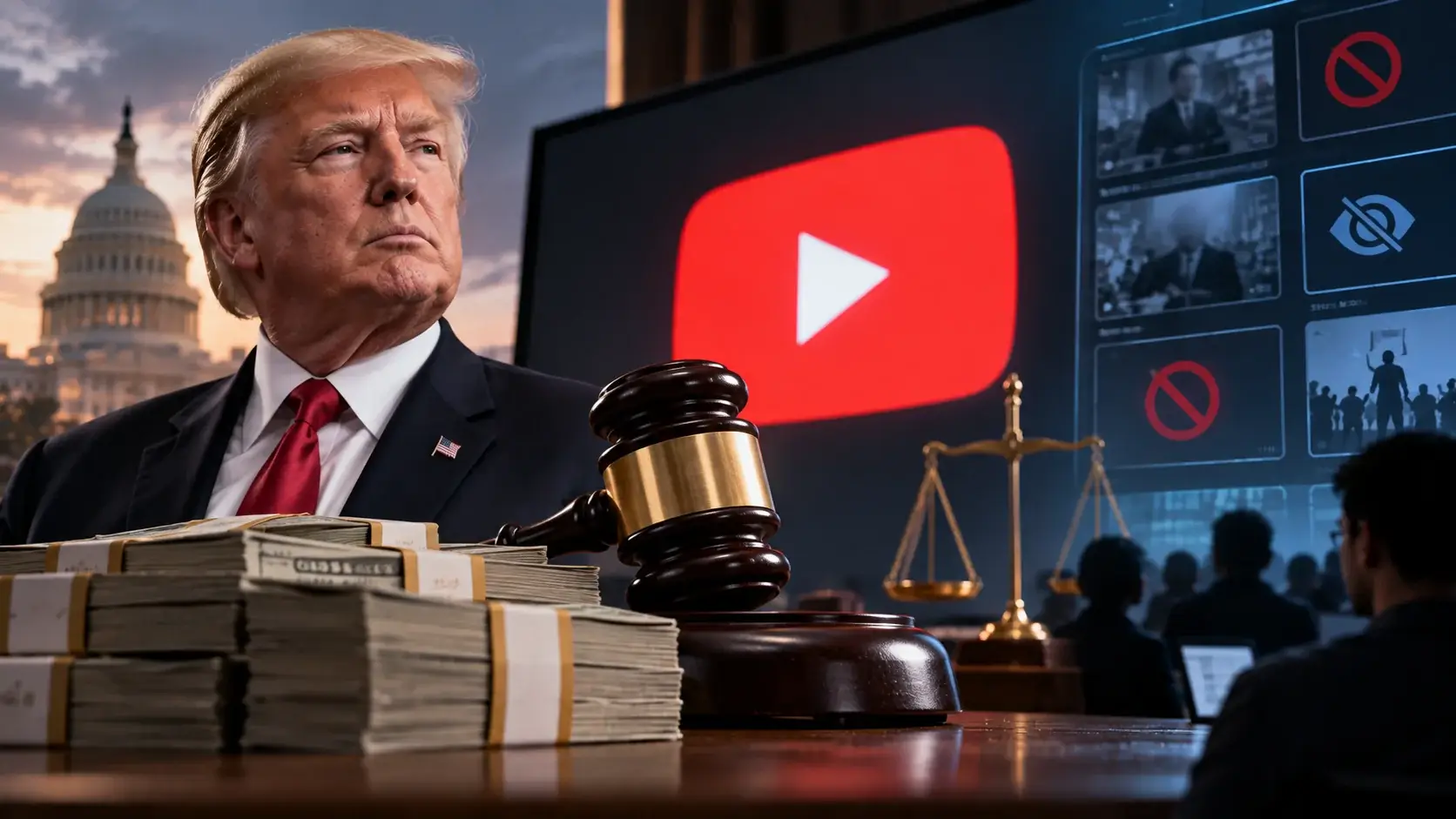
Alphabet’s $24.5 million settlement of Donald Trump’s lawsuit over YouTube’s 2021 account suspension closed a four-year legal dispute, but it did not produce a court ruling that YouTube had acted unlawfully. The September 2025 agreement expressly stated that the payment was not an admission of liability or fault, while YouTube agreed to no product or content-policy changes as part of the settlement.
The allocation was also more specific than the headline number suggests. Of the $24.5 million, $22 million resolved Trump’s claims and was directed, at his instruction, to the Trust for the National Mall to support construction of the White House State Ballroom. Another $2.5 million was allocated among seven other plaintiffs, including the American Conservative Union and author Naomi Wolf.
The case matters beyond the payment because it completed a remarkable sequence involving the major social platforms that restricted Trump after January 6, 2021. Meta and X had already settled similar lawsuits earlier in 2025. Yet those settlements resolved disputed claims rather than establishing a judicial rule governing when private platforms can suspend political figures.
What the $24.5 Million Settlement Actually Says
The clearest account of the agreement comes from the September 29 federal court filing in Trump v. YouTube LLC in the U.S. District Court for the Northern District of California.
The filing states that Alphabet, YouTube’s ultimate parent company, would transfer $24.5 million to the attorney trust account of plaintiffs’ counsel. Of that amount, $22 million settled claims involving Trump, who directed that the money be contributed on his behalf to the Trust for the National Mall.
The filing describes the nonprofit as a tax-exempt organization involved in restoring and preserving the National Mall and says the contribution would support construction of the White House State Ballroom.
The remaining $2.5 million settled claims involving the American Conservative Union, Andrew Baggiani, Austen Fletcher, Maryse Veronica Jean-Louis, Frank Valentine, Kelly Victory and Naomi Wolf.
Most importantly, the document says the settlement does not constitute an admission of liability or fault by the defendants. The parties agreed to resolve disputed claims and avoid the expense and risks of continuing the litigation.
YouTube Suspended Uploads Rather Than Deleting Trump’s Channel
The dispute originated in January 2021 following the attack on the U.S. Capitol.
YouTube temporarily prevented Trump’s channel from uploading new videos, citing concerns about the potential for continuing violence. The company subsequently extended the restriction while other major social networks also took action against his accounts.
An important detail is that YouTube did not delete the channel. The restriction prevented new uploads and livestreams, and the channel was ultimately restored in March 2023.
Trump challenged the suspension as part of a broader set of lawsuits filed in 2021 against YouTube and Google, Facebook and its leadership, and Twitter and its then-CEO Jack Dorsey. The cases argued, among other claims, that the platforms had improperly restricted political speech.
The companies disputed those claims and defended their ability to enforce rules governing content and accounts on privately operated services.
The Settlement Did Not Establish That YouTube’s Suspension Was Illegal
That distinction is central to understanding the case.
A settlement ends litigation because the parties agree to resolve their dispute. It does not necessarily determine which side would have won if the case had continued to a final judgment.
Alphabet’s agreement therefore cannot accurately be described as a judicial finding that YouTube unlawfully censored Trump.
The settlement filing explicitly avoids that conclusion by stating that the agreement does not constitute an admission of liability or fault.
YouTube also was not required to change its platform or moderation policies under the agreement. That separates the financial resolution of Trump’s individual lawsuit from the broader legal question of what moderation rights and obligations large platforms have.
For readers trying to understand the precedent, what the settlement did not decide is almost as important as the $24.5 million payment itself.
YouTube Was the Last of Three Major Platforms to Settle
The agreement completed a series of settlements involving the major social networks Trump sued after the restrictions imposed in 2021.
Meta agreed in January 2025 to pay approximately $25 million to settle the lawsuit involving Facebook and Instagram. X, formerly Twitter, subsequently agreed to pay approximately $10 million in February.
YouTube’s $24.5 million agreement followed in September.
Together, the settlements meant that Trump’s litigation against the three major platform companies ended without the core constitutional and platform-governance dispute being resolved through a definitive ruling in his favor on the merits.
That outcome is important because financial settlements can be motivated by several considerations. Companies can weigh legal expenses, uncertainty, management attention and wider business considerations when deciding whether continuing litigation is worthwhile.
A payment by itself therefore does not establish why a company settled or what a court would ultimately have decided.
The First Amendment Question Is More Complicated Than “Censorship”
The cases also exposed a recurring source of confusion in debates over online speech.
The First Amendment generally constrains government action. YouTube, Facebook and X are privately operated platforms, even though they provide spaces where enormous amounts of public and political discussion take place.
That distinction creates tension because large social networks can exercise extraordinary practical influence over who can reach an audience online while remaining private companies with their own terms of service.
The legal debate becomes more complicated when government officials pressure platforms to remove or restrict particular content. Courts have examined where persuasion by government officials ends and unconstitutional coercion could begin.
Trump’s YouTube settlement, however, did not establish a new rule resolving those broader questions.
That is why describing the case simply as a battle between “free speech” and “censorship” can obscure the underlying legal issues. Constitutional restrictions on government and contractual moderation by private platforms are related policy debates, but they are not legally identical.
Platform Policies Have Changed Since 2021
The social-media environment surrounding the lawsuit also changed dramatically during the four years it remained active.
Twitter was acquired by Elon Musk and became X, accompanied by substantial changes to moderation policies, account reinstatements and the company’s approach to speech. Meta also changed important parts of its moderation and fact-checking strategy.
YouTube restored Trump’s channel in March 2023, saying at the time that it had evaluated the continued risk of real-world violence while balancing voters’ opportunity to hear from major national candidates.
By the time the lawsuit settled in September 2025, the original suspension was therefore no longer an active restriction.
The dispute had shifted from whether Trump could use YouTube toward whether the platform should face legal consequences for the action it took more than four years earlier.
The $22 Million Ballroom Payment Made the Settlement Unusual
The destination of most of the settlement money gave the agreement another unusual dimension.
Trump directed the $22 million allocated to resolve his claims to the Trust for the National Mall to support the White House State Ballroom rather than receiving that portion as an ordinary personal settlement payment.
That arrangement was explicitly recorded in the court filing.
The remaining $2.5 million went to the other plaintiffs according to their separate settlement agreements.
The allocation subsequently attracted political scrutiny. Democratic lawmakers questioned Google and YouTube about the circumstances surrounding the settlement and raised concerns about corporate payments associated with the ballroom project. Those questions represented lawmakers’ concerns; they did not establish that the settlement itself was unlawful.
Alphabet, meanwhile, did not concede wrongdoing in resolving the litigation.
Maintaining that distinction is particularly important because the case sits at the intersection of corporate litigation, technology regulation and presidential politics.
The Broader Question Is How Platforms Treat Political Leaders
Trump’s suspension was part of a larger debate over whether political leaders should be treated differently from ordinary platform users.
One argument is that speech by elected officials has unusually high public-interest value. Restricting an important political figure can prevent citizens from directly accessing statements that may influence elections, government policy or public debate.
The competing concern is that large audiences can magnify harm. If a platform determines that content from an influential account violates rules or contributes to a risk of violence, exempting political leaders could weaken the platform’s ability to enforce its safety standards consistently.
Different platforms have moved between those considerations over time.
The policy problem becomes especially difficult during elections and political crises, when decisions to remove content can themselves become politically consequential.
The YouTube settlement did not resolve that tension. It ended one lawsuit arising from one particularly consequential moderation decision.
Content Moderation Is Becoming More Automated
The underlying challenge has become more complicated as platforms increasingly use automated systems and artificial intelligence to identify potentially harmful material.
YouTube operates at a scale where human reviewers cannot examine every upload before enforcement decisions are made. Automated systems therefore help detect spam, violent material, copyright violations and other content that may breach platform rules. But automation introduces another problem: false positives.
Gignomist recently examined this issue in the context of Google Blogger sites being locked after an apparent automated malware-detection error. That incident involved a different product and policy issue, but it illustrates the wider governance challenge facing platforms that enforce rules across enormous quantities of user-generated content.
Platforms need enough automation to operate at scale while maintaining appeals and human-review systems capable of correcting mistakes.
For political speech, the consequences of errors can be particularly significant because moderation decisions can immediately become part of public and partisan debate.
Large Platforms Face Conflicting Pressures
YouTube and other social networks operate between several competing demands.
Users expect protection from harassment, fraud, violent material and other harmful content. Governments increasingly impose rules covering online safety, illegal material, child protection and platform transparency. Advertisers generally want brand-safe environments, while civil-liberties advocates warn against excessive restrictions on lawful expression.
Political groups can simultaneously accuse the same platform of moderating too much and too little.
That makes content governance fundamentally different from simply writing a list of prohibited behaviors. Platforms have to interpret policies across different languages, countries, political contexts and billions of pieces of content.
Every high-profile enforcement decision can then become evidence in a wider argument about platform power.
The Trump litigation was an unusually visible example of that problem, but the underlying challenge affects every large user-generated platform.
Settlements Are Not the Same as Legal Precedents
The most important long-term lesson from the YouTube case may be the distinction between commercial settlement and judicial precedent.
YouTube paid $24.5 million. Meta paid approximately $25 million. X paid approximately $10 million. Those are concrete outcomes.
But none of those numbers, standing alone, establishes a general legal rule saying social networks cannot suspend political figures. Nor do they establish that every moderation decision made after January 6 was legally justified.
A precedent normally emerges when courts decide legal questions in rulings that can guide later cases. Settlements often prevent that process from reaching a final merits decision.
For technology companies, settling can reduce uncertainty and litigation costs. For the public, however, it can leave the underlying legal question unresolved. That is exactly what happened here.
What the YouTube Settlement Means Now
The September 2025 agreement definitively answered one question: how Trump’s lawsuit against YouTube would end.
Alphabet agreed to pay $24.5 million. Trump’s $22 million portion was directed toward the Trust for the National Mall for the White House State Ballroom, while $2.5 million was allocated among the other plaintiffs. The lawsuit was dismissed with prejudice, bringing the dispute to an end. But the settlement answered far less about the future of online speech.
It did not include an admission that YouTube’s 2021 suspension was unlawful. It did not force YouTube to change its moderation policies. And it did not create a court ruling establishing how social platforms must handle political leaders during periods of unrest. Those unresolved issues are more consequential than the settlement figure itself.
The internet’s largest platforms remain private companies with enormous influence over public communication, while governments, courts, users and advertisers continue to contest where their moderation authority should begin and end.
YouTube’s $24.5 million payment closed a lawsuit. It did not close that debate.