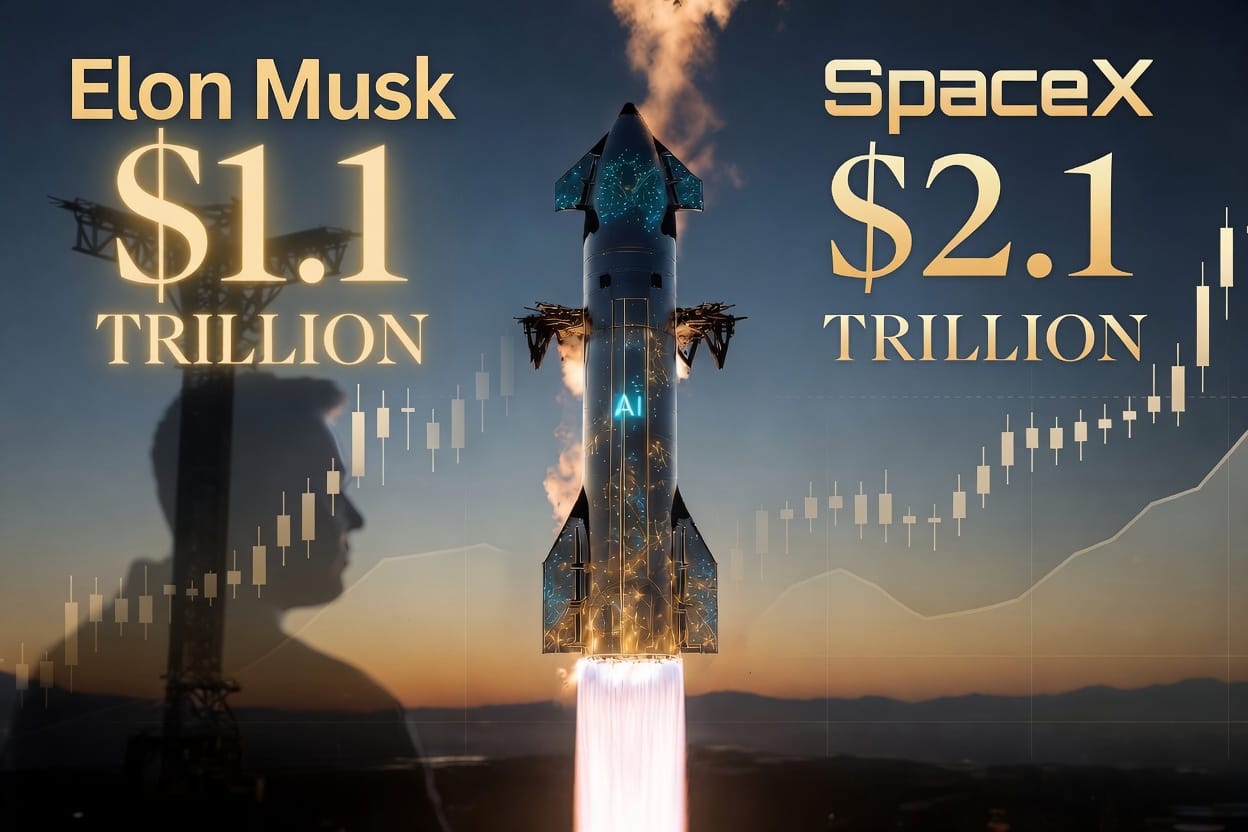
In October 2025, Elon Musk, the founder and CEO of SpaceX, briefly became the first individual in history to reach a net worth of $500 billion — a landmark achievement that underscored his growing influence in global technology and innovation. Just eight months later, on June 12, 2026, SpaceX shattered records once again with the largest initial public offering (IPO) in history. Priced at $135 per share and raising approximately $75 billion, the company’s shares opened trading on the Nasdaq at $150–$155 and closed the day at approximately $160.95–$161.
This extraordinary debut propelled SpaceX’s market valuation above $2.1 trillion and elevated Elon Musk to the status of the world’s first trillionaire, with his total net worth surpassing $1.1 trillion when combining his SpaceX holdings with stakes in Tesla and other ventures.
For technologists, investors, entrepreneurs, and innovators following the convergence of AI, robotics, and space exploration, this milestone is more than a financial event — it is a powerful validation of how advanced autonomous systems and intelligent engineering can transform industries and redefine human ambition. At The Gignomist, we explore this intersection to understand not only what is possible today, but what it inspires for tomorrow.
The Technological Foundation: AI and Autonomy at the Core of SpaceX
SpaceX’s journey from a 2002 startup with a mission to reach Mars to a multi-trillion-dollar public company was built on relentless innovation in AI, robotics, and autonomous systems. These technologies were not peripheral enhancements; they formed the operational backbone that enabled reusability, scalability, and cost reduction at unprecedented levels.
Central to this success is the autonomous landing capability of the Falcon 9 first stage. What was once considered nearly impossible — a rocket booster returning from space, re-entering the atmosphere at hypersonic speeds, and landing vertically on a drone ship or launch pad with pinpoint accuracy — became routine through sophisticated guidance, navigation, and control systems. These rely heavily on real-time AI-driven decision-making, sensor fusion, and predictive algorithms that process vast streams of telemetry data to adjust trajectories, manage fuel, and compensate for atmospheric variables.
Starship, SpaceX’s next-generation fully reusable vehicle, takes this further. Advanced avionics, multi-sensor navigation with high redundancy, and autonomous rendezvous and docking capabilities allow it to operate with minimal human intervention. AI systems optimize everything from propellant transfer in orbit to thermal protection during re-entry. These autonomous features have dramatically lowered the cost per launch, enabling the rapid deployment of the Starlink constellation — now a profitable engine generating substantial revenue through global satellite broadband.
As Qualcomm president and CEO, Cristiano R. Amon says “robotics are the next trillion-dollar frontier for AI“, robotics plays an equally critical role in manufacturing and operations. SpaceX’s factories employ advanced robotic systems for precision assembly of rockets, engines, and satellites, accelerating production cycles while maintaining the highest safety standards. This integration of robotics has allowed the company to scale output in ways traditional aerospace firms could only dream of, turning what were once bespoke, high-cost projects into more efficient, repeatable processes.
AI also powers Starlink’s constellation management. With thousands of satellites in low-Earth orbit, machine learning algorithms optimize routing, beamforming, handoffs, and collision avoidance in real time. This creates a resilient, high-speed global network that is already transforming connectivity in remote areas — with profound implications for the gig economy, Web3 developers, remote robotics, and decentralized technologies.
These breakthroughs did not happen overnight. They resulted from years of iterative experimentation, data-driven learning, and a culture that embraces rapid testing and failure as part of the innovation loop. The “Elon factor” — Musk’s hands-on leadership and vision — amplified this by fostering cross-pollination across his companies.
Synergies Across the Musk Ecosystem: AI, Robotics, and Multi-Planetary Ambition
SpaceX’s technological edge is strengthened by synergies with Musk’s other ventures. The integration (or close collaboration) with xAI provides powerful AI models that enhance autonomous systems. Tesla’s Optimus humanoid robot project benefits from similar AI advancements, while SpaceX gains from Tesla’s expertise in batteries, power systems, and large-scale manufacturing.
Imagine Optimus or humanoid robots deployed in SpaceX factories or even on future Mars missions — performing maintenance, assembly, and exploration tasks in environments hostile to humans. Orbital data centers powered by Starlink and cooled in space could address the energy and heat challenges of training ever-larger AI models, creating a virtuous cycle where space infrastructure accelerates terrestrial AI progress.
This convergence of AI, robotics, and space technology is inspiring a new generation of engineers and entrepreneurs. It demonstrates that deep-tech challenges — once the domain of governments — can be tackled successfully by focused private innovation, yielding extraordinary economic and societal returns.
Lessons for Technologists, Entrepreneurs, and Investors
For AI and robotics professionals, SpaceX’s story offers several actionable insights:
- Autonomy Scales Reliability and Cost Efficiency: Systems that make real-time decisions in unforgiving environments (like space) translate well to Earth-based applications such as autonomous vehicles, industrial robotics, and drone delivery. Developers should prioritize robust sensor fusion, simulation-based training, and edge AI capabilities.
- Data is the Ultimate Moat: SpaceX’s thousands of launches and landings have generated unparalleled real-world datasets for training autonomous systems. Similarly, companies in gaming, cybersecurity, or the gig economy can leverage proprietary data loops to build defensible AI products.
- Long-Term Vision Attracts Capital: Despite high risks and long development cycles, SpaceX’s clear multi-planetary goal sustained investor confidence through multiple funding rounds and secondary markets. Entrepreneurs should articulate ambitious yet technically grounded visions that align with global challenges like climate resilience, connectivity, and human expansion.
- Interdisciplinary Innovation Wins: The blending of aerospace engineering, software, AI, and robotics at SpaceX shows the power of breaking silos. Teams that combine domain expertise with cutting-edge machine learning will lead the next wave of breakthroughs.
For investors and CXOs in tech, the IPO underscores the massive value creation potential in companies that master physical AI and autonomous infrastructure. While valuations at this scale invite scrutiny, SpaceX’s fundamentals — proven revenue from Starlink, launch cadence dominance, and technological leadership — provide a compelling case. Post-IPO capital will likely accelerate R&D in AI-driven space applications, orbital manufacturing, and beyond.
An Inspiring Future: Multi-Planetary Humanity Powered by Intelligent Machines
SpaceX’s success is ultimately inspiring because it expands our collective imagination. It proves that technology, when guided by bold vision and rigorous execution, can overcome seemingly insurmountable barriers. The same AI and robotics that landed rockets and optimized satellite networks will one day support human settlements on Mars, enable sustainable orbital economies, and solve pressing problems back on Earth — from disaster response to global internet access for underserved gig workers and creators.
As we stand at this inflection point, with Elon Musk’s trillionaire milestone symbolizing the rewards of technological perseverance, the message is clear: the frontiers of AI, robotics, and space are wide open. Innovators who embrace autonomy, invest in talent, and pursue ambitious, multi-decade missions will shape not only markets but the future of civilization itself.
The Gignomist will continue tracking these developments — from AI advancements in Starship to Starlink’s impact on the global gig economy and Web3. SpaceX’s IPO is not the end of a story; it is the launchpad for the next chapter in human technological achievement.